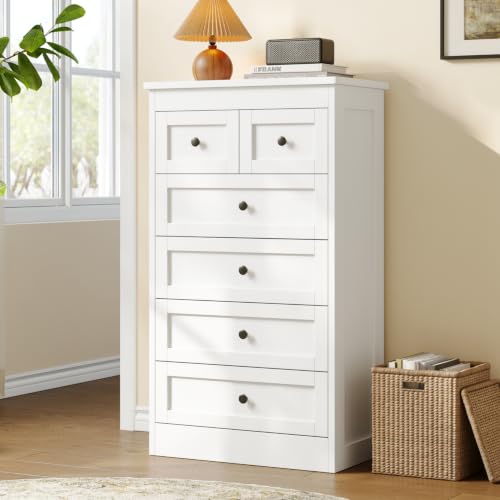
What Counts as a Narrow Set of Drawers?
A narrow set of drawers for bedroom use is typically defined by width rather than height or depth. While a standard double dresser can run 60 inches or more across, narrow models usually fall between roughly 18 and 32 inches wide. Within that range, you will find two broad categories:
- Tall and skinny dressers — narrow width paired with generous height, often four to six drawers stacked vertically. These maximize vertical storage in a small footprint.
- Low-profile narrow dressers — shorter silhouettes that fit under windows or beside a bed frame, usually with three or four drawers.
If your priority is a true closet-style footprint, a tall skinny dresser for closet configuration can be the most efficient option because it adds height instead of width. For bedrooms where the wall is short but the ceiling is standard, a tall skinny dresser often provides the best drawer count per inch of floor space.
Why Choose a Narrow Dresser Instead of a Standard One?
Bedroom layouts frequently include dead zones: the strip between a bed and a wall, the corner beside a door swing, or the narrow return wall in an L-shaped room. A standard-width dresser simply will not fit into those spots. A narrow set of drawers converts them into functional storage.
Beyond fit, narrow dressers also support better room flow. In a compact apartment bedroom, keeping the walking path clear matters as much as drawer volume. A slim piece lets you retain that clear path while still holding folded clothing, linens, and accessories. For rooms that are tight in both width and depth, pair a narrow dresser with a shallow dresser for small bedroom layout — the reduced depth keeps the piece from protruding into the room.
Quick rule of thumb
Leave at least 24 inches of clear floor space in front of any dresser so drawers can open fully. A narrow dresser helps you meet that clearance in rooms where a full-width unit would crowd the bed or doorway.
Key Buying Factors for a Narrow Bedroom Dresser
Because narrow dressers trade width for height or depth, each specification matters more than it would on a larger piece. Evaluate these factors in order:
1. Width, Depth, and Height Together
Never evaluate width in isolation. A 24-inch-wide dresser that is 20 inches deep still occupies more floor area than a 24-inch-wide model that is only 15 inches deep. Measure the available wall run, the protrusion into the room, and the height of any window sill or light switch before committing. If the space is especially tight, a shallow depth dresser for small spaces is worth prioritizing over a wider low-profile option.
2. Drawer Count and Layout
Narrow dressers compensate for limited width with vertical stacking. Common configurations include three-drawer, four-drawer, five-drawer, and six-drawer stacks. More drawers generally mean more organization flexibility — you can dedicate separate drawers to socks, activewear, folded shirts, and linens — but each drawer becomes shallower in height. If you store bulky sweaters, fewer but taller drawers usually serve better. If you organize smaller items, a higher drawer count with shallower compartments is more practical.
3. Material and Build Quality
Solid wood construction — oak, pine, walnut, or maple — remains the most durable option for a piece you intend to keep long term. Engineered wood with quality veneers can be a reasonable mid-range choice, but check the drawer box construction, not just the outer frame. Metal side runners with a smooth glide and a positive stop are a meaningful upgrade over basic wooden runners. For a deep dive into what separates tiers, see our high-quality solid wood dresser guide.
4. Style Fit
A narrow dresser is often placed where it is highly visible — beside the bed or against the first wall you see entering the room. Style therefore matters as much as function. Mid-century silhouettes with tapered legs read as airy in small rooms, while shaker-style fronts with recessed panels suit traditional and farmhouse interiors. A mid-century modern 4-drawer dresser is a strong default for compact modern bedrooms; a shaker style dresser suits calmer, classic spaces.
5. Finish and Light Reflection
In small bedrooms, finish choice affects perceived spaciousness. Light finishes — white, natural oak, or pale wood tones — reflect more light and make a tight corner feel less enclosed. A narrow white dresser is especially effective in rooms with limited natural light, while a narrow wooden chest of drawers adds warmth without bulk.
Narrow Dresser Types at a Glance
| Configuration | Typical Footprint | Best For | Tier Guidance |
|---|---|---|---|
| Tall skinny dresser | 18–24 in wide, 5–6 drawers | Closet nooks, walls beside a door, small bedrooms | Entry-level to mid-range |
| Narrow 4-drawer dresser | 24–30 in wide, 4 drawers | Bedside storage, guest rooms, dorm rooms | Mid-range |
| Low-profile narrow dresser | 28–32 in wide, 3 drawers | Under windows, beside bed frames | Essential tier to mid-range |
| Narrow chest with deep drawers | 26–30 in wide, 4–5 deep drawers | Bulky clothing, bedding, sweater storage | Premium to high-end tier |
Placement Ideas for Narrow Drawers in a Bedroom
Where you place the piece determines how usable it actually is. Consider these proven placements:
- Beside the bed as a nightstand alternative. A narrow three-drawer unit can replace a standard nightstand and add two to three extra drawers of storage. A white bedside table and dresser pairing keeps the look cohesive.
- In the closet. A tall, narrow unit fits into a walk-in closet corner and frees bedroom floor space entirely. A tall skinny dresser is purpose-built for this scenario.
- Along the entry wall. For bedrooms where the door opens onto a short wall, a slim dresser creates a landing zone for keys, bags, and folded items without blocking the door swing.
- Under a window. A low-profile narrow dresser keeps the window clear and adds a surface for a lamp or plant.
If you are furnishing a student or rental room, a dorm dresser layout often follows the same narrow principle — prioritize height over width and keep depth shallow.
How Much Storage Does a Narrow Dresser Really Give You?
The common assumption is that a narrow dresser means less storage. In practice, it depends on how the unit is configured. A 24-inch-wide, six-drawer tall unit often holds comparable folded-clothing volume to a 48-inch-wide, three-drawer low dresser, because vertical stacking uses height that a low unit leaves empty.
The trade-off is access and drawer height. Tall stacks require more bending and reaching, and deeper drawers hold more than shallow ones. If you have a mix of bulky and small items, choose a layout with a combination of drawer heights rather than uniform drawers. For rooms that also need hanging space, consider whether a dresser closet combo better serves the overall storage plan than adding a second freestanding piece.
Mistakes to Avoid When Buying Narrow Drawers
- Measuring only the wall, not the drawer extension. Drawers need clear space to pull out. A narrow dresser beside a bed can become unusable if the bed blocks drawer travel.
- Ignoring the depth. A narrow front does not guarantee a shallow side profile. Always check the depth specification.
- Choosing uniform drawer heights for mixed storage. A mix of taller and shorter drawers is more practical than identical drawers when space is limited.
- Overlooking stability. Tall, narrow furniture has a higher tip-over risk. Look for anti-tip hardware and anchor the unit to the wall, especially in children's rooms.
- Buying without checking drawer box quality. Smooth runners and solid joints matter more on a piece you will open dozens of times a day.
Safety anchoring is non-negotiable in a nursery or child's room. If you are outfitting one, review our nursery dressers guidance and always secure the unit to the wall.
Matching a Narrow Dresser to Your Bedroom Style
Because narrow units are often placed prominently, finish and hardware should align with the rest of the room. White finishes work well in bright, airy rooms; a white dresser with white handles keeps the look minimal and quiet. Warm wood tones suit rustic and Scandinavian interiors, where a natural oak dresser adds texture without visual weight.
Hardware is an easy upgrade point. Swapping basic knobs for pull handles for dresser drawers can shift the style of an otherwise plain narrow unit. If you prefer a finished look straight out of the box, prioritize models whose hardware already matches your palette.
Editor's note on tiers
Across narrow dresser categories, entry-level models typically use engineered wood and basic wooden runners, while mid-range models upgrade to smoother metal glides and better joint construction. Premium and high-end tier units usually add solid wood drawer boxes and heavier hardware. Match the tier to how long you intend to keep the piece and how frequently it will be used.
Related Storage Solutions Worth Considering
A narrow dresser rarely solves every storage need on its own. Depending on your room, complementary pieces may close the gaps:
- A storage dresser with integrated compartments for items that do not belong in drawers.
- A dresser bench for seating plus a small amount of extra storage at the foot of the bed.
- A lowboy dresser if the room has more wall width than height.
- A six drawer dresser when you can spare slightly more width but want the same vertical efficiency.
- A lightweight dresser for renters or rooms where moving furniture between spaces is a regular occurrence.
If your bedroom is part of a larger bedroom set, a solid wood bedroom dresser set can keep the narrow unit visually consistent with the bed and nightstands. For a broader planning framework before you commit, our dresser budget guide helps you prioritize where to allocate tier decisions.
Final Checklist Before You Buy
- Measure wall width, room protrusion, and drawer pull-out clearance.
- Confirm the depth — narrow front does not always mean shallow side.
- Choose a drawer layout that matches your mix of bulky and small items.
- Check drawer box construction and runner quality, not just the outer frame.
- Verify anti-tip hardware is included and plan to anchor the unit.
- Select a finish that reflects light in a small room.
A narrow set of drawers for bedroom use is not a compromise — it is a targeted solution. Chosen with the right footprint, drawer layout, and build quality, it delivers storage that fits the room you actually have.