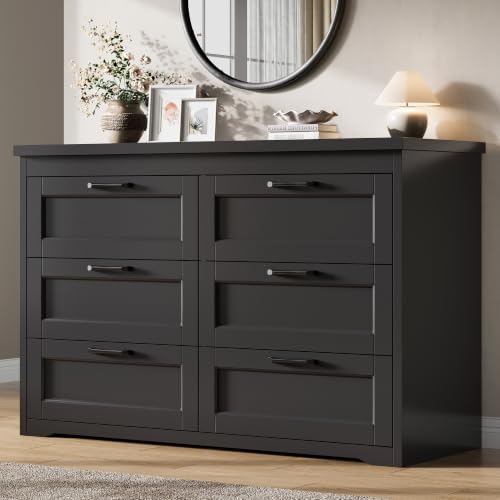
Double Dresser with Deep Drawers: The Complete Buying Guide
Maximize bedroom storage with a wide double dresser that features genuinely deep drawers. Learn how to evaluate depth, drawer slides, materials, and layout so you choose a piece that keeps clothes organized for years.
START EXPLORINGWhy deep drawers matter: A double dresser with deep drawers solves a common bedroom problem — plenty of drawer fronts but not enough usable space. Deep drawers let you store bulky clothing like sweaters, jeans, and bedding flat rather than cramming them into shallow compartments. This guide explains how to identify true depth, what construction details signal quality, and how to plan a layout that stays organized.
If you are researching a double dresser with deep drawers, you already understand the appeal: a wide surface for styling and daily essentials, paired with storage that actually holds a full wardrobe. The challenge is that the term "deep drawer" is used loosely across listings. Some drawers are deep front-to-back but shallow top-to-bottom; others are the reverse. Understanding the distinction is the difference between a dresser that works and one that frustrates you daily.
This guide walks you through what deep actually means in practical terms, how a double dresser differs from a double-wide dresser and a double chest of drawers, which materials and hardware hold up best, and how to organize deep drawers so items do not disappear into the back. By the end, you should have a clear checklist for evaluating any candidate before you commit.
What Exactly Is a Double Dresser?
A double dresser is a wide, low-profile storage piece typically arranged in two columns of drawers side by side. Most models range from roughly 54 to 72 inches in width and stand between 30 and 40 inches tall, giving you a generous top surface while keeping drawers at easy reach. The double-column layout usually yields six to eight drawers, depending on how the columns are split.
This format differs from a tall chest of drawers, which stacks a single column vertically. The wide, low design of a double dresser suits a primary bedroom well: it fits beneath a window, anchors a wall opposite the bed, and doubles as a surface for a mirror, lamp, or decorative tray. For rooms where wall width is generous but height is limited, a double dresser for bedroom use is often the most practical configuration.
When depth is added to the equation, the piece becomes far more capable. A double dresser with deep drawers can absorb seasonal clothing, extra linens, and bulky knitwear that would overwhelm a standard-depth unit. The trade-off is that deeper drawers require more floor space and stronger hardware, so the details matter.
What "Deep" Really Means in Drawer Specifications
Drawer depth is measured two ways, and confusing them is the most common shopping mistake. Interior depth (front-to-back) determines how far back you can reach; interior height (top-to-bottom) determines how much you can stack. A drawer described as deep may be 16 inches front-to-back but only 6 inches tall — fine for folded shirts but useless for a thick sweater stack.
For a double dresser with deep drawers intended for bulky clothing, look for interior height of at least 7 to 9 inches on the deeper drawers. The front-to-back measurement should land around 14 to 18 inches of usable interior space. Anything beyond 18 inches becomes awkward to reach without pulling the drawer fully open, which puts stress on the slides.
| Drawer Tier | Typical Interior Height | Best For |
|---|---|---|
| Shallow tier | 4–6 inches | Socks, underwear, accessories, folded t-shirts |
| Standard tier | 6–8 inches | Folded shirts, trousers, workout wear |
| Deep tier | 8–10 inches | Sweaters, jeans, linens, bulky knitwear |
| Extra-deep tier | 10+ inches | Bedding, blankets, seasonal storage, off-season clothing |
A well-designed double dresser often mixes tiers: shallow drawers near the top for smaller items and deep drawers lower down for bulkier clothing. This mixed configuration is usually more useful than uniform depth throughout. When reviewing a listing, check whether the manufacturer publishes interior dimensions — if only exterior dimensions are given, treat the depth claim with caution.
Key Buying Factors for Deep-Drawer Double Dressers
Beyond raw dimensions, several construction and design factors determine whether a double dresser with deep drawers performs well over time. Deep drawers carry more weight, so the supporting hardware and structure become more critical than on a shallow unit.
Drawer Slides and Load Capacity
Deep drawers loaded with clothing can become heavy quickly. Look for heavy-duty full-extension drawer slides that allow the drawer to pull out completely, giving you access to the back. Full-extension slides also reduce the strain of reaching into a deep drawer while it is only partly open. Side-mount slides are common in mid-range models; under-mount slides with soft-close mechanisms are typical of premium and luxury tiers. If the listing does not specify slide type, that is usually a sign of entry-level construction.
Drawer Box Construction
The drawer box itself — the sides, bottom, and joinery — determines how well a deep drawer holds its shape under load. Dovetail joinery is the traditional benchmark for durability; box joints and reinforced stapled construction are common at lower tiers. A thicker bottom panel (at least 1/4 inch, ideally 3/8 inch or more) resists sagging when the drawer is full. English dovetail drawer fronts with solid wood sides are a strong indicator of a long-term investment piece.
Material and Frame Rigidity
Deep drawers exert more torque on the frame, so a rigid carcass matters. Solid wood frames in oak, maple, or walnut offer the most durable construction and resist warping over time. High-quality engineered wood with a reinforced internal frame can perform well in the mid-range tier, particularly when the drawer boxes are solid wood. Avoid units where the entire structure — including drawer boxes — is thin engineered board, as deep drawers in that configuration tend to loosen and sag.
Width and Footprint Planning
Double dressers are wide by definition, and deep drawers add front-to-back footprint. Measure your wall width, then account for clearance to open drawers fully — typically 20 to 24 inches of open floor space in front. If your room is tight, consider a dresser for small spaces instead, or a narrower configuration that still offers depth. For walk-in closets, a double-sided dresser for walk-in closet layout can provide access from both sides, which is especially efficient for deep drawer storage.
Hardware and Finish Quality
Drawer pulls on deep drawers experience more pull force, so sturdy drawer pulls with through-bolted mounting are preferable to surface-mounted hardware. Metal pulls with a rust-proof finish hold up better in humid climates. For finish, a durable topcoat resists scratches from daily use; painted finishes in the premium tier typically include a protective clear coat. If you plan to customize, review our dresser hardware guide before choosing replacement knobs or handles.
Layout and Drawer Count: Finding the Right Balance
Double dressers commonly offer six, seven, or eight drawers, but the count alone does not tell the whole story. What matters is the distribution of drawer sizes. A six-drawer double dresser with two wide deep drawers at the bottom and four standard drawers above often stores more practical clothing than an eight-drawer unit split into uniformly shallow compartments.
Consider how you actually fold and store clothing. If you prefer flat folding for sweaters and jeans, prioritize deep drawers with generous interior height. If you use vertical folding methods, standard-depth drawers with dividers may serve you better. Our drawer dividers guide explains how to segment both shallow and deep drawers for efficient access.
For a coordinated bedroom, a dresser and nightstand set can unify the room visually while ensuring matching finishes. If you need additional storage, pairing a double dresser with a dresser and chest of drawers combination covers both wide and tall storage needs. For walk-in closets with limited wall space, a double-sided dresser offers access from two directions and can be more efficient than a single wide unit.
How to Organize Deep Drawers Effectively
Deep drawers fail when items pile up with no structure. The back of a deep drawer becomes a black hole where clothing goes to be forgotten. A few practical habits prevent that outcome:
- Use vertical folding for soft items. Filing sweaters and shirts upright keeps every piece visible and prevents the back from becoming a graveyard.
- Add drawer organizers and dividers. Adjustable dividers segment deep drawers into zones for categories like workout wear, loungewear, or accessories. See our drawer organizers guide for options.
- Assign the deepest drawers to the bulkiest items. Reserve the deepest tier for sweaters, jeans, and linens rather than daily essentials you need to reach quickly.
- Rotate seasonally. Off-season clothing can live in the deepest drawer at the back, freeing front space for current wardrobe items.
- Keep small items contained. Socks, underwear, and jewelry belong in shallow drawers or in organizer trays within deeper drawers to prevent them from scattering. A dedicated dresser for socks and underwear configuration can help if this is a priority.
If you are setting up a new unit, our dresser organization ideas and dresser organization guide provide step-by-step systems for both shallow and deep drawer layouts.
Coordinating with Matching Bedroom Furniture
A double dresser with deep drawers often serves as the anchor of a bedroom storage plan. Matching it with complementary pieces keeps the room cohesive and ensures consistent finishes and hardware. Popular combinations include a double dresser and nightstand set for a balanced look, or a dresser and two nightstand set for primary bedrooms where both sides of the bed need surface space.
If your closet needs extra capacity, a dresser for closet arrangement can supplement the bedroom unit, and a double-sided dresser for walk-in closet layout is worth considering for larger spaces. For a full room plan, our dresser buying guide covers how to size and position multiple storage pieces together.
Quality Tiers: What to Expect at Each Level
Rather than focusing on numbers, it helps to understand what construction and features define each tier of the market. This classification reflects relative positioning and does not change over time.
| Tier | Construction Signals | Best For |
|---|---|---|
| Entry-level | Engineered wood carcass, stapled or box-joint drawer boxes, side-mount slides, limited depth options | Guest rooms, temporary setups, light use |
| Mid-range | Reinforced engineered wood or mixed solid wood, solid wood drawer sides, under-mount or heavy-duty side slides | Primary bedrooms, daily use, families |
| Premium | Solid wood frame, dovetail joinery, full-extension soft-close slides, mixed-depth drawer layouts | Long-term bedroom investment, high-frequency use |
| Luxury | Hardwood throughout, hand-finished joinery, premium hardware, custom depth configurations | Design-led interiors, heirloom-quality furniture |
A mid-range double dresser with deep drawers is typically the sweet spot for most buyers: solid enough to support loaded deep drawers, refined enough in finish to suit a primary bedroom, and well-specified for the category. Entry-level units can work well in low-traffic rooms, but deep drawers on entry-level slides tend to wear faster under load. At the premium and luxury tiers, you gain smoother mechanisms, dovetail construction, and more consistent depth across drawers. For a deeper comparison of materials, see our dresser quality guide.
A Practical Checklist Before You Commit
- Verify interior dimensions. Confirm front-to-back depth and top-to-bottom height for each drawer, not just the unit's exterior.
- Check the slide rating. Heavy-duty full-extension slides are preferable for deep drawers; soft-close is a bonus at the premium tier.
- Inspect drawer box construction. Dovetail joinery and solid wood sides signal durability; thin stapled boxes are a warning sign for deep drawers.
- Measure clearance. Ensure 20–24 inches of open floor space in front of the dresser for full drawer extension.
- Confirm the frame material. Solid wood frames resist the extra torque of loaded deep drawers better than thin engineered panels.
- Plan the drawer mix. A combination of shallow and deep drawers usually serves better than uniform depth.
- Coordinate the finish. If you are buying a set, match finishes and hardware across pieces for a cohesive bedroom.
- Review the brand's drawer warranty. A longer warranty on slides and drawer boxes usually reflects confidence in load performance.
If you are also weighing related formats, our comparisons of dresser and night stand configurations and dresser and matching night stand options can help you plan a complete bedroom setup.
Ready to Compare Deep-Drawer Double Dressers?
Explore our curated selection of double dressers with deep drawers and find the configuration that matches your storage needs.
Explore OptionsFrequently Asked Questions
How deep should drawers be in a double dresser?
Deep drawers in a double dresser typically range from 14 to 18 inches of usable interior depth front-to-back, with 8 to 10 inches of interior height for genuinely deep tiers. Drawers around 16 inches offer a balanced compromise between capacity and easy access, while deeper options suit bulky items like sweaters and linens.
What is the difference between a double dresser and a standard dresser?
A double dresser is wider than a standard dresser and usually features two columns of drawers side by side, often with six to eight drawers total. This layout provides more usable storage surface and capacity, making it a strong fit for primary bedrooms. A double-wide dresser is a related format that emphasizes width even further.
Are deep drawers good for organizing clothes?
Deep drawers excel for bulky items like sweaters, jeans, and linens. For smaller items, combine deep drawers with drawer organizers and dividers to keep contents visible and accessible rather than letting them pile up at the back.
What material is best for a double dresser with deep drawers?
Solid wood construction such as oak, maple, or walnut offers the most durable long-term performance. High-quality engineered wood with reinforced drawer boxes is a solid mid-range alternative, especially when paired with heavy-duty metal drawer slides.
How much clearance do I need in front of a double dresser?
Plan for 20 to 24 inches of open floor space in front of the dresser so deep drawers can extend fully. Full-extension slides require more clearance than partial-extension slides but give you complete access to the back of the drawer.