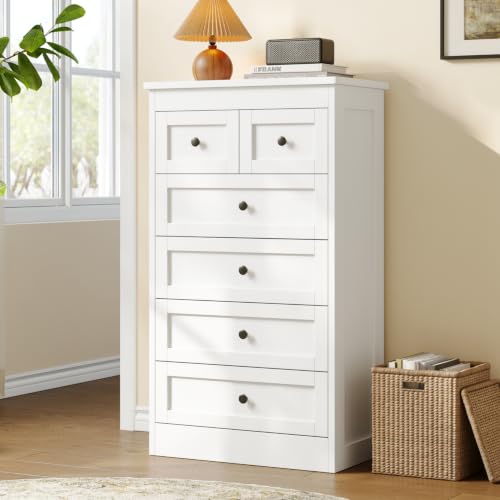
Chest of Drawers 6 Drawers Tall: The Complete Guide
A tall six-drawer chest maximizes vertical bedroom storage without consuming valuable floor space. This in-depth guide covers sizing, materials, drawer mechanics, and practical buying criteria so you can choose the right piece with confidence.
Explore Recommended ModelsWhy a Tall 6-Drawer Chest Deserves Your Attention
A tall chest of drawers with six drawers is one of the most space-efficient storage solutions for a bedroom. Unlike wide dressers that stretch along the wall, a tall unit stacks storage vertically, making it an excellent fit for compact rooms, apartments, and shared spaces. Six drawers provide a clear organizational advantage: each drawer can be dedicated to a specific category of clothing or accessories, reducing clutter and simplifying your daily routine.
For anyone in the research stage, the key questions usually revolve around height, drawer depth, material durability, and how well the piece integrates with existing bedroom furniture. This guide answers those questions directly and helps you evaluate what matters most before you commit to a purchase.
Quick summary: A tall 6-drawer chest typically stands between 48 and 60 inches high, with drawer interiors around 5 to 8 inches deep. It suits bedrooms where floor space is limited but vertical clearance is available. Mid-range and premium tiers offer smoother glides, deeper drawers, and more durable joinery.
What Exactly Is a Tall 6-Drawer Chest of Drawers?
A tall chest of drawers—sometimes called a tallboy or highboy—is a vertical storage unit characterized by a height that exceeds its width. When configured with six drawers, it usually adopts one of two layouts: six equally sized drawers stacked vertically, or a split configuration with two smaller top drawers and four larger drawers below. Both designs prioritize vertical organization.
Compared to a standard tall chest of drawers, the six-drawer version offers more compartmentalization without necessarily increasing the footprint. This makes it particularly useful for organizing socks, undergarments, folded shirts, and accessories in separate zones. If you prefer a wider profile, a low and wide chest of drawers is an alternative worth considering, but the tall configuration remains the best choice for tight floor plans.
Key Dimensions to Check Before Buying
Sizing is the most common source of buyer regret with tall chests. Before ordering, measure both the intended wall space and the full delivery path, including doorways and stairwells. The table below outlines typical dimensional ranges for tall six-drawer chests across different market tiers.
| Dimension | Typical Range | What It Means for You |
|---|---|---|
| Overall Height | 48–60 inches | Top drawers should sit at or below eye level for easy access; taller units suit long-term storage on upper tiers. |
| Overall Width | 28–40 inches | Narrower widths fit tight wall segments; wider units offer more surface area on top. |
| Overall Depth | 16–20 inches | Deeper units hold bulkier items but require more clearance for drawer extension. |
| Drawer Interior Height | 5–8 inches | Deeper drawers suit folded sweaters; shallower drawers work well for accessories. |
| Drawer Interior Width | 22–36 inches | Wider drawers accommodate folded shirts laid flat; narrower drawers suit rolled items. |
If your room is especially tight, a chest of drawers to fit in closet configuration may be more practical. Conversely, if you have generous wall space and prefer a horizontal layout, explore a chest of drawers with large drawers for bulkier storage needs.
Understanding Six-Drawer Layouts
Equal-Stack Layout
All six drawers are the same height and width. This layout is straightforward and works well when your clothing mix is fairly uniform. It is common in modern and minimalist designs, where clean lines and symmetry are priorities.
Split Layout (2 Small + 4 Large)
The top two drawers are shallower, while the lower four are deeper. This configuration is practical for separating small accessories from bulkier clothing. It is frequently found in traditional and transitional styles, and it offers more nuanced organization than an equal-stack design.
Two-Column Layout
Some six-drawer chests arrange drawers in two side-by-side columns of three. This layout increases the number of compartments but narrows each drawer. It suits buyers who prefer categorized storage over wide, flat drawers. If this appeals to you, a chest of drawers set of 2 may also be worth reviewing for paired storage.
Materials and Construction Quality
The material and joinery of a tall chest directly affect its longevity and how smoothly it operates over time. Broadly, the market divides into three tiers: entry-level, mid-range, and premium.
Entry-Level Tier
These units typically use engineered wood with a veneer or laminate finish. They are lighter and more sensitive to humidity, but they can serve well in low-traffic rooms or as temporary solutions. Drawer glides are usually basic side-mounted runners.
Mid-Range Tier
Mid-range chests often combine solid wood fronts with engineered wood carcasses. They feature smoother metal glides, better hardware, and more consistent finishes. For most buyers, this tier represents a balanced choice between durability and refined operation.
Premium Tier
Premium and luxury chests use solid hardwoods—oak, walnut, maple, or mahogany—with dovetail joinery and soft-close or full-extension drawer glides. They are heavier, more stable, and designed as long-term investments. If you are comparing wood options, our guides on chest of drawers in black and wood and chest dresser with deep drawers offer further detail on finish and depth considerations.
Construction tip: Look for dovetail or doweled drawer joints, metal drawer glides with a smooth extension, and a finished back panel. These details distinguish well-built units from entry-level assemblies and directly influence how the chest performs over years of daily use.
Features That Improve Daily Use
- Full-extension glides: Allow you to reach the back of each drawer without strain—especially valuable in a tall unit where lower drawers are farther from eye level.
- Soft-close mechanisms: Prevent drawers from slamming, which protects the frame and reduces noise in shared living spaces.
- Anti-tip hardware: Essential for tall furniture; wall-anchoring kits are strongly recommended, particularly in households with children.
- Dust-proofing: Felt or rubber seals between drawers keep clothing free of dust and reduce friction.
- Adjustable levelers: Compensate for uneven floors and keep the chest stable and aligned.
- Interior dividers or liners: Pre-installed or optional dividers improve organization. A quality bureau drawer liner can also protect delicate garments.
Placement and Room Integration
A tall six-drawer chest works best against a solid wall with at least 24 inches of clearance in front for drawer extension. In smaller bedrooms, placing it beside the bed or opposite the foot of the bed keeps the room balanced. For walk-in closets, a chest of drawers for walk-in closet arrangement can centralize clothing storage and free up bedroom floor space.
If you are coordinating matching pieces, a chest of drawers and matching wardrobe or a chest of drawers and nightstand set creates a cohesive look. For living areas, a chest of drawers for living room can double as a console or media storage, though height and drawer depth should be adjusted to the room's function.
Buying Checklist: What to Verify Before You Purchase
- Measure twice: Confirm height, width, depth, and the delivery path through doors and hallways.
- Check drawer extension: Full-extension glides are preferable; partial extension limits access to the rear of each drawer.
- Inspect joinery: Dovetail joints signal premium construction; stapled or glued joints indicate entry-level assembly.
- Confirm anti-tip hardware: Tall chests should include or support wall-anchoring hardware.
- Review the finish: A consistent, sealed finish resists moisture and wear better than unfinished or thinly coated surfaces.
- Assess the drawer bottoms: Reinforced bottoms support heavier loads without sagging over time.
- Consider the top surface: If you plan to place a lamp or decor, verify that the top is level and adequately sized.
Frequently Asked Questions
How tall should a six-drawer chest be?
Most tall six-drawer chests range from 48 to 60 inches in height. A height around 50–55 inches keeps the top drawers within comfortable reach for most adults while providing ample vertical storage.
Is a tall chest stable without wall anchoring?
Tall chests are more prone to tipping than low dressers, especially when upper drawers are open and loaded. Wall anchoring is strongly recommended as a standard safety practice, particularly in homes with children or pets.
What is the difference between a tallboy and a highboy?
Both terms describe tall chests of drawers. A highboy traditionally refers to a tall chest on legs with a more formal silhouette, while a tallboy is a broader term for any tall, vertical chest. In modern retail, the terms are often used interchangeably.
How much weight can each drawer hold?
Drawer capacity depends on construction. Entry-level units typically support lighter loads, while mid-range and premium chests with reinforced bottoms and metal glides handle heavier folded clothing with less strain. Always distribute weight evenly across the drawer base.
Can a six-drawer chest work in a small bedroom?
Yes—tall chests are actually ideal for small bedrooms because they use vertical space instead of floor space. Ensure at least 24 inches of clearance in front for drawer extension and keep the unit away from door swing paths.
What should I look for in drawer glides?
Metal ball-bearing glides with full extension offer the smoothest and most durable operation. Soft-close mechanisms are a worthwhile upgrade, and side-mounted glides are common in entry-level units while under-mounted glides appear in mid-range and premium tiers.
Final Thoughts
A tall chest of drawers with six drawers is a practical, space-efficient investment for any bedroom. By focusing on dimensions, drawer layout, material tier, and hardware quality, you can select a piece that serves your storage needs for years. Use the checklist above as a decision framework, and explore the recommended models below to compare features side by side. For a broader look at the category, our complete guide to the 6-drawer tall chest and buying guides provide additional context before you finalize your choice.