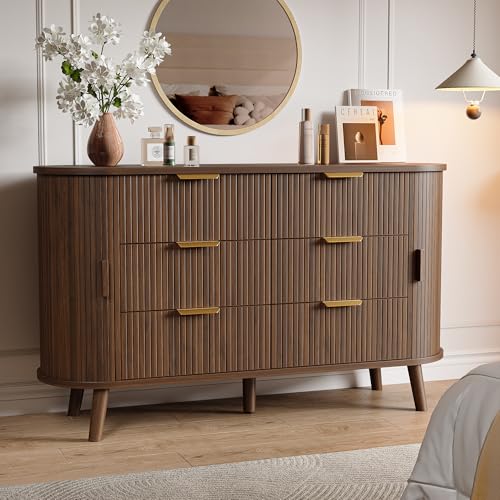
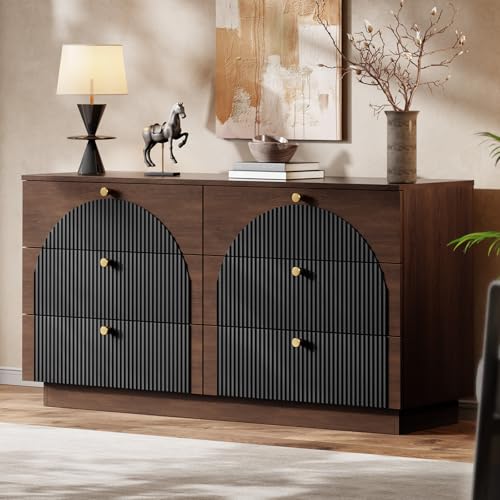
What Is an Arched Dresser?
An arched dresser is a chest of drawers defined by a curved or arched top edge. The arch may be a subtle bow, a pronounced half-circle, or a scalloped wave, and it often echoes the shape of a doorway or window. This design detail gives the piece a softer silhouette than a standard rectangular dresser, turning functional storage into a decorative statement. Many arched dressers pair the curved top with fluted sides, recessed handles, or tapered legs, which reinforces the sculptural look.
The style has roots in Art Deco and mid-century design, where curved geometry was used to make furniture feel dynamic. Today, arched dressers appear in modern, Japandi, transitional, and even cottage interiors. If you are still deciding between storage silhouettes, our guide to dresser types can help you compare the arched profile against flat-top and tallboy options.
Arched Dresser Styles and Design Variations
Not every arched dresser looks the same. The arch can appear in several places, and each variation changes how the piece reads in a room:
- Arched top edge: The most common form, where the top surface curves upward like a bridge. It draws the eye upward and works well under a window or against a plain wall.
- Arched drawer fronts: Some designs curve each drawer face individually, creating a rippling, wave-like effect. This suits modern and Art Deco interiors.
- Arched mirror frame: A curved mirror attached to the dresser extends the arch motif and adds height. If you prefer a matching mirror, explore bedroom dresser sets with mirror.
- Arched side panels: Less common but striking, where the sides bow outward. These pieces feel more like sculpture than storage and suit open floor plans.
Finish also shapes the style. A white arched dresser feels airy and nursery-friendly, while a walnut or oak arched dresser brings warmth and gravitas. For a broader survey of finish options, see our materials and finishes section.
How to Choose the Right Arched Dresser
Before you commit, work through four practical filters: size, material, drawer configuration, and room context. Each one affects daily usability as much as appearance.
1. Size and Proportion
Measure the wall where the dresser will sit, then subtract at least 24 inches for drawer pull-out and walkway clearance. Arched dressers often run slightly taller than flat-top models because of the curve, so check ceiling height and any wall-mounted decor. A narrow arched dresser can fit a small bedroom or hallway, while a wide arched dresser anchors a primary bedroom. If space is tight, our dressers for small spaces guide offers additional layout strategies.
2. Materials and Construction Quality
Look for solid wood frames and dovetail drawer joints if you want longevity. Mid-tier arched dressers commonly use engineered wood with veneers, which can look excellent but requires gentler handling. Entry-level models may use particle board, which is lighter and less resistant to moisture. In all tiers, check that the arched top is reinforced, since a curved panel can be a weak point if the build is rushed.
3. Drawer Configuration
Arched dressers typically offer three to six drawers. A three-drawer arched dresser suits a guest room or entryway, while a six-drawer model works for a couple sharing a bedroom. Deep bottom drawers are useful for bulky items like sweaters and linens. If you need more capacity, compare with a chest of drawers or a tall dresser.
4. Room Context and Decor Style
An arched dresser can serve as a bedroom focal point, a nursery changing station, or a living room console. In a nursery, secure the dresser to the wall and avoid sharp edges. In a living room, an arched dresser can hold media equipment or table linens. For styling inspiration, browse bedroom dresser ideas and dresser styling tips.
Arched Dresser Tiers: What to Expect
To compare models without relying on fluctuating retail figures, use market-position tiers. The table below summarizes what each tier generally delivers in construction, finish, and hardware.
| Tier | Best For | Typical Construction | Hardware & Finish |
|---|---|---|---|
| Entry-level | Guest rooms, first apartments, temporary setups | Particle board or thin engineered wood, stapled or cam-lock assembly | Basic metal glides, painted or laminated finish |
| Mid-range | Primary bedrooms, nurseries, everyday use | Engineered wood with veneer, some solid wood trim, screw-and-dowel joints | Ball-bearing glides, brushed metal or wood handles, multi-step finish |
| Premium | Design-focused bedrooms, long-term ownership | Solid wood frame, dovetail drawers, reinforced arched top | Soft-close glides, solid brass or hardwood hardware, hand-applied finish |
| Luxury | Statement interiors, collector-grade furniture | Kiln-dried hardwood, mortise-and-tenon joinery, custom arch geometry | Custom-cast hardware, artisan finishes, made-to-order sizing |
A mid-range arched dresser is usually the sweet spot for most households: it offers smoother drawer action and a more convincing finish than entry-level models, while premium and luxury tiers are worthwhile investments for buyers who plan to keep the piece for a decade or more.
Arched Dresser vs. Other Dresser Shapes
The arch is only one way to soften a dresser. A bachelor chest offers a compact footprint, while a bachelors chest variant emphasizes height. A antique dresser may already feature a subtle curved top, especially in French and Victorian styles. If you love the arch but want a vintage feel, explore antique French dresser and antique French chest of drawers; both often include curved aprons and scalloped edges that echo the arched look.
For a more contemporary read, pair an arched dresser with a bedroom dresser and nightstand set so the curve repeats across the room. If you prefer a low profile, a bedroom chest of drawers with a gentle bow front can deliver a similar softness.
Placement and Styling Tips
An arched dresser looks best when it has breathing room. Center it on a wall, leave space on either side, and avoid crowding the curved top with tall items that hide the silhouette. A low-profile lamp, a small plant, and a shallow tray are usually enough. In a nursery, anchor the dresser with a wall strap and keep the top clear of loose blankets.
Lighting matters too. A wall sconce or pendant hung slightly above the arch can highlight the curve. If the dresser doubles as a console, choose a mirror with a matching arch to reinforce the geometry. For more layout ideas, see bedroom dresser and night stands and bedroom dresser and end tables.
Care and Maintenance
Dust the arched top regularly, since the curve can collect debris. Use a soft, slightly damp cloth and avoid harsh solvents on veneered surfaces. Check drawer glides every few months and tighten screws as needed. If the dresser sits in a humid room, use a dehumidifier to protect the wood and prevent the arch from warping. For general upkeep, our dresser organization guide also covers interior care and seasonal rotation.
Frequently Asked Questions
What is an arched dresser?
An arched dresser is a storage piece with a curved or arched top edge, often echoing architectural arches. The design softens the silhouette and adds a sculptural focal point to a bedroom, nursery, or living space.
What rooms suit an arched dresser best?
Arched dressers work beautifully in bedrooms, nurseries, entryways, and living rooms. Their curved tops pair especially well with modern, transitional, Japandi, and Art Deco interiors where soft geometry is a design priority.
How do I measure for an arched dresser?
Measure the available wall space, leaving at least 24 inches of clearance for drawer access and walkways. Account for the arched top, which may be taller than a flat-top dresser, and confirm ceiling height and door swing clearance before finalizing your choice.
Are arched dressers durable?
Durability depends on construction. Solid wood arched dressers with dovetail joints and reinforced frames are the most long-lasting. Mid-tier models often use engineered wood with veneers, while entry-level options may use particle board, which is less resilient over time.
Ready to bring an arched dresser home?
Compare construction tiers, drawer configurations, and finish options in one place, then choose the curved-top dresser that fits your room and routine.
View Recommended Arched Dressers