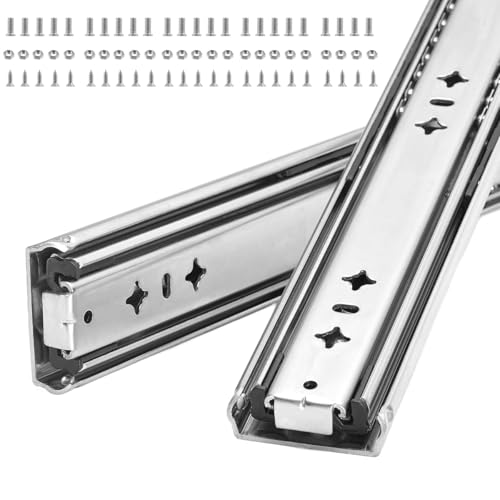
Heavy Duty Drawer Slides: The Complete Buyer's Guide
Heavy duty drawer slides are the backbone of any high-load storage system — from workshop tool chests and kitchen pantries to camper van conversions and commercial cabinetry. This guide explains load ratings, materials, mounting styles, and the key differences between slide types so you can choose the right hardware with confidence.
Who this guide is for: If you already know you need drawer slides that can carry serious weight, this page walks you through the technical details that actually affect performance — extension type, bearing construction, mounting position, and locking features — so your build stays smooth and reliable for years.
What Makes a Drawer Slide "Heavy Duty"?
A standard household drawer slide is typically rated for light loads and built with thin steel and basic ball bearings. Heavy duty drawer slides differ in three measurable ways: load rating, material thickness, and bearing design. A slide earns the heavy duty label when it is engineered to carry sustained loads far beyond typical residential furniture requirements — commonly in the several-hundred-pound range and above for commercial-grade units.
The most important variable is the load rating, which is usually stated as a maximum weight per pair of slides at full extension. A pair of slides rated for high loads at full extension is more demanding to build than one rated only when closed, so always check whether the rating applies to the fully extended position.
- Steel gauge: Heavier-gauge cold-rolled steel resists flexing under load. Premium slides often use reinforced profiles with additional bends for rigidity.
- Bearing type: Ball bearing slides distribute load across steel balls in a track, while roller bearing slides use cylindrical rollers. Both appear in heavy duty designs, but ball bearing construction generally offers smoother travel under heavy loads.
- Extension type: Full extension slides let the drawer open completely, exposing the entire contents. Over-travel and extra-long variants add even more clearance.
- Finish: A rust-proof finish such as zinc plating or a powder-coated surface extends service life in humid or outdoor environments.
Types of Heavy Duty Drawer Slides
Slide design determines how the drawer travels and how much of it you can access. Below are the main categories and where each one performs best.
Full Extension Slides
The drawer opens fully so every inch of the interior is reachable. This is the default choice for tool drawers, deep pantries, and storage beds.
Undermount Slides
Concealed beneath the drawer bottom for a clean look. Heavy duty undermount full extension models are popular in premium cabinetry where hardware should stay hidden.
Bottom-Mount Slides
Installed under the drawer base rather than on the sides, distributing load across the floor of the cabinet. Often chosen for wide, shallow drawers.
Side-Mount Slides
The classic configuration that attaches to the drawer sides and cabinet walls. Available in the widest range of lengths and load ratings.
Locking Slides
Include a locking mechanism that holds the drawer in place during transport or vibration. Common in vehicles, mobile workstations, and medical cabinetry.
Self-Closing Slides
Draw the drawer shut automatically from the last few inches of travel. Useful in high-traffic kitchens and commercial settings.
For specialized builds, explore dedicated variants such as heavy duty full extension drawer slides, heavy duty undermount drawer slides with full extension, heavy duty bottom drawer slides, and heavy duty locking drawer slides for applications that demand extra security.
Understanding Load Ratings Before You Buy
Every heavy duty slide comes with a stated load capacity, but the number alone can be misleading. Load ratings depend on three factors that should be considered together: the weight carried, the extension position, and the number of slides used.
As a rule of thumb, a pair of slides is rated to support the stated load when the drawer is fully extended. The further a drawer extends, the greater the leverage on the slide rails, which is why some manufacturers publish separate ratings for closed and extended positions. If your drawer will stay open for long periods during use — as in a workbench or pantry — favor slides with a strong full-extension rating.
| Tier | Typical Application | Best For |
|---|---|---|
| Entry-level | Light workshop and residential storage | Occasional-use drawers with moderate loads |
| Mid-range | Kitchen pantries, home office, garage shelving | Daily-use drawers with steady, moderate-to-heavy loads |
| Premium | Van conversions, mobile workstations, deep tool drawers | Frequent use with heavy loads and extended travel |
| Commercial-grade | Industrial cabinets, medical carts, heavy machinery storage | Continuous-duty cycles and maximum load demands |
Within each tier, the difference between models usually shows up in travel smoothness, side-to-side play, and long-term durability. Mid-range slides typically offer a noticeably smoother mechanism than entry-level units, while premium and commercial-grade slides add tighter tolerances and reinforced rails for sustained heavy cycling.
Materials and Construction Quality
Heavy duty slides live or die by their steel. Cold-rolled steel is the standard for quality slides because it holds its shape under stress and resists bending at full extension. Look for a rust-proof finish — zinc plating is common and effective — especially if the slides will be installed in a garage, workshop, van, or any humid environment.
Bearing construction matters just as much as the rail itself. Heavy duty ball bearing slides use hardened steel balls in a cage to spread load evenly along the track, delivering smooth, consistent travel under weight. Heavy duty roller bearing drawer slides use cylindrical rollers instead, which can be a good match for applications where the drawer travels in a straight line with less side load. Both are legitimate heavy duty options; the right choice depends on the load direction and how often the drawer is cycled.
- Reinforced rail profiles: Additional bends and thicker steel reduce flex on wide drawers.
- Hardened bearings: Steel bearings resist flattening under sustained load better than softer alternatives.
- Precision machining: Tighter tolerances mean less rattle and smoother travel over thousands of cycles.
- Corrosion protection: Plated or coated finishes extend service life in damp or outdoor settings.
Choosing the Right Length and Size
Slide length must match the depth of your drawer box and cabinet. If the slide is too short, the drawer will not extend fully; if it is too long, it will not fit inside the cabinet. Measure the drawer depth from the front edge to the back of the box, then choose a slide of the same nominal length.
Common sizes cover most residential and workshop builds, and specialty lengths are available for deep cabinets and long drawers. Popular options include heavy duty 24-inch drawer slides, heavy duty 30-inch drawer slides, heavy duty 36-inch drawer slides, and heavy duty 40-inch drawer slides. For extra-deep storage, heavy duty 60-inch drawer slides and heavy duty 72-inch drawer slides handle long travel requirements.
Narrow cabinets and compact builds call for a shorter footprint; 24-inch slides are the workhorse here. Extra-long builds benefit from heavy duty extra-long drawer slides that maintain rigidity across longer spans.
High-Load Capacity Options
Some projects demand extreme load ratings. Industrial cabinets, heavy tooling storage, and commercial equipment often require slides engineered for the highest weight classes available. If your build falls into this category, look for models designed explicitly around high-load performance, such as heavy duty drawer slides rated for 500 lbs and heavy duty drawer slides rated for 500 kg for the most demanding commercial-grade applications.
When pushing toward the top of the load range, confirm that the cabinet structure and drawer box can handle the same load — the slides are only one link in the chain. Reinforced drawer bottoms and solid cabinet framing are essential partners for any high-capacity slide system.
Matching Slides to Your Application
The best slide depends on where it will be installed. Different environments place different demands on hardware, and the right choice for a kitchen is rarely the right choice for a van build.
Kitchen and Pantry
Kitchen drawers carry dense loads and cycle frequently. Heavy duty kitchen cabinet drawer slides are built for this rhythm, and heavy duty pull-out pantry slides extend the concept to tall, narrow storage where full access matters. For cabinet builds generally, heavy duty cabinet drawer slides cover the standard configurations.
Vehicles and Van Conversions
Vans and mobile setups introduce vibration and motion. Locking mechanisms become essential, which is why heavy duty drawer slides for van conversions and heavy duty locking slide rails are the standard choice. A locking slide keeps the drawer secured while the vehicle is in motion.
Workshop and Tool Storage
Tool drawers are heavy, frequently opened, and often left extended. Heavy duty pull-out drawer slides and pull-out pantry-style slides work well here, while heavy duty commercial drawer slides suit professional workshops where duty cycles are high.
Specialty Configurations
Some installations need a specific mounting or travel pattern. 24-inch slides fit compact cabinets; self-closing slides keep drawers tidy in high-traffic areas; and roller drawer slides offer a smooth-travel alternative where side loads are minimal.
Installation Tips and Maintenance
Even premium slides underperform if installed poorly. Follow these fundamentals for a smooth, long-lasting result:
- Mount parallel: The two slides on a drawer must be perfectly parallel to each other and to the cabinet opening. Even a small misalignment causes binding and accelerates wear.
- Use the right fasteners: Heavy duty slides come with mounting screws chosen for their load rating. Replacing them with shorter or thinner screws weakens the connection.
- Reinforce the drawer box: A heavy load needs a sturdy box. A reinforced drawer bottom prevents sagging that can throw the slides out of alignment.
- Check the cabinet frame: The cabinet must be able to carry the combined weight of the drawer, slides, and contents. Reinforce the mounting points if needed.
- Lubricate sparingly: Most sealed ball bearing slides are pre-lubricated. A light application of dry lubricant on the track, not grease, keeps travel smooth without attracting dust.
- Test before loading: Open and close the drawer several times before adding weight. Listen for grinding or rattling, which signal misalignment.
Frequently Asked Questions
How do I know which load rating I need?
Weigh your expected contents and add a safety margin. If the loaded drawer will stay open for long periods or be opened frequently, choose a slide whose full-extension rating comfortably exceeds the drawer's loaded weight.
Can I use heavy duty slides on a regular dresser?
Yes, but it is usually unnecessary. Heavy duty slides are designed for high loads and frequent cycling. For standard bedroom storage, a regular full extension slide is sufficient. Reserve heavy duty models for tool drawers, pantries, and commercial or vehicle applications.
What is the difference between ball bearing and roller bearing slides?
Ball bearing slides use steel balls in a cage for even load distribution and smooth travel. Roller bearing slides use cylindrical rollers, which can be simpler and effective for straight-line travel. Both appear in heavy duty designs; ball bearing construction is generally preferred for heavier, more frequent use.
Do I need locking slides?
If the drawer will be installed in a moving vehicle, a mobile cart, or any setting with vibration, locking slides are strongly recommended. For stationary furniture, standard slides are fine.
How do I measure for replacement slides?
Measure the length of the existing slide from front to back, not the drawer opening. Match that nominal length exactly. Also note the mounting style — side, bottom, or undermount — so the replacement fits the same mounting points.
What maintenance do heavy duty slides need?
Very little. Keep the tracks clean of debris, avoid over-lubricating, and check the mounting screws periodically. Sealed ball bearing slides generally last for years with minimal attention.
Final Thoughts: Choosing With Confidence
Heavy duty drawer slides are one of those components where the details matter more than the marketing. Focus on three things: a load rating that comfortably covers your contents at full extension, a steel construction with a proper rust-proof finish, and a mounting style that matches your cabinet and drawer box. Get those right, and the rest — smooth travel, quiet operation, long service life — follows naturally.
Whether you are outfitting a workshop, a kitchen pantry, or a camper van, the right slide makes the whole system feel solid every time you open it. Use the guides above to narrow your options, then move on to the recommended products below to compare specific models.
Explore Recommended Slides