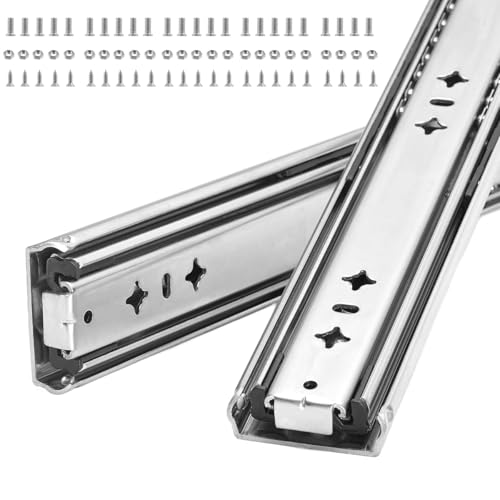
Heavy Duty Ball Bearing Slides
Everything you need to know about ball bearing drawer slides — load ratings, materials, extension types, installation, and how to choose the right slides for dressers, cabinets, and heavy storage drawers.
START THE GUIDEWhy ball bearing slides matter: A dresser is only as good as the mechanism that carries its drawers. Ball bearing slides reduce friction, distribute weight evenly, and keep even fully loaded drawers gliding smoothly for years. Understanding the specifications before you buy or retrofit can save you from sagging drawers, broken tracks, and frustrating sticking.
What Are Heavy Duty Ball Bearing Slides?
Heavy duty ball bearing slides are drawer slide mechanisms built around a cage of steel ball bearings that roll between telescoping metal channels. The bearings convert sliding friction into rolling friction, which is why a well-made set allows a loaded drawer to move with a light, consistent push. Compared to friction slides or basic roller slides, ball bearing slides distribute load across many contact points rather than a few plastic wheels.
The "heavy duty" designation refers to construction and rated capacity rather than a single standardized number. These slides typically use thicker gauge steel, reinforced mounting brackets, and more bearing rows than standard slides. They are the standard choice for dresser drawers, kitchen cabinet pull-outs, tool storage, and commercial furniture where drawers see frequent use and variable loads. If you are comparing drawer hardware options in general, our guide to heavy duty drawer slides covers the broader category.
Core Components
- Ball bearing cage: Holds the steel balls in alignment so they roll evenly along the track.
- Telescoping channels: Two or three interlocking steel sections that extend the drawer outward.
- Mounting brackets: Attach the slide to the cabinet side and the drawer box.
- Release lever or disconnect tab: Allows the drawer to be lifted out for cleaning or moving.
- Stops and dampers: Limit travel and, on some models, soften closing.
Types of Ball Bearing Drawer Slides
Not all ball bearing slides are interchangeable. The extension type, mounting position, and closing mechanism determine how a drawer behaves in daily use.
By Extension
- Full extension: The drawer pulls out completely so the entire interior is accessible. This is the preferred choice for deep dresser drawers and pantry pull-outs. See our detailed page on heavy duty full extension drawer slides.
- Partial extension: The drawer stops at roughly three-quarters of its depth. Suitable where rear access is not needed and cabinet depth is limited.
- Over-travel: Extends slightly beyond full extension, useful for corner cabinets and appliances.
By Mounting Position
- Side mount: The most common configuration, mounted on the outside of the drawer box and the inside of the cabinet. Easy to retrofit.
- Undermount: Hidden beneath the drawer floor for a clean look. Requires a compatible drawer box and precise installation. Our guide to heavy duty undermount drawer slides with full extension explains the requirements.
- Bottom mount: Mounted under the drawer, often used in file cabinets and specific furniture designs. See heavy duty bottom drawer slides.
By Mechanism and Feature
- Self-closing: A spring or cam pulls the drawer shut in the final few inches. Covered in our heavy duty self-closing drawer slides article.
- Locking: A built-in latch holds the drawer closed or locks it for security, common in mobile storage and van fit-outs. See heavy duty locking drawer slides and heavy duty locking slide rails.
- Roller bearing variants: Some slides use cylindrical rollers instead of balls. These are covered under heavy duty roller bearing drawer slides and heavy duty roller drawer slides.
Understanding Load Ratings and Capacity
Load capacity is the single most important specification when selecting slides. It is usually expressed as a pair rating — the weight a matched set can support when the drawer is fully extended, which is the most stressful position. A slide rated for a given load per pair assumes both slides are installed correctly, squarely, and with the recommended fasteners.
Always leave a safety margin. If a drawer holds roughly 60 percent of a slide's rated capacity in normal use, the mechanism stays smooth and long-lived. For dresser drawers filled with folded clothing, a mid-range pair is typically adequate. For tool drawers, canned goods, or workshop storage, move up to professional-grade or commercial-grade slides. We detail the range in our overview of heavy duty drawer slides rated for 500 lbs and the even more demanding heavy duty drawer slides rated for 500 kg.
| Tier | Typical Use Case | Best For |
|---|---|---|
| Entry-level | Light drawers, occasional use | Bedroom dressers, small cabinets |
| Mid-range | Everyday dresser and kitchen drawers | Standard dressers, office furniture |
| Premium | Heavy clothing drawers, loaded pantry | Large dressers, pantry pull-outs |
| Professional-grade | Tool storage, workshop drawers | Garage cabinets, mobile workstations |
| Commercial-grade | Continuous heavy loads | Van fit-outs, industrial storage |
Choosing the Right Slide Length
Slide length must match the drawer depth, not the cabinet depth. Measure the drawer box from front to back, then select a slide that is equal to or slightly shorter than that measurement. A slide that is too long will not fit; one that is too short will limit how far the drawer opens.
- 24 inch: Common for nightstands and smaller dressers. See heavy duty drawer slides 24 inch and the narrower heavy duty 24 inch drawer slides.
- 30 inch: Standard for many six-drawer dressers. Covered in heavy duty drawer slides 30 inch.
- 36 inch: Larger dressers and kitchen cabinets. See heavy duty drawer slides 36 inch.
- 40 inch: Wide dressers and sideboards. Covered in heavy duty drawer slides 40 inch.
- 60 and 72 inch: Extra-long pull-outs for benches and van storage. See heavy duty drawer slides 60 inch and heavy duty drawer slides 72 inch.
For unusually deep drawers, our article on heavy duty extra long drawer slides covers the specialized options.
Materials and Build Quality
The steel grade and coating determine corrosion resistance and how the slide holds up in humid bedrooms or kitchens. High-grade steel with a zinc or nickel plating resists rust better than uncoated steel. The bearing cage should be metal, not plastic, on any slide rated for demanding loads.
Check the following when evaluating build quality:
- Steel thickness: Thicker channels resist flexing under load.
- Bearing rows: More rows spread load and reduce wobble.
- Finish: A rust-proof finish matters in humid environments.
- Mounting holes: Multiple holes allow fine adjustment during installation.
- Release mechanism: A sturdy disconnect lever makes drawer removal safe and easy.
Installation Best Practices
Most premature slide failures are installation problems rather than product defects. Follow these steps to get a smooth, long-lasting result.
- Measure twice: Confirm drawer box depth, height, and side clearance before ordering.
- Remove the old hardware: Take out the existing slides and fill any stripped screw holes with wood filler or a hardwood plug.
- Mark a level line: Use a pencil and a spirit level to mark the mounting height on both cabinet sides. The two sides must be at identical heights.
- Pre-drill pilot holes: This prevents splitting and keeps screws tight.
- Mount the cabinet member first: Attach the slide to the cabinet side, then extend it and align the drawer member.
- Test before final tightening: Slide the drawer in and out, check for rubbing or uneven travel, then tighten all screws fully.
For specific furniture types, see the guides on heavy duty kitchen cabinet drawer slides and heavy duty cabinet drawer slides. If you are fitting slides into a vehicle, the heavy duty drawer slides for van article covers the specific mounting and locking requirements.
Maintenance and Troubleshooting
Ball bearing slides are largely maintenance-free, but a few habits extend their life.
- Wipe tracks with a dry cloth every few months to remove dust and lint.
- Apply a light silicone-based lubricant only if movement becomes stiff. Heavy grease attracts dust and can gum up the bearings.
- Check screw tightness periodically, especially on drawers that carry heavy loads.
- Do not overload a drawer beyond the rated capacity of the slide pair.
- If a drawer sticks on one side, loosen the mounting screws slightly, realign, and retighten rather than forcing the drawer.
How to Choose Heavy Duty Ball Bearing Slides
Use this checklist to narrow your options before you compare specific products.
- Identify the drawer type: Dresser, kitchen cabinet, tool chest, or vehicle storage. Each has different demands.
- Estimate the load: Weigh a typical loaded drawer, then add a safety margin. Choose a tier with comfortable headroom.
- Decide on extension: Full extension for deep drawers, partial extension where rear access is not needed.
- Confirm the mounting position: Side mount is easiest to retrofit; undermount requires a compatible drawer box.
- Measure the drawer depth: Match the slide length to the drawer box, not the cabinet.
- Check the finish: Choose rust-resistant plating for humid rooms.
- Consider closing and locking features: Self-closing for convenience, locking for security or mobile use.
If you are also upgrading the furniture itself, the how to choose a dresser guide helps you match drawer hardware to the overall build quality. For projects that repurpose an older piece, the article on ideas for repurposing a dresser shows how new slides can transform a worn-out drawer.
Frequently Asked Questions
What are heavy duty ball bearing slides?
They are drawer slide mechanisms that use steel ball bearings in a metal cage to reduce friction and support substantial loads. They are built with thicker steel and reinforced brackets for demanding applications in dressers, cabinets, and commercial furniture.
How do I determine the right load rating for drawer slides?
Estimate the maximum weight the drawer will hold, then add a safety margin of at least 25 to 30 percent. For dresser drawers holding clothing, mid-range slides generally suffice, while tool drawers and pantry pull-outs require professional-grade or commercial-grade slides.
What is the difference between full extension and partial extension slides?
Full extension slides allow the drawer to pull out completely, giving access to the entire drawer interior. Partial extension slides stop at roughly three-quarters of the way out, leaving the back of the drawer harder to reach.
Can heavy duty ball bearing slides be installed on existing dressers?
Yes, in most cases. You need to confirm the drawer box dimensions, the slide length, and the mounting clearance. Retrofitting usually requires removing the old slides, filling old screw holes, and aligning the new slides squarely on both the cabinet and drawer box.
How do I maintain ball bearing drawer slides?
Keep the tracks free of dust and debris, wipe them with a dry cloth periodically, and apply a light silicone-based lubricant if movement becomes stiff. Avoid heavy grease that attracts dust, and check screw tightness every few months.
Ready to Upgrade Your Drawers?
Explore our recommended heavy duty ball bearing slides below. Each option is selected for build quality, smooth travel, and dependable load support in dressers, cabinets, and workshop storage.
VIEW RECOMMENDED SLIDES