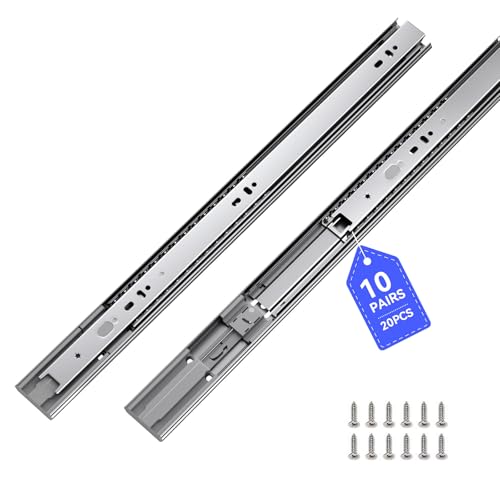
What Makes a Drawer Slide "Heavy Duty"?
The term "heavy duty" is used loosely in product listings, but in practical terms it refers to a slide assembly engineered to carry higher loads while maintaining smooth travel, minimal sag, and long service life. Three engineering factors separate heavy-duty slides from standard residential hardware:
- Load capacity: Measured in pounds or kilograms per pair, this is the maximum weight the slide is rated to support through its full extension cycle. Kitchen applications generally call for at least 100 lbs per pair, with mid-range and premium slides commonly rated between 150 and 250 lbs, and commercial-grade models reaching 500 lbs or more.
- Bearing system: Heavy-duty slides use steel ball bearings in a hardened race, or reinforced rollers, to distribute load evenly along the track. This reduces friction, prevents binding, and keeps the drawer aligned as it moves in and out.
- Material and gauge: High-grade steel with a rust-proof finish is standard. Thicker steel profiles and reinforced mounting brackets resist flexing under load, which is what prevents the drooping and sagging that plagues under-specified slides.
If you are comparing options, our guide to heavy duty drawer slides covers the broader category, while this page focuses specifically on kitchen cabinet applications.
Load Ratings Explained: What Do the Numbers Mean?
Load ratings are the single most important specification to understand. A slide rated for 100 lbs per pair means the pair, working together, is designed to carry 100 lbs of evenly distributed weight across the drawer. Ratings are typically determined through cycle testing under controlled conditions, so real-world performance depends on installation quality, drawer size, and how the weight is distributed.
For kitchen use, a practical way to think about ratings:
- Light kitchen drawers (utensils, linens, small tools): standard slides in the 75 to 100 lbs range are usually sufficient.
- Cookware and dish drawers (pots, pans, stacked plates, mixing bowls): 150 to 250 lbs per pair is the sensible target. This is where heavy duty slides begin to make a real difference.
- Deep pantry and appliance drawers (stand mixers, bulk staples, built-in bins): 250 lbs and above, with commercial-grade options available for the most demanding installations.
Our 500 lbs heavy duty drawer slides guide explores the upper end of the rating spectrum for anyone outfitting a serious kitchen or workshop-grade cabinet.
Mounting Types: Side-Mount, Undermount, and Bottom-Mount
The mounting style determines how the slide attaches to the cabinet and drawer, and it affects both installation complexity and how the drawer looks and functions.
Side-Mount Slides
Side-mount slides attach to the outside of the drawer box and the inside of the cabinet frame. They are the most common retrofit option because the mounting pattern is relatively forgiving and they work with many existing drawer boxes. Heavy-duty side-mount models are widely available and are a practical choice for upgrading kitchen cabinets without rebuilding the drawers. They are visible when the drawer is open, which some homeowners view as a trade-off for the easier installation.
Undermount Slides
Undermount slides attach beneath the drawer bottom, keeping the sides clean and the mechanism hidden. They offer a refined look and often include soft-close and self-closing features. However, they require a compatible drawer bottom and a specific clip or locking device, which makes retrofitting more involved. For new kitchen installations, undermount heavy-duty slides are an excellent choice when specified correctly. Our heavy duty undermount full extension slides guide covers the details.
Bottom-Mount Slides
Bottom-mount slides sit under the drawer and are common in furniture and some cabinet systems. Heavy-duty bottom-mount designs exist but are less common in kitchens than side-mount or undermount. The heavy duty bottom drawer slides resource explains where they fit best.
Extension Types: Full Extension, Three-Quarter, and Over-Travel
Extension describes how far the drawer pulls out relative to its depth. Full extension slides allow the drawer to come completely out of the cabinet, giving unobstructed access to the back of the drawer. This matters in kitchens, where deep drawers holding cookware and appliances are common. Three-quarter extension slides leave part of the drawer inside the cabinet, limiting access to the rear. Over-travel slides extend slightly beyond full extension, which is useful when a cabinet door or handle would otherwise block access.
For heavy-duty kitchen applications, full extension is the practical standard. It lets you lift heavy items straight up rather than reaching awkwardly into a partially open drawer, which reduces strain and improves safety. The heavy duty full extension drawer slides guide covers the range of options.
Bearing Systems: Ball Bearing vs. Roller Bearing
Ball bearing slides use small steel balls running in a track to reduce friction. They deliver smooth, quiet movement and handle heavy loads well because the load is distributed across many contact points. This is the dominant system for heavy-duty kitchen slides. Our heavy duty ball bearing slides overview explains the construction in more detail.
Roller bearing slides use wheels or rollers instead of balls. They are generally more tolerant of dust and debris and can be simpler in construction, but they often feel less refined under heavy loads and may develop flat spots on the rollers over time. For a kitchen environment where crumbs and flour are common, roller slides have practical advantages, but for the heaviest cookware drawers, ball bearing designs are usually the stronger choice.
Soft-Close and Self-Closing Mechanisms
Soft-close and self-closing features are increasingly common on heavy-duty slides. A self-closing mechanism pulls the drawer shut from the last few inches, while a soft-close damper slows the final travel to prevent slamming. Both protect the cabinet and the contents, and both reduce wear on the slide itself.
One important detail: on very heavy drawers, verify that the soft-close damper is rated for the same load as the slide. Some dampers are rated lower than the slide's maximum capacity, which means the soft-close action may not engage properly under a full load. The heavy duty self-closing drawer slides guide covers load-matched options.
Length and Sizing: Matching Slides to Your Cabinets
Slide length must match the drawer depth, and the cabinet depth must accommodate the slide's closed length. Standard kitchen cabinet depths generally work with slides in the 12 to 22 inch range, but deep pantry cabinets and large cookware drawers may need longer slides. Measuring the drawer box depth and the cabinet interior depth before ordering is essential.
Common lengths and their typical applications:
- 12 to 16 inches: standard upper and base cabinet drawers, utensil and cutlery drawers.
- 18 to 24 inches: cookware, dish, and general base cabinet drawers.
- 24 to 30 inches: deep pantry drawers and large appliance pull-outs. Our 24 inch heavy duty drawer slides and 30 inch heavy duty drawer slides guides cover these sizes.
- 36 inches and above: extra-deep pantry and specialty cabinets. See the 36 inch, 40 inch, and extra-long heavy duty slides resources for the larger formats.
Tier Comparison: Choosing the Right Grade for Your Kitchen
Drawer slides are commonly grouped into quality tiers that reflect construction, load capacity, and refinement. Rather than anchoring to any single figure, the table below describes what each tier typically delivers and where it fits best in a kitchen.
| Tier | Typical Characteristics | Best For |
|---|---|---|
| Entry-level | Basic ball or roller bearing construction; moderate load capacity; limited features; adequate for light drawers. | Utensil and linen drawers; cabinets with light contents. |
| Mid-range | Smoother ball bearing mechanism; higher load capacity; often full extension; some soft-close options. | Cookware and dish drawers; general base cabinet upgrades. |
| Premium | Reinforced steel construction; high load capacity; refined soft-close damping; consistent alignment under load. | Heavy cookware, appliance drawers, busy family kitchens. |
| Commercial-grade | Highest load ratings; hardened bearing systems; over-travel and locking options; designed for continuous heavy use. | Deep pantry drawers, built-in appliance pull-outs, professional-style kitchens. |
Practical tip: match the slide to the drawer, not the cabinet
A single kitchen often benefits from different slide tiers in different cabinets. A light utensil drawer does not need the same specification as a deep cookware drawer. Choosing per drawer keeps the installation balanced and avoids over-building the simple parts of the kitchen.
Installation and Retrofit Considerations
Upgrading existing kitchen cabinets to heavy-duty slides is a common project, and it is usually feasible with some planning. The key considerations are:
- Mounting pattern compatibility: Measure the existing screw hole spacing and compare it with the new slide. If they do not match, you may need to drill new holes in the cabinet frame or use an adapter.
- Cabinet structure: Heavy loads should be supported by a solid cabinet frame. Reinforcing the cabinet back or adding a rear mounting bracket is often necessary for very heavy drawers. Our heavy duty cabinet drawer slides guide covers structural considerations.
- Drawer box condition: The drawer box itself must be sturdy enough for the load. A weak drawer bottom or loose joinery will fail before the slide does.
- Clearance: Confirm that the cabinet interior depth accommodates the slide's closed length and that the drawer front clears surrounding cabinets when fully extended.
For side-mount retrofits, the process is usually straightforward. For undermount conversions, check whether the existing drawer bottom is compatible with the clip system, or plan to replace the drawer box. If you are building new cabinets, choosing heavy-duty slides from the start is simpler than upgrading later.
Specialty Options for Specific Kitchen Needs
Beyond the standard configurations, several specialty slide types address specific kitchen challenges:
- Locking slides: Useful for drawers holding sharp tools or for cabinets that need to stay closed in moving environments. See the heavy duty locking drawer slides and heavy duty locking slide rails guides.
- Pull-out pantry slides: Designed to bring deep pantry contents into easy reach. Our heavy duty pull-out pantry slides resource covers the format.
- Pull-out drawer slides: A broad category covering pull-out shelves and bins. The heavy duty pull-out drawer slides guide explains where they work best.
- Roller and roller bearing variants: For kitchens where dust and debris are a concern, the heavy duty roller bearing drawer slides and heavy duty roller drawer slides guides compare the trade-offs.
- Commercial-grade slides: For the most demanding installations, the heavy duty commercial drawer slides overview covers what separates commercial-grade hardware from premium residential options.
Frequently Asked Questions
What load rating should heavy duty kitchen cabinet drawer slides have?
For kitchen cabinets holding cookware, small appliances, or bulk pantry items, look for slides rated for at least 100 lbs (45 kg) per pair. Mid-range and premium slides commonly offer 150 to 250 lbs, while commercial-grade options reach 500 lbs or more. The right rating depends on what you store, not on the cabinet size alone.
What is the difference between ball bearing and roller bearing drawer slides?
Ball bearing slides use steel balls in a track for smooth, quiet, low-friction movement and are the standard for heavy-duty kitchen applications. Roller bearing slides use wheels or rollers and are generally simpler and more resistant to dust and debris, but they usually feel less refined under heavy loads. For heavy cookware and deep pantry drawers, ball bearing slides are typically the stronger choice.
Do heavy duty kitchen cabinet drawer slides need full extension?
Full extension is strongly recommended for kitchen cabinets. It lets the drawer pull completely out of the cabinet so you can reach the back without bending or straining. Most heavy-duty slides for kitchen use are full extension or over-travel designs. Three-quarter extension models exist but limit access to the rear of the drawer.
Can I upgrade standard kitchen cabinet slides to heavy duty ones?
In many cases yes, provided the cabinet box and drawer box can support the added load and the mounting pattern matches. Side-mount slides are usually the easiest retrofit because they attach to the drawer side and cabinet frame. Undermount slides require a compatible drawer bottom and often a specific clip system, so check compatibility before ordering. Reinforcing the cabinet back or adding a rear mounting bracket is often needed for very heavy loads.
Are soft-close heavy duty drawer slides available?
Yes. Self-closing and soft-close mechanisms are available on heavy-duty slides, including ball bearing and undermount styles. Soft-close dampers reduce slamming and protect both the cabinet and the contents. On very heavy drawers, verify that the soft-close mechanism is rated for the same load as the slide itself, since some dampers are rated lower than the slide's maximum capacity.
Ready to Choose Your Slides?
Browse our recommended heavy-duty kitchen cabinet drawer slides below, or explore the related guides for specific sizes, load ratings, and mounting styles. Every drawer in your kitchen deserves hardware that matches the job it does.
View Recommended Products