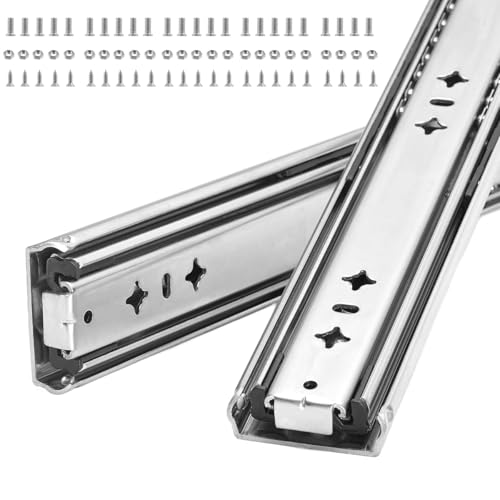
Heavy Duty Commercial Drawer Slides: The Complete Selection Guide
Commercial drawer slides are the unsung backbone of workshop storage, service van shelving, industrial cabinets, and high-use furniture. When a standard residential slide fails under repeated daily load, a heavy duty commercial-grade slide keeps working. This guide explains load ratings, extension types, mounting methods, materials, and locking options so you can specify the right slide for demanding environments with confidence.
What Makes a Drawer Slide "Commercial-Grade"?
The term "commercial-grade" is not a regulated certification, but it reflects a consistent set of engineering priorities. A heavy duty commercial drawer slide is built to survive thousands of open-and-close cycles under substantial loads, often in dusty, vibrating, or temperature-variable environments. The differences from a residential slide show up in three areas: the steel gauge, the bearing system, and the tolerances of the rail geometry.
Commercial slides typically use cold-rolled or stainless steel rails with thicker gauge stock than residential models. The bearing raceways are engineered for higher point loads, and the detent and stop mechanisms are reinforced so the drawer does not creep open under vibration. If you are comparing slide families, it helps to review the broader category of heavy duty drawer slides to see how commercial models sit relative to general-purpose options.
Quick rule of thumb: If the drawer will hold tools, inventory, or equipment and will be opened multiple times per shift, specify a commercial-grade slide. If it holds linens and opens twice a day, a residential slide is sufficient.
Understanding Load Ratings
Load ratings on drawer slides are expressed as a maximum weight per pair, tested under a standardized cycling protocol. A commercial-grade pair commonly starts around 250 lbs and moves upward through the professional-grade range past 500 lbs. The rating assumes an evenly distributed load and a properly aligned installation; an overloaded or misaligned drawer will fail regardless of the slide's stated capacity.
Two practical rules apply when matching a slide to a load. First, add a safety margin of at least 25 percent above your expected working load to account for dynamic forces during opening and closing. Second, remember that load capacity declines as slide length increases, because a longer rail has more leverage against its mounting points. A slide rated for a given load at 24 inches may carry less at 40 inches. For very heavy drawers, review the 500 lbs-rated slide options and confirm the rating at your specific length.
- Essential tier: up to roughly 150 lbs per pair — light commercial and residential use.
- Mid-tier: roughly 150–250 lbs per pair — general workshop and office storage.
- Commercial-grade: roughly 250–400 lbs per pair — service vehicles, retail fixtures, industrial cabinets.
- Professional-grade: roughly 400–500 lbs per pair — heavy tooling, equipment drawers.
- Industrial grade: above 500 lbs per pair — specialized machinery and extreme-load applications.
Extension Types and Travel Distance
Extension describes how far the drawer travels relative to the cabinet. Choosing the wrong extension type is one of the most common specification errors, because it directly affects access to the drawer contents.
Full Extension
A full extension drawer slide allows the drawer to pull out until the back of the drawer box is flush with the cabinet face. This gives complete access to the drawer interior and is the standard choice for commercial storage where every item must be reachable. Full extension slides are available across the entire commercial load range.
Over-Travel and Extra-Long Extension
For deep drawers, an extra-long extension slide pushes the drawer past the cabinet face by one to two inches, making it easier to reach items at the back. These are useful in van shelving and deep workshop drawers where a standard full extension still leaves the rear of the drawer awkward to access. If you need a very long rail, the 72-inch heavy duty slide options are worth reviewing for large-format storage.
Three-Quarter Extension
Three-quarter extension slides are generally not recommended for commercial use, because the back third of the drawer stays inside the cabinet. They appear occasionally in low-use furniture but are a poor fit for equipment and inventory storage.
Materials and Bearing Mechanisms
Two bearing families dominate the commercial market: ball bearing and roller bearing. Each has a distinct trade-off between smoothness and tolerance for debris.
Ball Bearing Slides
Steel ball bearings in a hardened raceway deliver smooth, quiet travel and high load capacity. They are the default for retail fixtures, office furniture, and clean workshop environments. The heavy duty ball bearing slides category covers the most common commercial configuration, with options up to the 500 lbs range and beyond.
Roller Bearing Slides
Roller bearing slides use cylindrical rollers that tolerate dust, grit, and small debris better than ball bearings. They are frequently specified for van shelving, agricultural equipment, and workshop cabinets where cleanliness cannot be guaranteed. The trade-off is that travel is usually a touch less smooth than a comparable ball bearing slide.
Undermount Slides
Undermount full extension slides hide the mechanism beneath the drawer box, producing a cleaner appearance and smoother action. They require precise drawer box dimensions and are less tolerant of field modification, so they are best planned at the cabinet-design stage rather than retrofitted.
Materials and Finishes
Commercial slides use high-grade steel, often with a zinc or zinc-nickel plating, and stainless steel variants for humid or wash-down environments. Look for a rust-proof finish and a reinforced front and rear bracket. The thickness of the steel is a reliable indicator of build quality: commercial-grade rails flex less under load, which directly extends the service life of the bearing system.
Mounting Options: Side, Undermount, and Bottom
Mounting style determines installation complexity and the drawer box dimensions you need to plan for. The three main configurations are side-mount, undermount, and bottom-mount.
Side-Mount Slides
Side-mount slides attach to the sides of the drawer box and the cabinet walls. They are the most straightforward to install and retrofit, which makes them the default for workshop and van applications. The drawer box must be narrower than the cabinet opening by the combined thickness of both slides, typically one inch total. For cabinetry work, the heavy duty cabinet drawer slides and kitchen cabinet drawer slide options cover the most common side-mount configurations.
Undermount Slides
Undermount slides attach beneath the drawer box and are concealed when the drawer is closed. They demand precise box dimensions and are typically installed during cabinet assembly. The payoff is a clean look and a quieter action, which matters in residential and high-end commercial furniture.
Bottom-Mount Slides
Bottom drawer slides support the drawer from below, which is useful for very wide drawers where side-mounted rails would deflect. They are common in under-bed storage and wide equipment drawers.
Locking, Soft-Close, and Self-Closing Features
Feature selection depends on whether the drawer is stationary or mobile, and on how the drawer is used in daily operation.
Locking Slides
For vans, service vehicles, and any installation where a drawer could slide open during transport, heavy duty locking drawer slides are essential. The lock engages when the drawer is closed and releases with a deliberate pull, preventing accidental opening under vibration or on an incline. Related rail-based locking systems are covered under heavy duty locking slide rails.
Soft-Close and Self-Closing
Self-closing slides pull the drawer the final inch to a fully closed position, which keeps drawers flush and reduces the chance of a partially open drawer catching on passers-by. Soft-close dampers add a controlled finish and are increasingly common in retail and hospitality furniture. For commercial workshop use, some users prefer no damper, because grit can degrade the mechanism over time; in that case a simple positive-close slide is the more robust choice.
Pull-Out Platforms
Beyond drawers, heavy duty slides are used to build pull-out platforms for appliances, pantries, and storage bays. The pull-out drawer slide and pull-out pantry slide categories cover the platform-style hardware used in these installations.
Application Guide: Van, Cabinet, Workshop, and More
Different environments stress drawer slides in different ways. Matching the slide family to the application is the fastest route to a reliable installation.
- Service vans and mobile shelving: prioritize locking, vibration resistance, and a load rating with margin. The van drawer slide options are built around these constraints.
- Workshop and tool storage: choose full extension, ball bearing or roller bearing slides with a high cycle rating. Long drawers benefit from the 36-inch and 40-inch length options.
- Retail and office fixtures: appearance and smooth action matter; undermount or side-mount slides with soft-close are common.
- Outdoor and humid environments: specify stainless steel or heavily plated slides, and consider roller bearings for debris tolerance.
- Extreme loads: review the 500 kg-rated slide range for industrial-scale drawers and platforms.
- Compact installations: the 24-inch heavy duty slides and 24-inch slide options suit shallower cabinets and tight van bays.
When planning a full storage build-out, it is also worth reviewing complementary hardware such as drawer handles and, for furniture projects, heavy duty dresser mirror brackets to ensure the whole assembly is specified to the same standard.
Quality Tier Comparison
The table below compares the main quality tiers on the factors that matter most for commercial selection. Use it to align expectations with the application rather than to compare specific products.
| Tier | Typical Load Range | Build Characteristics | Best For |
|---|---|---|---|
| Essential tier | Up to ~150 lbs per pair | Lighter gauge steel, basic ball bearing raceway, limited cycle testing | Light commercial and residential drawers |
| Mid-tier | ~150–250 lbs per pair | Thicker rails, smoother bearing raceway, improved detents | General workshop and office storage |
| Commercial-grade | ~250–400 lbs per pair | Reinforced brackets, high-cycle bearing system, corrosion-resistant finish | Service vehicles, retail fixtures, industrial cabinets |
| Professional-grade | ~400–500 lbs per pair | Heavy gauge steel, precision raceways, extended cycle life | Heavy tooling and equipment drawers |
| Industrial grade | Above 500 lbs per pair | Maximum steel gauge, specialized bearing systems, often stainless options | Machinery, extreme-load platforms, wash-down environments |
Mid-range models usually offer a noticeably smoother mechanism than entry-level slides, while commercial-grade and above add the structural reinforcement needed for daily heavy use. Within a tier, the specification that separates a good slide from a great one is usually the quality of the bearing raceway and the rigidity of the mounting brackets.
Measurement and Installation Essentials
Most premature slide failures trace back to measurement or alignment errors rather than defective hardware. The checklist below covers the essentials for a reliable installation.
- Measure the drawer box depth from front to back; the slide length should match this dimension closely.
- Measure the cabinet opening depth to confirm the slide will not bottom out before the drawer closes.
- For side-mount slides, the drawer box should be narrower than the opening by the combined slide thickness, typically one inch total.
- For undermount slides, confirm the drawer box width and depth against the manufacturer's specification, as clearances are tighter.
- Check level and square before fastening. A slide installed out of level will bind and wear unevenly.
- Use the specified fasteners and engage all mounting holes; commercial slides often rely on bracket reinforcement that is compromised by missing screws.
- Cycle-test the drawer through its full travel before loading it, and re-check alignment after the first week of use.
Safety note: Any drawer that can be pulled fully open creates a tip-over risk for the cabinet. Anchor tall cabinets and mobile units to a wall or floor point, and consider interlock systems for multi-drawer tool cabinets.
Ready to compare specific heavy duty commercial drawer slides for your project? Browse our curated selection of commercial-grade slides organized by load rating, extension type, and mounting style.
Explore Recommended SlidesFrequently Asked Questions
What load rating should I look for in heavy duty commercial drawer slides?
For commercial-grade applications, look for slides rated at 250 lbs or higher per pair. Commercial-grade slides typically range from 250 to 500 lbs, while professional-grade models can exceed 500 lbs for industrial and van applications. Always match the rating to your expected load plus a safety margin of at least 25 percent.
What is the difference between full extension and over-travel drawer slides?
Full extension slides allow the drawer to pull out completely, giving full access to the drawer interior. Over-travel slides extend even further, typically one to two inches beyond the drawer face, which is useful for deep drawers where you need to reach items at the back.
Are locking drawer slides necessary for commercial use?
Locking slides are strongly recommended for mobile applications such as van shelving and service vehicles, and for any commercial setting where drawers must stay secure during transport or when unattended. Heavy duty locking drawer slides typically include a positive lock mechanism that engages when the drawer is closed.
What is the difference between ball bearing and roller bearing drawer slides?
Ball bearing slides use steel balls in a raceway to deliver smooth, quiet motion and high load capacity, making them the standard for commercial-grade applications. Roller bearing slides use cylindrical rollers and are often chosen for their ability to handle debris and dusty environments, though they generally offer slightly less smooth travel at comparable ratings.
How do I measure for replacement heavy duty drawer slides?
Measure the drawer box depth from front to back, the cabinet opening depth, and the drawer box width. The slide length should match the drawer box depth. For side-mount slides, the drawer box must be narrower than the opening by the combined slide thickness. For undermount slides, measure the drawer box width and depth precisely, as clearances are tighter.
Final Selection Checklist
Before ordering, confirm four figures: the load you expect to carry plus a safety margin, the slide length that matches your drawer box depth, the extension type that gives the access you need, and the mounting style your cabinet or drawer box supports. If the installation is mobile, add locking to the requirement list. With those four decisions settled, the quality tier follows naturally, and the slide you choose will hold up to the demands of commercial use rather than merely meeting a residential standard.
For related storage hardware, you may also find our guides to heavy duty kitchen cabinet slides and locking slide rails useful when planning a full cabinet build.