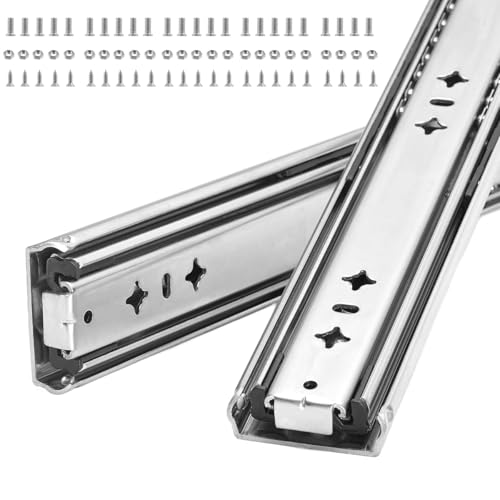
Heavy Duty Locking Slide Rails: The Complete Buyer's Guide
Everything you need to know about heavy duty locking drawer slides — load ratings, locking mechanisms, materials, and how to choose the right rail system for your dresser, cabinet, or storage project.
Explore Recommended ModelsWhy heavy duty locking slide rails matter: A drawer is only as reliable as the rails it rides on. Standard slides can flex, sag, or allow the drawer to slide open unexpectedly under heavy loads. Heavy duty locking slide rails solve these problems by combining reinforced steel construction with a positive locking mechanism that holds the drawer securely in place — whether fully closed, fully open, or both. For anyone storing tools, files, linens, or heavy clothing, upgrading to a locking rail system is one of the most practical improvements you can make.
What Are Heavy Duty Locking Slide Rails?
Heavy duty locking slide rails are precision-engineered drawer slide systems built to support substantial weight while incorporating a locking feature. Unlike standard ball-bearing slides, these rails use thicker steel, reinforced brackets, and a locking lever or tab that engages at specific extension points. The locking action prevents the drawer from rolling open on its own — a critical safety feature for RVs, marine applications, tool chests, and homes with curious children.
These rails are commonly found in industrial workbenches, commercial filing systems, medical cabinetry, and premium bedroom furniture. In a residential setting, they are increasingly popular for wide dressers with deep drawers where heavy items like denim, blankets, or tools are stored. The locking mechanism also makes them ideal for wood chest of drawers for bedroom use where drawers should remain closed during daily movement.
Key Features to Evaluate
When comparing heavy duty locking slide rails, focus on these core characteristics. Each feature directly affects how the rail performs under load and over time.
Load Capacity
The rated weight a pair of rails can support. Entry-level heavy duty rails typically handle around 100–150 lbs per pair, mid-range models 200–250 lbs, and premium/commercial-grade rails 300 lbs or more. Always choose a rating above your expected load for a safety margin.
Locking Mechanism
Look for a positive lock that engages firmly. Some rails lock only in the closed position, while others lock in both open and closed positions (often called "double-locking" or "hold-in/hold-out"). The latter is preferred for RVs and mobile applications.
Extension Type
Full extension slides allow the drawer to pull out completely, giving access to the entire interior. Over-travel slides extend slightly beyond the drawer front, making back corners easier to reach. Both are common on premium heavy duty rails.
Material & Finish
Cold-rolled steel is standard. High-grade steel with zinc plating or a rust-proof coating resists corrosion. For humid or coastal environments, stainless steel rails are the most durable choice. Look for reinforced mounting brackets on top-tier models.
Ball Bearing vs. Roller
Ball-bearing slides offer smoother, quieter operation and better load distribution than roller slides. Most heavy duty locking rails use ball bearings for consistent performance under heavy loads.
Side-Mount vs. Under-Mount
Side-mount rails are visible on the drawer sides and easier to install. Under-mount rails are concealed beneath the drawer for a cleaner look but require precise installation and are less common in heavy duty applications.
Heavy Duty Locking Slide Rails by Tier
To help you navigate the market without relying on figures, here is a tier-based comparison. Each tier reflects a relative position in the market based on construction quality, load rating, and locking sophistication.
| Tier | Typical Load Range | Locking Type | Best For |
|---|---|---|---|
| Entry-Level | 100–150 lbs / pair | Closed-position lock | Light residential drawers, small cabinets, basic storage |
| Mid-Range | 150–250 lbs / pair | Closed-position lock, some with open lock | Bedroom dressers, kitchen cabinets, office storage |
| Premium | 250–350 lbs / pair | Dual-locking (open + closed) | Heavy dressers, tool chests, garage storage, RVs |
| Commercial-Grade | 350+ lbs / pair | Dual-locking with reinforced catch | Industrial workbenches, medical carts, marine, heavy-duty filing |
💡 Pro Tip: A mid-range rail with a higher load rating often outperforms a premium rail with a lower one in real-world use. Always prioritize the load rating and locking type over brand name alone. For wood dressers for bedroom use, a mid-range dual-locking rail is usually sufficient and delivers smooth operation.
How to Choose the Right Heavy Duty Locking Slide Rails
Selecting the right rail system comes down to matching the product to your specific drawer, load, and environment. Follow this checklist to narrow your options.
- Measure your drawer depth and width — rails come in standard lengths (e.g., 12", 14", 16", 18", 20", 22", 24"). The rail length should match the drawer depth for full extension.
- Calculate your maximum load — weigh the drawer and its heaviest expected contents. Add a 20–30% safety margin, then choose a rail rated above that number.
- Decide on locking positions — closed-only locking is fine for stationary furniture. Dual-locking (open + closed) is essential for mobile or tilted applications.
- Check the extension type — full extension for complete access, over-travel for easier back-corner reach. Standard extension is rare on heavy duty models.
- Consider the environment — humid or outdoor settings call for stainless steel or zinc-plated rails with a rust-proof finish. Dry indoor settings can use standard cold-rolled steel.
- Verify mounting style — side-mount is easier to retrofit; under-mount is cleaner but less common in heavy duty configurations. Check that your cabinet framing can support the rail's screw pattern.
- Look for reinforced brackets — premium and commercial-grade rails include thicker mounting flanges that resist flexing under load.
For those building or upgrading furniture, heavy duty locking rails pair well with wooden chest of drawers and wood cabinet with drawers projects where durability is a priority. If you are outfitting a wooden tallboy chest of drawers, choose a rail with a closed-position lock at minimum to prevent drawers from drifting open.
Installation and Maintenance Tips
Proper installation ensures the locking mechanism engages correctly and the load is distributed evenly. Follow these guidelines for a reliable setup.
Installation: Mount the cabinet member to the cabinet side and the drawer member to the drawer side, keeping the rails parallel and level. Use the manufacturer's recommended screws and drive them into solid wood or metal framing — never into particleboard edges without appropriate inserts. Test the locking action before loading the drawer. For wood dresser retrofits, pre-drill pilot holes to avoid splitting the drawer box.
Maintenance: Wipe rails with a dry cloth to remove dust. Apply a light coat of dry lubricant (such as PTFE spray) to the ball bearing track every 6–12 months. Avoid oil-based lubricants that attract dust. Check the locking lever periodically to ensure it engages firmly — a loose lock is a safety hazard, especially in wood chest of drawers for sale listings where the rails may have seen prior use.
⚠️ Safety Note: Never exceed the rated load capacity of the rail pair. Overloading causes premature wear, rail deformation, and can lead to the drawer detaching — a serious risk in wooden storage chest with drawers and tall dressers where heavy items are stored above waist height.
Common Applications for Heavy Duty Locking Slide Rails
These rails are versatile and appear in a wide range of furniture and storage systems. Here are the most common use cases:
Bedroom Dressers
Heavy clothing, linens, and blankets put constant stress on drawer slides. Locking rails keep drawers closed and prevent sagging in women's dresser and wide dresser designs.
Tool Chests & Workbenches
Tools are dense and heavy. Commercial-grade locking rails with dual-locking keep loaded drawers from rolling open on sloped surfaces or during transport.
RV & Marine Cabinetry
Motion during travel requires positive locking. Dual-locking rails prevent drawers from sliding open on the road or at sea, protecting contents and passengers.
Filing & Office Storage
File drawers are heavy and frequently opened. Locking rails add security and stability, especially in wood bureau and office cabinet setups.
Kitchen & Pantry Cabinets
Pots, pans, and canned goods are heavy. Full-extension locking rails give full access to deep cabinets while holding drawers securely closed.
Nursery & Children's Furniture
Locking rails add a layer of safety by preventing drawers from pulling out unexpectedly. Pair with drawer stops for extra protection in wooden changing table with drawers units.
Frequently Asked Questions
What is a heavy duty locking slide rail?
A heavy duty locking slide rail is a drawer slide system engineered to support high loads while providing a locking mechanism that holds the drawer in place, either fully closed, fully open, or both. These rails are commonly used in industrial, commercial, and residential applications where security and load capacity are essential.
What load capacity should I look for in heavy duty locking slide rails?
Load capacity varies by tier. Entry-level heavy duty rails typically support around 100–150 lbs per pair, mid-range models often handle 200–250 lbs, and premium or commercial-grade rails can support 300 lbs or more per pair. Always match the rated capacity to your intended load with a safety margin.
What is the difference between full extension and over-travel slide rails?
Full extension slides allow the drawer to pull out completely, giving access to the entire drawer interior. Over-travel slides extend slightly beyond the drawer's front edge, providing easier access to the back corners of the drawer. Over-travel is often found on premium and commercial-grade rails.
Are locking slide rails suitable for outdoor or humid environments?
Yes, if you choose rails with corrosion-resistant finishes. Stainless steel and zinc-plated steel with a rust-proof coating are good options for humid or coastal environments. For outdoor use, marine-grade stainless steel rails are the most durable choice.
How do I install heavy duty locking slide rails?
Installation generally involves mounting the cabinet member to the cabinet side and the drawer member to the drawer side, ensuring the rails are parallel and level. Most heavy duty rails require screws driven into solid wood or metal framing. Always follow the manufacturer's installation guide and use the recommended fasteners for the intended load.
Final Thoughts
Heavy duty locking slide rails are a smart upgrade for any drawer that carries weight or needs to stay put. By understanding load ratings, locking types, materials, and installation requirements, you can choose a rail system that will perform reliably for years. Whether you are outfitting a wood dresser with black handles, a wood dresser set, or a custom storage project, the right rails make all the difference.
Ready to compare specific models? Browse the recommended heavy duty locking slide rails below, selected for their construction quality and locking reliability across tiers.