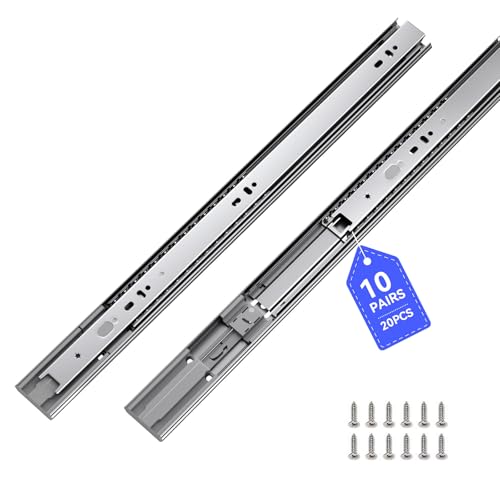
Heavy Duty 24 Inch Drawer Slides: The Complete Buying Guide
Everything you need to know about load capacity, materials, mounting styles, and installation before choosing heavy duty 24 inch drawer slides for your cabinet, workshop, or home project.
Why this guide matters: A drawer slide is the hidden mechanism that determines whether a heavy drawer glides smoothly for years or sags, sticks, and eventually fails. If you are researching heavy duty 24 inch drawer slides, you are likely planning a build, a repair, or an upgrade where reliability is non-negotiable. This guide walks you through the specifications that matter, the trade-offs between slide types, and the practical steps to choose and install the right pair.
What "Heavy Duty 24 Inch" Actually Means
Two numbers define this category: the 24 inch length and the heavy duty rating. The 24 inch figure refers to the closed length of the slide rail, measured from the front of the cabinet or drawer box to the rear mounting point. Because most slides are designed so that the extension roughly matches the closed length, a 24 inch slide typically provides about 24 inches of travel when fully open. This makes it a common fit for medium-to-large drawer boxes used in dressers, base cabinets, workbenches, and storage units.
The "heavy duty" label is less standardized, but it generally signals a slide built to carry significantly more weight than the light-duty slides found in basic furniture. Where a standard drawer slide might be rated around 50 to 100 pounds per pair, heavy duty models are engineered with thicker steel, larger ball bearings, reinforced rails, and more robust mounting brackets. Within this category you will find entry-level heavy duty slides suited to loaded dresser drawers, mid-range models built for kitchen and garage cabinets, and top-tier commercial-grade slides designed for continuous industrial use.
Key takeaway: Always match the slide's load rating to the real-world weight of the loaded drawer, not just the empty drawer box. A drawer full of tools, canned goods, or heavy linens can easily weigh two to three times the empty weight.
Load Capacity: The Most Important Specification
Load capacity is the single most useful number when comparing heavy duty 24 inch drawer slides, but it is also the most misunderstood. Manufacturers typically publish a per-pair rating, meaning the figure assumes both slides are installed correctly and the load is distributed evenly across the drawer box. A slide rated for 250 pounds per pair does not mean each individual rail carries 250 pounds.
Use the following framework to interpret capacity tiers:
- Entry-level heavy duty: Suitable for loaded bedroom dressers, linen drawers, and light workshop storage. These slides handle everyday residential loads well but are not intended for constant heavy cycling.
- Mid-range heavy duty: A solid choice for kitchen base cabinets, garage storage, and utility drawers that see regular use with moderately heavy contents.
- High-end and commercial-grade: Built for industrial cabinets, tool chests, mobile workstations, and drawers that are opened and closed many times per day under substantial loads.
If your drawer contents are near the upper limit of a slide's rating, consider stepping up one tier. A slide operating well within its capacity will run smoother, last longer, and resist sagging far better than one pushed to its maximum. For related heavy-duty specifications, you can compare options in our guide to heavy duty drawer slides.
Ball Bearing vs Roller Bearing Slides
The bearing type is the second major decision point. Ball bearing slides use small steel balls running in tracks to reduce friction, while roller slides use nylon or steel rollers. Each has a place, but they behave very differently under load.
| Feature | Ball Bearing Slides | Roller Bearing Slides |
|---|---|---|
| Operation smoothness | Very smooth, quiet glide | Functional but less refined |
| Load distribution | Excellent, spreads load across many contact points | Good for lighter loads, can wear unevenly |
| Durability under heavy use | High, especially in high-end tiers | Moderate, best for entry-level applications |
| Typical placement | Mid-range to commercial-grade slides | Entry-level and light-duty slides |
| Best for | Heavy drawers, frequent use, quiet operation | Light drawers, occasional use, simple builds |
For most heavy duty 24 inch applications, ball bearing slides are the safer default. They handle heavier loads, run quieter, and hold up better over years of use. If you want a deeper comparison, see our article on heavy duty ball bearing slides.
Mounting Styles: Side-Mount, Undermount, and Bottom-Mount
Mounting style affects installation complexity, drawer box design, and how much of the drawer interior you can use. The three main options for 24 inch slides are side-mount, undermount, and bottom-mount.
Side-Mount Slides
Side-mount slides attach to the outside of the drawer box and the inside of the cabinet. They are the most common and easiest to retrofit, which makes them a popular choice for repairs and DIY upgrades. The trade-off is that the rails occupy space on both sides of the drawer, slightly reducing usable interior width.
Undermount Slides
Undermount slides are hidden beneath the drawer box, giving a clean look with no visible hardware when the drawer is open. They are common in premium cabinetry and often include soft-close features. Installation is less forgiving because alignment must be precise, but the result is a polished appearance and unobstructed drawer sides. For full-extension heavy duty options, see heavy duty undermount drawer slides full extension.
Bottom-Mount Slides
Bottom-mount slides sit under the drawer and are often used in furniture where side clearance is limited. They are less common in heavy duty 24 inch specifications but remain relevant for specific cabinet designs. Our guide to heavy duty bottom drawer slides covers this style in more detail.
Full Extension vs Partial Extension
Extension length determines how far the drawer pulls out. A partial extension slide might open to 75 percent of the drawer's depth, while a full extension slide opens completely, giving access to the entire drawer interior. For heavy duty 24 inch slides, full extension is usually the better choice for several reasons:
- You can reach the back of the drawer without removing it.
- Load is distributed more evenly across the slide when fully open.
- It is essential for deep drawers used for tools, files, or bulky items.
If full access matters, explore heavy duty full extension drawer slides for a wider set of options. Partial extension models still have a place in shallow or lightly loaded drawers where cost and simplicity are priorities.
Materials and Build Quality
The best heavy duty 24 inch drawer slides share a few material characteristics. The rails are typically made from cold-rolled steel, often with a zinc or black oxide coating to resist corrosion. Bearing cages are usually steel or high-grade polymer, and the ball bearings themselves are hardened steel for wear resistance.
When evaluating build quality, look for:
- Rail thickness: Thicker steel resists flexing under load.
- Bearing count and size: More and larger bearings distribute load better.
- Finish: A rust-proof finish matters in garages, kitchens, and humid environments.
- Mounting hardware: Quality screws and brackets prevent loosening over time.
For applications exposed to moisture or heavy use, slides described as having a rust-proof finish or commercial-grade construction are worth prioritizing. You can compare construction details across the broader category in our heavy duty commercial drawer slides overview.
Special Features Worth Considering
Beyond the basics, several features can make a meaningful difference depending on how the drawer will be used:
- Soft-close mechanism: Drawers glide shut gently, reducing slam noise and wear. See heavy duty self-closing drawer slides for options that combine soft-close with heavy load ratings.
- Locking mechanism: Useful for tool cabinets, commercial storage, and drawers that need to stay closed during transport. Our guide to heavy duty locking drawer slides covers the key considerations.
- Disconnect lever: Lets you remove the drawer without tools for cleaning or reorganization.
- Over-travel: Some slides extend slightly beyond full extension, improving access to the rear of the drawer.
How to Choose the Right Pair for Your Project
With the specifications clear, use this step-by-step approach to narrow your options:
- Measure the drawer depth. Confirm that a 24 inch slide fits your cabinet and drawer box. The closed length must match the available mounting depth.
- Estimate the loaded weight. Weigh or estimate the drawer contents, then choose a slide rated comfortably above that figure.
- Decide on extension. Choose full extension if you need complete access; partial extension is acceptable for shallow, lightly loaded drawers.
- Choose a mounting style. Side-mount for easy retrofits, undermount for a clean look, bottom-mount for specific cabinet designs.
- Select the bearing type. Ball bearing is the default for heavy duty use; roller bearing is acceptable for lighter loads.
- Check the finish and hardware. Prioritize corrosion resistance for kitchens, garages, and humid climates.
If you are still comparing overall categories, the broader heavy duty drawer slides guide provides context for how 24 inch models fit alongside other lengths and ratings. For dimension-specific comparisons, you can also review heavy duty drawer slides 24 inch options.
Installation Tips for Heavy Duty 24 Inch Slides
Correct installation is as important as the slide itself. A premium pair of slides will underperform if the drawer box is out of square or the rails are misaligned. Follow these practical steps:
- Check the drawer box. Ensure it is square and sturdy. Heavy loads demand a rigid box, not a flimsy one.
- Use the manufacturer's template. Most slides include a paper or plastic template for screw hole placement. Use it.
- Pre-drill screw holes. This prevents splitting, especially in engineered wood or hardwood drawer boxes.
- Mount the cabinet rail first. Level and secure it before attaching the drawer rail.
- Test alignment before final tightening. Open and close the drawer several times, then tighten all screws once movement is smooth.
- Check the disconnect mechanism. Confirm you can remove and reinstall the drawer easily after installation.
For cabinet-specific installation notes, see heavy duty cabinet drawer slides and heavy duty kitchen cabinet drawer slides.
Common Mistakes to Avoid
Even experienced builders run into the same issues with heavy duty 24 inch drawer slides. Watch for these:
- Underestimating loaded weight. The most common cause of premature slide failure.
- Mixing slide brands or models on one drawer. Always use a matched pair.
- Ignoring drawer box rigidity. A weak box will flex and bind even on excellent slides.
- Over-tightening screws. This can distort the rail and cause binding.
- Skipping the test cycle. Open and close the drawer repeatedly before declaring the installation complete.
Frequently Asked Questions
What does 24 inch refer to on heavy duty drawer slides?
The 24 inch measurement refers to the closed length of the slide, which also corresponds to the maximum extension when the slide is fully open. It is measured from the front of the cabinet to the rear mounting point.
What load capacity should I look for in heavy duty 24 inch drawer slides?
Most heavy duty 24 inch slides support between 100 and 500 pounds per pair. For standard bedroom or kitchen drawers, a mid-range load rating is sufficient. For workshop, garage, or commercial applications, choose slides rated for the higher end of the category.
Are ball bearing slides better than roller slides?
Ball bearing slides generally offer smoother operation, quieter movement, and better load distribution than roller slides. Roller slides are simpler and often found in entry-level applications. For heavy duty use, ball bearing slides are typically the preferred choice.
Can I install heavy duty 24 inch drawer slides myself?
Yes, most side-mount and undermount slides can be installed with basic tools including a drill, screwdriver, and measuring tape. Full extension and locking models may require additional alignment steps. Always follow the manufacturer's template and instructions.
Ready to Compare Heavy Duty 24 Inch Drawer Slides?
Explore curated options below, then match load rating, extension, and mounting style to your project for a long-lasting, smooth-gliding result.
View Recommended Slides