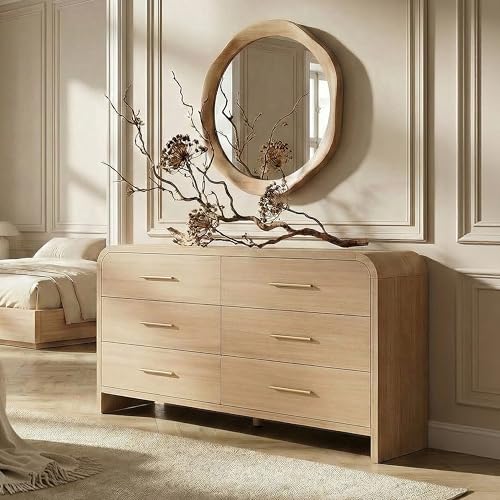
Curved Dresser: The Complete Guide to Soft-Edge Bedroom Storage
Discover why curved dressers are redefining modern bedroom design. From gentle bowed fronts to sculpted silhouettes, learn how to choose, style, and invest in a curved dresser that combines elegance with everyday function.
Explore the Buying GuideWhy curved dressers deserve your attention: Straight lines will always have their place, but a curved dresser introduces a soft, organic rhythm that instantly warms a bedroom. Whether you are furnishing a compact apartment or upgrading a primary suite, understanding the nuances of curved construction, drawer mechanics, and finish quality will help you choose a piece that looks refined and serves you for years. This guide walks you through every decision point.
On This Page
What Is a Curved Dresser?
A curved dresser is a storage chest whose front, sides, or entire body feature gentle arcs, bowed profiles, or serpentine contours rather than flat planar surfaces. The curvature can be subtle — a slight bow across the drawer fronts — or dramatic, with a fully sculpted silhouette that resembles a piece of contemporary sculpture. This design approach softens the visual weight of a large storage piece and introduces a welcoming, tactile quality that flat-front dressers rarely achieve.
Curved dressers appear across many furniture traditions. French provincial and Rococo designs used serpentine fronts to convey refinement; Art Deco makers experimented with streamlined curves; and today's modern curved dressers often feature softly rounded corners, pill-shaped drawer pulls, and continuous curved profiles that feel calm and architectural. If you are comparing shapes, our guide to classic dresser styles helps situate curved designs within the broader furniture landscape.
The appeal is not only aesthetic. Rounded edges reduce the risk of sharp impacts in tight bedrooms, and curved drawer fronts can make the piece feel less imposing in a compact room. Many shoppers exploring compact dresser options find that a gently bowed design fits more comfortably into narrow circulation paths than a deep rectangular chest.
Curved Dresser Design Styles
Curvature is a design language, and different styles use it in distinct ways. Understanding these categories helps you narrow your search and communicate your preferences clearly.
1. Modern & Contemporary Curved Dressers
Contemporary curved dressers favor clean, uninterrupted surfaces. Drawer fronts may bow gently across their entire width, with integrated or minimalist hardware. Rounded corners and softened edges are standard. These pieces often pair well with a contemporary dresser and nightstand set for a cohesive bedroom scheme. Look for flush-mounted drawers and subtle shadow gaps rather than protruding pulls.
2. French Provincial & Serpentine Fronts
Traditional French designs use serpentine or bombe curves — the front swells outward at the center and recedes at the edges. These dressers typically feature ornate hardware, carved detailing, and cabriole legs. A serpentine front adds visual movement and has been a hallmark of refined bedroom furniture for centuries. Our overview of classic dresser construction covers related traditional joinery and detailing.
3. Scandinavian & Organic Modern
Scandinavian-influenced curved dressers emphasize natural wood grain, soft radii, and understated forms. The curvature is often gentle, echoing the organic shapes found in Danish and Japanese design. These pieces work beautifully in calm, minimal bedrooms and pair naturally with Danish dresser aesthetics. Expect light oak or walnut finishes with oiled or matte surfaces.
4. Art Deco & Streamline Moderne
Art Deco curved dressers use bold geometry softened by sweeping arcs. Look for stepped profiles, glossy finishes, and metallic accents. The curvature here is architectural — often a continuous band that wraps around the piece — rather than a subtle drawer bow.
5. Sculptural & Statement Pieces
Some curved dressers are designed as focal points: undulating bodies, asymmetrical profiles, or organic shapes that blur the line between furniture and sculpture. These are typically high-end or designer pieces where the form is as important as the storage function. If you are drawn to statement furniture, explore designer dresser options for related ideas.
Materials & Construction of Curved Dressers
Curved forms place different demands on materials and joinery than flat-front construction. Understanding what to look for helps you assess quality and longevity.
Solid Wood Curved Dressers
Solid wood is the benchmark for durability and repairability. Curved drawer fronts are typically shaped from solid stock using CNC machining or steam bending, depending on the radius and thickness. Oak, walnut, maple, and cherry are common choices. A solid wood curved dresser represents a long-term investment — it can be sanded and refinished if the surface dulls. Our guide to oak dressers and walnut dressers explores the character of these woods in more detail.
Engineered Wood & Veneer
Many mid-range curved dressers use engineered wood cores with veneered surfaces. Veneer allows makers to achieve consistent curves and attractive grain patterns at a lower material cost. Quality veneered dressers can be durable, but check that edges are well-sealed and that the veneer is thick enough to resist lifting. Avoid pieces where the curvature is achieved through thin, poorly supported panels.
Joinery & Drawer Construction
Curved drawer boxes require precise joinery. Dovetail joints remain the gold standard for drawer corners, though high-quality box joints or reinforced rabbet joints are also acceptable in mid-tier pieces. Drawer bottoms should be set in grooves rather than stapled. For curved fronts, the drawer box itself is usually rectangular, with the curved face attached as a separate front panel — check that this attachment is secure and flush.
Glides & Hardware
Drawer glide quality dramatically affects daily use. Entry-level curved dressers often use side-mounted roller glides; mid-range and premium pieces typically use under-mount ball-bearing glides with soft-close mechanisms. Soft-close is especially valuable on curved drawers because the front-heavy geometry can cause harder closing if the glide is low quality. Our dresser quality guide covers glide types and testing methods in detail.
Construction Checklist for Curved Dressers
✓ Drawer fronts feel solid with no flex when pressed at the center of the curve.
✓ Drawers open and close smoothly across their full travel — no binding at the edges.
✓ Curved edges are smoothly sanded with consistent radius and no rough seams.
✓ Veneer seams (if present) are tight and aligned with the grain direction.
✓ Back panel is securely attached and the piece does not rack or wobble.
✓ Anti-tip hardware is included or available.
Storage & Drawer Configuration
Curved dressers are available in a range of drawer counts and interior layouts. The curve itself does not significantly reduce usable drawer volume, but it does influence how the piece feels in a room and how you organize it.
Common Drawer Counts
- 3-drawer curved dressers: Often wider and shallower, suitable for folded clothing and accessories. Good for smaller bedrooms or as a secondary storage piece.
- 4- to 5-drawer curved dressers: The most common configuration. Typically one or two smaller top drawers for delicates and three larger drawers below for clothing.
- 6- to 8-drawer curved dressers: Larger capacity for couples or wardrobes with extensive folded storage. Often taller and deeper.
If you need maximum capacity in a curved format, look at tall configurations — our guide to tall dressers explains how vertical storage can fit into compact footprints. For shared bedrooms, a couples dresser with split drawer layouts may be worth considering.
Interior Organization
Curved drawer fronts do not change the interior box shape, so standard organizers work well. Consider clothes drawer dividers to keep folded items upright, and clothing drawer organizers for smaller items. For a full system, our dresser organization guide walks through compartment planning step by step.
Specialty Configurations
Some curved dressers include felt-lined top drawers for jewelry or watches, cedar-lined bottom drawers for seasonal storage, or integrated charging outlets. If you are converting a dresser for a different room, our guide to converting a dresser into a bathroom vanity shows how curved pieces can be adapted — though curved fronts require more careful plumbing planning than flat-front units.
Curved Dresser Buying Guide
Buying a curved dresser involves a few considerations that do not apply to standard rectangular pieces. Use this framework to make a confident decision.
Step 1: Measure Your Space Carefully
Curved dressers can have a deeper footprint than their nominal dimensions suggest, because the center of the curve projects forward. Measure the maximum depth at the widest point, not just the side panel depth. Allow at least 30 inches (76 cm) of clearance in front of the dresser for comfortable drawer access. If your room is tight, explore small dresser options or consider a corner dresser configuration.
Step 2: Choose Your Curvature Level
Decide whether you want a subtle bow, a pronounced serpentine front, or a fully sculpted body. Subtle curves are easier to integrate into existing furniture arrangements; dramatic curves demand more visual breathing room. If your bedroom already has strong architectural features, a gentle curve may harmonize better than a bold statement piece.
Step 3: Assess Drawer Mechanics
Test the drawers in person if possible. Curved fronts can amplify any binding in the glide system because the weight distribution differs from flat fronts. Look for full-extension glides, soft-close dampers, and smooth operation across the full travel. If shopping online, read reviews that specifically mention drawer smoothness and alignment.
Step 4: Evaluate Finish & Edge Quality
Curved surfaces show finish quality more readily than flat ones. Look for consistent sheen, smooth transitions at radius points, and well-sealed edges. Painted curved dressers should have even coverage with no thin spots on the curves. For wood finishes, check that the grain follows the curve naturally rather than being cut off awkwardly. Our guides to white dressers and natural wood dressers cover finish expectations in more detail.
Step 5: Confirm Safety Features
All dressers should include or support anti-tip hardware. Curved dressers can have a higher center of gravity if the upper drawers project forward, so secure anchoring to the wall is especially important. This is non-negotiable in homes with children — our children's dressers guide covers safety standards in depth.
Step 6: Match Your Bedroom Aesthetic
Curved dressers suit a wide range of interiors, but they are particularly effective in rooms with soft textures, rounded mirrors, and organic accents. If your bedroom leans industrial or ultra-minimal, a gently bowed piece can add welcome warmth without disrupting the scheme. Explore bedroom dresser ideas for placement inspiration.
| Tier | Typical Construction | Drawer Glides | Best For |
|---|---|---|---|
| Entry-level | Engineered wood with veneer; glued and stapled joinery | Side-mounted roller glides | Guest rooms, temporary setups, light use |
| Mid-range | Engineered wood core with quality veneer; box or reinforced joints | Under-mount ball-bearing glides, some soft-close | Primary bedrooms, daily use, balanced tier |
| Premium | Solid wood fronts and frames; dovetail drawers | Full-extension soft-close under-mount glides | Long-term use, refined bedrooms, high-end tier |
| Luxury | Solid hardwood throughout; hand-finished curves; custom joinery | Premium soft-close systems with precision alignment | Statement bedrooms, collector-grade furniture |
Styling & Placement Tips for Curved Dressers
A curved dresser is a natural focal point, so styling should enhance rather than compete with its silhouette.
Placement Principles
- Give it breathing room: Curved pieces look best when there is visible space around the arc. Avoid pushing the dresser tight against a side wall if the curve wraps around.
- Anchor with a mirror: A round or arched mirror above a curved dresser echoes the shape and adds light. See our dresser mirror ideas for pairing suggestions.
- Consider symmetry lightly: Perfect symmetry can feel rigid against a curved form. Offset a lamp or plant slightly to let the curve read as intended.
- Use a rug to define the zone: A soft rug under the dresser visually grounds the piece and complements the organic lines.
Décor That Complements Curves
Choose accessories with rounded forms — ceramic vases, woven baskets, circular trays, and sculptural lamps. Avoid overly angular décor that fights the dresser's soft geometry. If you are styling a minimalist dresser top, let one or two curved objects carry the visual weight. For a warmer look, our farmhouse dresser decor ideas can be adapted with softer accessories.
Lighting
A table lamp with a rounded shade or a sculptural sconce placed near the dresser enhances the curved theme. Avoid harsh downlighting directly above the piece, which can flatten the curvature. For more lighting ideas, see our dresser lighting guide.
Curved vs. Standard Dressers: What's the Difference?
Both curved and flat-front dressers provide essential bedroom storage. The choice comes down to spatial context, aesthetic preference, and how much visual softness you want in the room.
- Visual impact: Curved dressers create a softer, more organic focal point; flat-front dressers read as clean and architectural.
- Space efficiency: Flat-front dressers are easier to fit flush against walls and furniture. Curved fronts project slightly at the center, which can affect clearance in tight rooms.
- Safety: Curved edges are more forgiving in high-traffic bedrooms and rooms shared with children.
- Construction complexity: Curved forms require more precise joinery and finishing; expect higher quality thresholds at each tier.
- Styling flexibility: Curved dressers pair naturally with organic, Scandinavian, French provincial, and contemporary schemes; flat-front pieces suit industrial, ultra-modern, and traditional styles equally well.
Neither is inherently superior. If you are comparing storage piece types more broadly, our article on chest of drawers explains the distinctions between dressers, chests, and tallboys.
Ready to Find Your Curved Dresser?
Browse our curated selection of curved dressers and storage pieces. Each recommendation is chosen for construction quality, drawer performance, and design longevity.
View Curved Dresser OptionsFrequently Asked Questions About Curved Dressers
A curved dresser softens the visual weight of bedroom storage and introduces an organic, welcoming shape. The absence of sharp edges also makes it a safer choice in tight circulation areas or rooms shared with children. Many people find that curved forms feel more relaxed and less imposing than large rectangular chests.
Not at all. The interior drawer box of a curved dresser is typically rectangular, so standard dividers and organizers fit normally. The only difference is the drawer front's shape, which does not affect interior capacity or layout. You can organize a curved dresser exactly as you would a flat-front piece — see our dresser organization guide for a step-by-step system.
It depends on the curve depth. A subtle bow adds only a small amount of forward projection, while a pronounced serpentine or bombe front can project several inches further than the side panels suggest. Always measure the maximum depth at the widest point of the curve. If space is limited, a gently curved compact dresser or a corner dresser configuration may be a better fit.
Solid wood offers the greatest durability and repairability, particularly for the drawer fronts where the curve is most visible. Quality veneered engineered wood is a common mid-tier choice and can perform well if edges are sealed and the core is dense. For a long-term investment, prioritize solid wood construction in the drawer fronts and a sturdy frame — our dresser quality guide explains what to inspect.
Yes, provided you choose the right scale. A gently curved dresser with a shallow profile can actually make a small room feel more open because the softened edges reduce visual bulk. Avoid highly sculpted statement pieces in very tight spaces; a subtle bow or rounded-corner design will integrate more easily. See our small bedroom storage ideas for layout guidance.
Dust with a soft microfiber cloth, following the curve rather than pressing across it. For wood finishes, use a mild wood cleaner and avoid silicone-based polishes that can build up on curved surfaces. Painted curved dressers should be wiped with a damp cloth and dried immediately. Avoid abrasive cleaners on veneered edges, where moisture can cause lifting. Our how to clean a dresser guide covers safe routines for different finishes.
Continue Exploring Dresser Knowledge
If you are still refining your shortlist, these related guides can help: compare dresser vs chest of drawers, understand solid wood vs engineered wood, or explore dresser sizing before you commit. For room-specific inspiration, browse room ideas and bedroom storage collections.