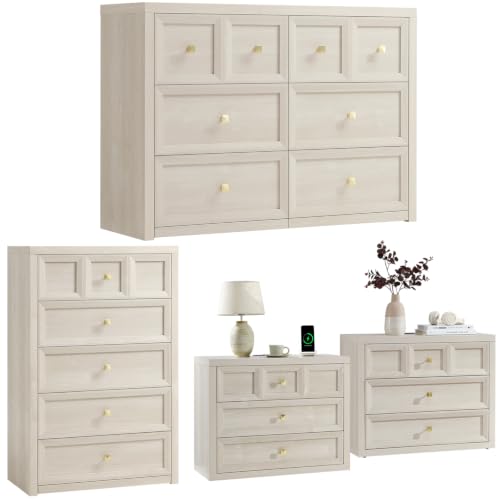
Bedroom Sets with Large Dressers
Everything you need to evaluate large-dresser bedroom sets — drawer capacity, layout, materials, and room fit — so you can decide with confidence before you buy.
JUMP TO DECISION GUIDEWhy this guide exists: If you are searching for a bedroom set with a large dresser, you already know the storage piece matters most. What is harder is comparing sets fairly — how many drawers you actually get, whether the layout fits your wardrobe, and how the set will hold up over years of daily use. This guide walks you through each of those questions in plain language.
What "Large Dresser" Really Means in a Bedroom Set
In the furniture market, "large dresser" is used loosely. Before comparing sets, it helps to fix a working definition. A dresser in a bedroom set is generally considered large when it offers substantial horizontal width, deep drawer boxes, and a high usable capacity — not merely a tall silhouette. A tall, narrow piece is usually classified as a chest of drawers, which is a different storage profile entirely.
When you evaluate bedroom sets with large dressers, look for these three signals:
- Width and drawer run: A wide dresser gives you long drawers that accommodate folded items, linens, or shared storage between partners.
- Drawer depth: Deep drawers are the difference between a set that holds a full wardrobe rotation and one that only holds the essentials. Sets built around big dressers with deep drawers are a practical reference point for what "large" should mean.
- Total drawer count: Six to nine drawers is common in large dressers, but the usable volume matters more than the count alone.
A quick distinction worth knowing
A large dresser and a chest of drawers serve different purposes in a bedroom. If your set includes both, you get a wide folding-and-sorting surface plus a tall stack of smaller, easily organized drawers. If you are weighing one against the other, our comparison of dresser versus chest layouts is a useful starting point before choosing a set.
Why Buy a Complete Set Instead of a Standalone Dresser
A complete bedroom set with a large dresser solves a coordination problem. When you buy the dresser, nightstands, and bed together, the finish, hardware, and proportions are designed to work as a unit. That matters more than it sounds — mismatched wood tones and hardware are one of the most common regrets in bedroom furnishing.
The practical benefits of a coordinated set include:
- Visual cohesion: Consistent finish, hardware style, and edge profiles across every piece.
- Proportional harmony: Nightstand height and dresser height are designed relative to the bed, which keeps the room feeling balanced.
- Simpler sourcing: One purchase, one delivery, one assembly process.
- Resale and replacement: Sets are easier to match later if you need to add a piece.
If you prefer a narrower configuration, a bedroom set with a dresser and a single nightstand keeps the matching advantage while taking up less floor space. For larger rooms or shared bedrooms, a set with dressers and nightstands gives each side of the bed its own surface and storage.
Common Large-Dresser Set Configurations
Bedroom sets with large dressers usually fall into a handful of layouts. Understanding the configuration first makes the rest of the comparison much faster.
| Configuration | What's Included | Best For |
|---|---|---|
| Dresser + one nightstand | One large dresser, one bedside table | Single sleepers, smaller primary bedrooms, guest rooms |
| Dresser + two nightstands | One large dresser, two matching bedside tables | Couples, symmetric bedroom layouts |
| Dresser + mirror | Large dresser with attached or coordinating mirror | Rooms without a separate vanity or full-length mirror |
| Dresser + chest of drawers | Wide dresser plus a tall chest | High storage volume, shared wardrobes, larger rooms |
| Dresser + chest + nightstands | Full storage package | Primary bedrooms where clothing storage is the priority |
Each configuration has a dedicated deep dive if you want the detail. The dresser and two nightstands layout is the most common for couples. If a mirror is important to your routine, explore dresser-with-mirror sets. And if you need maximum capacity, a set pairing a dresser with a chest gives you two distinct storage profiles in one coordinated finish.
Sizing a Large Dresser Set to Your Room
The most common mistake with large-dresser sets is buying for storage capacity without checking circulation space. A dresser that fills an entire wall can make a room feel cramped and make drawers awkward to open fully.
Work through these measurements before you commit:
- Wall length: Measure the wall where the dresser will sit. Leave breathing room on at least one side unless the piece is deliberately built-in.
- Drawer clearance: Confirm the dresser can be positioned so every drawer opens fully without hitting a bed, door, or wall.
- Walking path: Keep a clear path between the foot of the bed and the dresser face.
- Door swing: Check closet and room doors do not collide with the dresser or its open drawers.
- Height relative to the bed: A dresser used as a surface should sit comfortably relative to mattress height for daily use.
If the room is on the smaller side, our guide to dressers for small spaces explains how to get meaningful storage without overwhelming the floor plan. Sets built around a big dresser are best reserved for rooms that can genuinely accommodate the footprint.
Storage profile comparison
There is a meaningful difference between a wide dresser and a tall chest. A wide dresser spreads storage horizontally and gives you long drawers suited to folded clothing and linens. A tall chest stacks smaller drawers vertically, which suits accessories and items you want separated. Many large-dresser sets combine both. Our overview of bedroom sets with a chest of drawers covers when the taller profile earns its place.
Materials and Build Quality: What Separates Tiers
Two dressers can look identical in a listing photo and behave very differently after three years of use. The difference is in the construction, and it maps to broad quality tiers rather than any single specification.
| Tier | Typical Construction | What to Expect |
|---|---|---|
| Entry-level | Engineered wood panels, basic drawer glides | Adequate for light use and guest rooms; simpler joinery and hardware |
| Mid-range | Wood veneers over engineered cores, improved glides | Smoother drawer operation and more consistent finishes; a balanced choice for daily use |
| Premium | Solid wood frames with veneer panels, quality hardware | Greater stability, better weight handling, and refinishable surfaces |
| Luxury | Solid hardwood construction, dovetail joinery, soft-close hardware | Long-term investment pieces with the most refined fit and finish |
At every tier, the indicators that matter most are the same:
- Drawer joinery: Dovetail joints signal a more durable drawer box than stapled or glued construction.
- Drawer bottoms: A reinforced bottom panel resists sagging under heavier loads.
- Glides and runners: Smooth, consistent extension is a sign of better hardware; soft-close mechanisms are a comfort upgrade.
- Finish consistency: Even color and grain across all pieces in the set indicates controlled finishing.
- Back panels and dust boards: A finished or reinforced back panel is a useful durability signal.
Finish and material choices also shape the room's character. Sets in natural wood tones tend to age gracefully; painted finishes hide wear differently. If you are drawn to a specific material, our guides to dresser materials and finishes and solid wood versus engineered construction expand on the trade-offs.
Matching the Set to Your Bedroom Style
Style is where most buyers have the strongest instinct — and where the largest dresser can either anchor a room or dominate it. The safest approach is to let the dresser's visual weight guide the decision, because it is usually the largest storage piece in the room.
Clean lines, flat fronts, and restrained hardware work best. Sets with handleless or slim-bar hardware keep a large dresser from feeling heavy.
Planked details, visible grain, and warmer hardware tones suit these spaces. A large dresser in a farmhouse finish can serve as the room's focal point.
Moulded edges, framed drawer fronts, and classic hardware give a large dresser a more formal presence, which pairs well with upholstered beds.
In compact bedrooms, a visually lighter finish and a narrower drawer run help a large-capacity dresser feel less imposing. Our small bedroom storage ideas covers layout tactics for these rooms.
If you want inspiration beyond the set itself, the dresser styling tips guide explains how to dress the top surface without cluttering it — a detail that noticeably changes how large a dresser looks in a room.
Drawer Layout and Everyday Usability
Drawer count is the specification most buyers fixate on, but layout is what determines whether a dresser actually works for you. Two large dressers with eight drawers each can serve completely different wardrobes depending on how those drawers are proportioned.
Consider these layout patterns:
- Equal rows: Consistent drawer heights throughout — flexible, but less specialized.
- Deep bottom drawers: Shallow drawers up top for accessories, deep drawers below for folded clothing or linens.
- Split or double-wide: Two narrower drawers side by side, which helps partners divide storage.
- Jewelry or accessory drawer: A lined top drawer is a useful addition for smaller items.
Deep drawers are the most requested upgrade in large-dresser sets, and for good reason. For a detailed look at how depth changes usable capacity, see big dressers with deep drawers. If you are organizing an existing dresser, the drawer organization ideas guide covers dividers and folding methods that make large drawers easier to maintain.
Matching Additional Pieces Within the Set
One advantage of buying a set is that additional pieces share the same design language. That matters most when you expand the set later or when a specific configuration is not available as a bundle.
If you want a bedside table that matches but are sourcing separately, bedside cabinets with drawers and bedside dressers both work as coordinating companions, provided the finish and hardware match closely. When the bedside piece needs more storage than a standard nightstand, a bedside table and chest of drawers pairing is a practical alternative.
Finish matching is easier in some palettes than others. Neutral sets are the most forgiving to extend — a beige dresser pairs with a wide range of wall colors and bedding, and a beige dresser and nightstand set illustrates how cohesive a neutral palette looks across pieces. Darker palettes are similarly versatile: black dresser and nightstand sets and black bedroom sets both demonstrate how a consistent dark finish unifies a room.
A Practical Buying Checklist
Before you commit to any bedroom set with a large dresser, run through this list. It catches the issues that are hardest to fix after delivery.
- Measure twice: Wall length, drawer clearance, door swing, and walking paths.
- Confirm drawer depth, not just count: Ask for internal drawer dimensions where available.
- Check the joinery: Look for dovetail construction and reinforced drawer bottoms at higher tiers.
- Verify hardware quality: Smooth glides and soft-close mechanisms are worth prioritizing.
- Review the full set: Confirm every included piece shares the same finish and hardware.
- Plan assembly: Sets typically ship flat-packed; check whether assembly service is offered.
- Check safety features: Anti-tip hardware is essential for tall or heavily loaded dressers.
- Confirm return terms: Large furniture returns are costly; understand the policy before ordering.
Where sets are usually compared
Buyers evaluating complete sets often look at three tiers: entry-level sets that cover the basics, mid-range sets that improve drawer hardware and finish consistency, and premium or luxury sets built around solid wood construction. Our overview of the best dresser sets organizes the category by these tiers, and luxury dressers covers the top end of the market in more detail.
Decision Guide: Which Large-Dresser Set Fits Your Situation
| Your Situation | Recommended Configuration | Priority Feature |
|---|---|---|
| Couple sharing a primary bedroom | Dresser + two nightstands | Split or double-wide drawer layout |
| Single sleeper with a large wardrobe | Dresser + one nightstand | Deep bottom drawers |
| Room without a separate mirror | Dresser with mirror | Coordinating mirror frame and finish |
| Maximum storage needed | Dresser + chest of drawers | Combined horizontal and vertical storage |
| Guest room or secondary bedroom | Dresser + one nightstand | Entry-level or mid-range construction |
| Long-term primary bedroom investment | Full set, premium or luxury tier | Solid wood construction and dovetail joinery |
If you are still deciding between a large dresser and a smaller footprint, the dresser size guide walks through the measurements in more depth. And if the room has competing storage needs, the broader bedroom storage section covers how dressers, chests, and closets fit together as a system.
Frequently Asked Questions
How many drawers should a large dresser in a bedroom set have?
Most large dressers in coordinated sets offer six to nine drawers. The count is less important than the layout — deep bottom drawers and a mix of drawer heights usually serve a full wardrobe better than a uniform stack of shallow drawers.
Is a large dresser or a chest of drawers better for a bedroom set?
They serve different needs. A large dresser spreads storage horizontally with long drawers suited to folded clothing and linens. A chest stacks smaller drawers vertically, which suits accessories and separated items. Many buyers choose a set that includes both.
What size room suits a bedroom set with a large dresser?
The room needs enough wall length for the dresser plus clearance for fully opening drawers, and a clear walking path between the bed and the dresser. Measure drawer clearance and door swing before ordering, especially in compact rooms.
What construction details indicate a higher-quality set?
Dovetail drawer joinery, reinforced drawer bottoms, smooth or soft-close glides, and solid wood frames are the strongest indicators. Finish consistency across all pieces in the set is another useful signal of controlled manufacturing.
Can I add pieces to a bedroom set later?
Yes, provided the set remains in production and you match the finish and hardware exactly. Coordinating bedside pieces such as bedside cabinets with drawers or bedside dressers are the most common additions, but finish matching is easier in neutral palettes.
Do large dressers need anti-tip hardware?
Yes. Tall or heavily loaded dressers should always be secured to the wall with anti-tip hardware, regardless of the set's quality tier. This is a standard safety requirement for bedroom furniture.
Final Thoughts
A bedroom set with a large dresser is a long-term purchase, and the decisions that matter most are unglamorous: drawer depth, joinery quality, hardware smoothness, and room fit. Get those right and the set will serve you well for years. Get them wrong and no finish or style will make up for it.
Use the decision guide above to narrow your configuration first, then compare sets within that configuration by construction tier. If you want to see how specific pieces compare before committing to a full set, the buying guides section covers individual dresser categories in detail.