Bedroom Sets: Dressers and Nightstands Buying Guide
Everything you need to choose a coordinated bedroom set with a dresser and nightstands — sizing, style matching, storage planning, and material decisions explained in plain language.
Why this guide matters: A matched dresser-and-nightstand set does more than fill a room — it anchors the layout, simplifies storage planning, and keeps the visual language of your bedroom consistent. This guide walks you through the decisions that actually affect daily use, so you can choose a set that fits your room, your routines, and your long-term expectations.
What Defines a Bedroom Set With Dresser and Nightstands?
A bedroom set with dressers and nightstands is a coordinated group of storage furniture designed to work together. At minimum, the set includes a dresser and one or two nightstands; many collections also add a mirror, a chest of drawers, or a bed frame. Buying these pieces as a set offers practical advantages: finishes match exactly, hardware is consistent, proportions are designed to sit well together, and you avoid the trial-and-error of mixing brands.
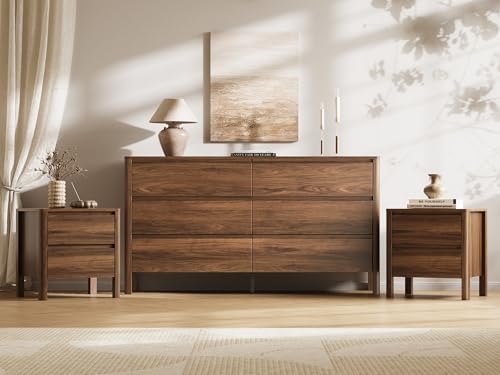
The most common configurations are a dresser paired with two nightstands for a primary bedroom, or a dresser with a single nightstand for smaller rooms and guest spaces. If you are comparing configurations, the dresser and nightstand set page covers the two-piece layout, while the dresser with two nightstands guide explains the symmetrical arrangement used in most primary bedrooms.
It also helps to understand what each piece contributes. The dresser handles folded clothing, linens, and accessories. The nightstands hold the items you need within arm's reach — a lamp, a book, a glass of water, a phone charger. When these two storage roles are planned together, the bedroom stays functional without extra clutter.
Why Buy a Coordinated Set Instead of Mixing Pieces?
Mixing furniture is a legitimate design choice, but it requires more effort to get right. A coordinated set removes several layers of friction:
- Finish consistency: Wood tones and paint colors are produced in the same batch and finish process, so the dresser and nightstands read as one unit rather than near-matches that clash under natural light.
- Proportional harmony: Manufacturers design the dresser and nightstands to relate to each other in height, depth, and drawer rhythm. A nightstand that is noticeably taller or deeper than the dresser top can look accidental.
- Hardware continuity: Drawer pulls, knobs, and legs share a design language, which makes the room feel intentional.
- Simpler purchasing and delivery: One order, one delivery window, and one set of assembly instructions reduce the logistics of furnishing a bedroom.
- Easier future expansion: If you later want to add a matching chest or mirror, collections usually offer companion pieces that fit the same visual system.
That said, a set is only an advantage when the pieces fit your room. The rest of this guide focuses on making that fit decision correctly.
How to Match Dresser and Nightstand Sizes to Your Room
Size mismatches are the most common reason a bedroom set feels awkward after delivery. The goal is a balanced visual weight: the dresser should be the dominant storage piece, and the nightstands should support it without competing.
Dresser Sizing Basics
A dresser should generally be wider than it is tall for a bedroom set, because a low, wide profile keeps sightlines open and provides a usable surface. Common width bands are roughly 40–50 inches for smaller rooms, 55–65 inches for standard primary bedrooms, and 70 inches or more for large spaces. Depth usually falls between 16 and 20 inches; anything deeper starts to intrude on walking space. If your room is generous, a large dresser can carry most of the clothing storage, while a bedroom set with a large dresser is a practical route for households with substantial wardrobe volume.
For compact rooms, the reverse strategy works better: a dresser plus chest configuration splits storage vertically and horizontally, letting you use wall space more efficiently than one oversized dresser. Sets that include a chest of drawers are especially useful in narrow rooms where a wide dresser would block circulation.
Nightstand Sizing Basics
Nightstand height should align closely with the top of your mattress — usually within a few inches — so the surface is reachable when you are lying down. Width is typically 18–28 inches. The nightstand should not be so deep that it crowds the bed, and it should leave enough floor space to open drawers fully. In tight layouts, a bedside dresser or a bedside cabinet with drawers offers extra storage without demanding much floor area. If you are furnishing a guest room or a small apartment, bedside tables paired with a chest of drawers can replace a full dresser entirely.
| Room Type | Suggested Dresser Width | Nightstand Width | Layout Note |
|---|---|---|---|
| Small bedroom / guest room | 40–50 in | 18–22 in | One nightstand is often enough; keep a clear walking path. |
| Standard primary bedroom | 55–65 in | 20–26 in | Two nightstands flanking the bed create symmetry. |
| Large primary suite | 70 in or more | 22–28 in | Add a chest or bench if floor space allows. |
| Narrow or shared room | 40–55 in plus chest | 18–22 in | Split storage across a dresser and chest to reduce width. |
Storage Planning: How Many Drawers Do You Actually Need?
Drawer count matters less than total usable volume and drawer depth. A six-drawer dresser with shallow drawers may hold less than a four-drawer dresser with deep, well-proportioned drawers. Before choosing a set, estimate what will live in it:
- Folded clothing: one to two drawers per household member for everyday items.
- Linens and bedding: one deeper drawer or a dedicated shelf in a chest.
- Accessories and small items: a top drawer with dividers, or a jewelry drawer if available.
- Seasonal rotation: overflow storage that can move to under-bed space or a closet.
Nightstand storage should be planned around the bedside routine. One drawer plus an open shelf covers most needs; two drawers are useful if you store medication, chargers, or reading materials. If you prefer a more curated look, a vanity dresser set adds a dedicated grooming surface without sacrificing drawer capacity.
For households with heavy storage demands, deep drawers are the deciding factor. Sets built around dressers with deep drawers reduce the number of separate pieces you need, which keeps the room visually calmer.
Style Matching: Making the Set Feel Intentional
Style coherence is easier with a set, but you still need to match the set to the room's architecture and your existing decor. A few practical guidelines:
- Match the finish to the room's light: Warm wood tones look richer in warm artificial light; cool grays and whites hold up better in rooms with abundant daylight.
- Keep hardware consistent: Gold, black, silver, and leather pulls each send a different signal. A set with uniform hardware reads as more polished than a mixed arrangement.
- Respect the bed frame: If the bed is upholstered or has a distinctive finish, choose a set that supports it rather than competes with it.
- Consider color direction: Neutral sets are easier to restyle later. A beige dresser and nightstand set is a flexible neutral choice, while a black and gold dresser and nightstand pairing makes a stronger statement.
If you already have a strong anchor piece — a dark bed frame, for example — a set that includes a mirror can tie the dresser to the rest of the room by repeating the frame's finish. For a more traditional look, a dresser with mirror set adds vertical interest without taking up floor space.
Materials and Build Quality: What to Look For
Bedroom sets sit in the mid-range to premium segment of the furniture market, and the material choices within that range vary widely. Rather than thinking in terms of entry-level versus top-tier, evaluate these construction signals:
- Drawer box construction: Dovetail joints and solid wood sides last longer than stapled or glued boxes. Metal side-runner glides are common; ball-bearing glides with soft-close mechanisms are a step up in smoothness and longevity.
- Frame material: Solid wood frames resist warping better than particleboard, though high-quality engineered wood with proper edge banding can be durable in dry indoor conditions.
- Finish durability: Look for lacquered or catalyzed finishes on painted pieces; these resist chipping and cleaning better than basic stains.
- Back panels and dust proofing: A finished back panel and dust-proofed drawer bottoms reduce maintenance and keep stored items cleaner.
- Weight and stability: Heavier pieces with reinforced corner blocks are less likely to wobble or tip. Anti-tip hardware is essential for any tall dresser or chest.
Sets positioned in the mid-tier typically offer solid joinery and reliable glides, while high-end tier sets add features like felt-lined top drawers, soft-close hardware throughout, and thicker case goods. If longevity is the priority, a set from the premium or luxury tier is a long-term investment that usually outperforms replacing an entry-level set every few years.
Quick Quality Checklist
Before committing to a set, confirm: dovetail or reinforced drawer boxes, glides rated for daily use, anti-tip hardware included, finished back panels, and a finish that matches across all pieces in the collection.
Layout Scenarios for Dresser and Nightstand Sets
The same set can feel spacious or cramped depending on placement. These layouts cover most bedrooms:
- Symmetrical primary bedroom: Bed centered on the main wall, nightstands on both sides, dresser on the opposite wall or adjacent wall with clear walking space in front of the drawers.
- Small room with one nightstand: Bed against a corner, single nightstand on the open side, dresser along the entry wall. This is the most space-efficient configuration and works well with a two-piece set.
- Dresser as a visual anchor: Place the dresser on the wall you see first when entering the room. A mirror above it adds light and depth without extra floor footprint.
- Split storage: Dresser on one wall, chest on another, nightstands flanking the bed. This distributes visual weight and shortens walking distance for different storage categories.
Leave at least 24 inches of clearance in front of dresser drawers and 18 inches beside the bed for comfortable movement. If those clearances are not possible, reduce the dresser width rather than sacrificing circulation.
Coordinating Additional Pieces
Many buyers start with a dresser and nightstands, then expand. Collections typically offer companion pieces that keep the room consistent:
- Chest of drawers: Adds vertical storage for households with extensive clothing or linen needs.
- Bench: A bench paired with a dresser creates a dressing area and adds seating without a separate vanity.
- Mirror: Completes the dresser and improves light distribution in the room.
- Bed frame: A matching bed frame unifies the room, though a contrasting frame can work if the finish is deliberate.
If you are building the room gradually, start with the best dresser sets shortlist and confirm that the collection offers the companion pieces you may want later. Buying into a collection with a coherent expansion path avoids the frustration of discontinued finishes.
Common Mistakes to Avoid
- Buying nightstands before measuring the bed height: A nightstand that sits far below or above the mattress is uncomfortable to use every night.
- Choosing a dresser that is too deep: Depth is the dimension most likely to disrupt circulation. Measure the walking path, not just the wall width.
- Ignoring drawer glide quality: Glides are the most-used mechanical part of a dresser. Cheap glides fail first and are difficult to replace.
- Overmatching: A full set in one finish can feel heavy in small rooms. Consider a set with a lighter finish or break up the visual mass with a mirror or wall decor.
- Skipping anti-tip hardware: Any dresser or chest taller than 30 inches should be anchored to the wall, especially in homes with children or pets.
Frequently Asked Questions
Should the dresser and nightstands match exactly?
In a coordinated set, they do match — same finish, hardware, and design language. If you are mixing pieces instead, aim for harmony rather than exact matching: similar wood tone, consistent hardware finish, and compatible proportions.
Is a dresser and two nightstands set worth it for a guest room?
Usually a single nightstand is enough for a guest room. Two nightstands make sense when the room is used by couples regularly or when symmetry is important to the layout. A two-piece set keeps the room flexible.
How do I choose between a dresser set and a dresser plus chest configuration?
Choose a dresser set when you want a single wide storage surface and a symmetrical look. Choose a dresser plus chest configuration when wall width is limited and you need to distribute storage vertically across two walls.
What height should nightstands be relative to the bed?
The nightstand top should sit within a few inches of the mattress top. This keeps the surface reachable when lying down and prevents lamps from sitting awkwardly low or high.
Do bedroom sets include the bed frame?
Some collections include a bed frame, but many dresser-and-nightstand sets are sold as storage-only groups. Check the product listing carefully so you know exactly which pieces are included.
How many drawers should a dresser in a bedroom set have?
For one or two adults, four to six drawers is a practical baseline, with additional depth for linens. Households with more clothing volume benefit from six to eight drawers or an added chest.
Ready to Furnish Your Bedroom?
Use the recommended sets below to compare configurations and features. Each listing shows the piece count, storage layout, and material details so you can match a set to your room dimensions and storage needs.