
36 Inch Dresser: The Complete Buying Guide
Everything you need to know about the 36 inch dresser — a compact, versatile storage solution that fits small bedrooms, guest rooms, and shared spaces without sacrificing functionality.
START EXPLORINGWhy the 36 inch dresser stands out: At exactly three feet wide, a 36 inch dresser sits in the sweet spot between compact and capable. It offers enough drawer space for a full wardrobe rotation while still leaving walking clearance in tighter bedrooms. This guide breaks down dimensions, drawer configurations, materials, and practical buying factors so you can decide with confidence.
What Exactly Is a 36 Inch Dresser?
A 36 inch dresser measures approximately 36 inches across its front face — the standard width reference for a compact double dresser or a generously sized single-column chest. Depth typically ranges from 16 to 20 inches, and height varies from roughly 30 inches for low, bench-like profiles up to 50 inches or more for tall configurations.
Because three feet is a widely used standard in bedroom furniture, the 36 inch dresser category includes several distinct layouts: a 36 inch wide 3 drawer dresser with deep compartments, a four-drawer model balancing depth and separation, and taller chest-style versions that stack five or more drawers vertically. The term 36 wide dresser is often used interchangeably with 36 inch dresser, though some listings use "wide" to emphasize a horizontal rather than tall silhouette.
Compared with a full-size double dresser at 60 inches or more, the 36 inch dresser is easier to place against short walls, between windows, or alongside a bed. Compared with a narrow 24 inch dresser, it provides meaningfully more drawer volume without demanding a large footprint. That balance is precisely why this width remains one of the most requested sizes among apartment dwellers and guest-room planners.
Key Buying Factors for a 36 Inch Dresser
Before comparing individual models, understand the five factors that most influence daily satisfaction: drawer count and layout, material and construction quality, glide mechanism, depth, and finish compatibility with your room.
1. Drawer Count and Layout
The number of drawers on a 36 inch dresser directly shapes how you organize clothing. A three-drawer model gives you deep, wide compartments — ideal for bulky sweaters, folded jeans, or bedding. A four-drawer or five-drawer configuration creates narrower tiers that separate tops, bottoms, and accessories more cleanly.
If you share the dresser with a partner, lean toward four or five drawers so each person gets dedicated space. If you primarily store off-season clothing or linens, a 36 inch wide 3 drawer dresser maximizes usable volume per drawer. For a vertically oriented layout that saves floor space, explore taller options such as a 40 inch tall dresser or a 30 inch tall dresser for comparison.
2. Material and Construction Quality
Solid wood — oak, maple, walnut, or pine — delivers the most durable construction and can be refinished over time, making it a long-term investment. Engineered wood with quality veneers offers excellent stability, resists warping in humid rooms, and typically presents a more uniform grain pattern. Both approaches can produce a well-built dresser; the difference lies in the joinery and the drawer box quality.
Look for dovetail or doweled drawer joints rather than stapled corners, and check that the back panel is reinforced rather than a thin sheet. A 3 drawer dresser solid wood build is a reliable benchmark for durability. For a broader comparison of materials across the category, see our materials and finishes resource.
3. Drawer Glides and Hardware
Glides determine how the dresser feels every single day. Entry-level dressers often use basic side-mounted roller slides, which work but can wobble under heavy loads. Mid-range models typically upgrade to ball-bearing side slides or undermount slides with soft-close dampers. Premium and luxury tiers frequently include full-extension undermount glides that let you reach the back of the drawer effortlessly.
If you plan to load drawers heavily, full-extension hardware matters. Our guides to 36 full extension drawer slides and 36 inch undermount drawer slides explain the differences in detail. Hardware finish — brushed nickel, matte black, antique brass, or wood knobs — also affects the final aesthetic, so confirm that replacement pulls are easy to source.
4. Depth and Clearance
Standard depth for a 36 inch dresser falls between 16 and 20 inches. Deeper drawers hold more, but they also consume floor space and require more room for the drawer to extend. In a narrow bedroom, a 16 inch depth is often the practical choice. In a guest room or walk-in closet where space is less constrained, an 18 to 20 inch depth adds useful capacity.
Always measure the drawer extension distance and leave at least 24 inches of clearance in front of the dresser so drawers can open fully. If depth is a primary constraint, compare with a 12 deep dresser or a 18 inch deep chest of drawers before committing.
5. Style and Finish
The 36 inch dresser is available across every major design language. Modern and minimalist models favor flat fronts, handleless push-to-open drawers, and matte finishes. Farmhouse and rustic styles lean on beadboard detailing, cup pulls, and distressed wood tones. Mid-century designs emphasize tapered legs, walnut veneers, and angled profiles.
Match the finish to the dominant wood tone in your bedroom — or deliberately contrast it for visual interest. A white or natural wood dresser brightens a small room, while a black or walnut finish adds weight and warmth. Review our room ideas section for styling inspiration that pairs well with a three-foot-wide dresser.
36 Inch Dresser Comparison by Tier
The table below classifies 36 inch dressers by market tier rather than by any numeric figure. Use it to set expectations for construction, glides, and intended use before you shortlist models.
| Tier | Typical Construction | Drawer Glides | Best For |
|---|---|---|---|
| Entry-Level | Engineered wood with paper or thin veneer; stapled or cam-lock joinery | Side-mounted roller slides, no soft-close | Guest rooms, dorm spaces, temporary setups |
| Mid-Range | Engineered wood with quality veneer or mixed solid-and-engineered build; doweled drawers | Ball-bearing side slides or basic undermount; some soft-close | Primary bedrooms, shared apartments, daily use |
| Premium | Solid wood frames with dovetail drawer boxes; reinforced back panels | Full-extension undermount with soft-close dampers | Long-term primary bedroom use, heavier clothing loads |
| Luxury | Kiln-dried hardwood throughout, hand-finished surfaces, precision joinery | Full-extension undermount, adjustable tension, premium hardware | Design-led interiors, heirloom-quality ownership |
As a rule of thumb, mid-range models usually offer smoother glide action and more consistent drawer alignment than entry-level builds. Premium and luxury tiers add full-extension access and stronger load ratings, which matter if you routinely fill drawers to capacity.
Pros and Cons of Choosing a 36 Inch Dresser
✅ Advantages
- Fits short walls and compact bedrooms without blocking traffic flow
- Offers significantly more capacity than 24 inch or 30 inch widths
- Available in three-, four-, and five-drawer configurations
- Easy to pair with a single nightstand or a small bench
- Wide style range across modern, farmhouse, and mid-century designs
⚠️ Considerations
- May feel tight for two people with extensive wardrobes
- Deep drawers can become disorganized without dividers
- Some entry-level builds use thin back panels and basic slides
- Requires careful measurement of drawer extension clearance
- Limited surface area for decor compared with a wide double dresser
How to Organize a 36 Inch Dresser Efficiently
A three-foot-wide dresser rewards deliberate organization. Because drawers are typically deeper than they are tall, folding method matters more than raw volume. Use the vertical folding technique — folding garments into a rectangle and standing them upright — so you can see every item at a glance without digging.
Assign categories by drawer: one for tops, one for bottoms, one for undergarments and socks, and one for activewear or loungewear. Drawer dividers and modular inserts prevent the "everything migrates to the back" problem that plagues deep drawers. For seasonal wardrobes, rotate out heavier items and store them in under-bed bins to keep the dresser focused on in-season clothing.
If the dresser is shared, split drawers horizontally by person rather than vertically — each person gets their own tier, which reduces crossover and keeps the layout stable. For more detailed systems, read our dresser organization guide and our roundup of drawer organization ideas.
Placement Tips for a 36 Inch Dresser
Placement affects both function and visual balance. The most common arrangement is against the wall opposite or adjacent to the bed, leaving 24 to 30 inches of walking clearance. In a small bedroom, positioning the dresser beside the bed as an oversized nightstand works well if the height aligns with the mattress top.
Consider the wall height as well. A low 36 inch dresser beneath a window creates a clean horizontal line and doubles as a display surface. A taller chest-style dresser works best against a solid wall where it won't interrupt sightlines. If you are planning a coordinated set, a 2 piece dresser and nightstand set or a 3 piece dresser and nightstand set can simplify the matching process.
36 Inch Dresser vs Other Widths
Understanding how 36 inches compares with neighboring standard widths helps you choose the right fit the first time.
- 24 inch dresser: Narrower and better suited to hallways or very tight corners, but with noticeably less drawer capacity. See our 24 inch dresser guide.
- 30 inch dresser: A middle step that adds a few inches of width while remaining compact. Compare with the 30 inch wide dresser.
- 32 inch dresser: Slightly narrower than 36 inches, sometimes chosen for symmetrical layouts. See the 32 inch dresser overview.
- 36 inch dresser: The most balanced compact width for a full clothing rotation.
- 38 inch and wider: Adds surface area and drawer width; review the 38 inch wide chest of drawers if you need more room.
If your room can accommodate a little more width, a 40 wide dresser or a 42 inch dresser provides additional drawer space without crossing into full double-dresser territory. For very tight spaces, a 28 inch wide dresser or 26 inch wide dresser may be the better fit.
Final Buying Checklist
Before You Check Out, Confirm These Details
- Measure the wall: Confirm at least 36 inches of unobstructed width plus a small margin on each side.
- Measure drawer extension: Leave 24 inches of clearance in front so drawers open fully.
- Count the drawers: Three for bulky items, four or five for organized categories and shared use.
- Check the drawer box: Dovetail or doweled joints outperform stapled corners.
- Verify the glides: Ball-bearing or undermount slides are smoother than basic roller slides.
- Confirm stability features: Anti-tip hardware is essential, especially in homes with children.
- Review the finish: Match or intentionally contrast with your existing bedroom wood tones.
- Check assembly requirements: Some models ship flat-packed and require two people to assemble safely.
Frequently Asked Questions
Is a 36 inch dresser big enough for two people?
A 36 inch dresser can work for two people if it has at least four to five drawers and you use smart organization such as drawer dividers. It is best suited for couples who fold efficiently and rotate seasonal clothing. For shared use, a four-drawer or five-drawer model is generally more practical than a three-drawer design.
What is the difference between a 36 inch dresser and a 36 inch wide dresser?
In practice, these terms describe the same width category. A 36 inch dresser and a 36 inch wide dresser both measure roughly three feet across the front. Some listings use "wide" to emphasize the horizontal layout compared with tall chests, but the footprint is essentially the same.
How many drawers should a 36 inch dresser have?
Most 36 inch dressers have three to five drawers. Three-drawer models offer deep, generous compartments, while four-drawer and five-drawer versions provide better separation for clothing categories. Choose three drawers for bulky items and four or five drawers for more organized, category-based storage.
Can a 36 inch dresser fit in a small bedroom?
Yes. A 36 inch dresser is one of the most space-efficient standard widths. It leaves room for walking clearance and pairs well with a bed and a single nightstand. Measure your wall space and account for drawer extension, since drawers need several inches of clearance to open fully.
Is solid wood better than engineered wood for a 36 inch dresser?
Solid wood offers superior durability and can be refinished, making it a long-term investment. Engineered wood with quality veneers is more stable in humid conditions and often more consistent in appearance. For daily use, either works well if the drawer glides and joinery are well made.
Related Guides to Explore Next
Ready to Choose Your 36 Inch Dresser?
Compare top-rated models, check availability, and read detailed feature breakdowns. Our curated selection below highlights 36 inch dressers across multiple tiers so you can match capacity, construction, and style to your bedroom.
VIEW RECOMMENDED MODELSRecommended 36 Inch Dressers & Compact Storage
⚠️ AFFILIATE DISCLOSURE: This website contains affiliate links. As an Amazon Associate, we earn from qualifying purchases. If you make a purchase through these links, we may receive a small commission at no additional cost to you. Read our full affiliate policy.

YANSNWO Black 4 Drawer Dresser for Bedroom, 36" Tall Chest of Drawers | Brushed Metal Handles, Unique Base Design, Replicated Wood Grain Finish, Modern Farmhouse for Bedroom/Living Room/Hallway
Check price on Amazon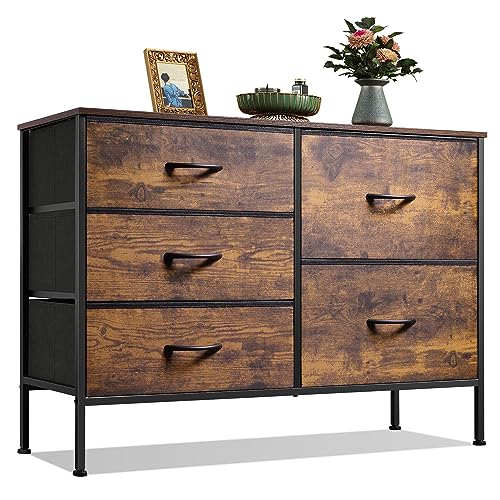
WLIVE 5 Drawer Fabric Dresser for Bedroom, Wide Storage Chest, Rustic Brown | 5-drawer wide fabric dresser with steel frame, multipurpose bedroom living room hallway dorm closet storage organizer
Check price on Amazon
Furnifact 3 Drawer Dresser, White Dresser for Bedroom, Nursery, Closet | Drawers for Clothes 30.31W x 19.69D x 26.77H (3 Drawers)
Check price on Amazon
Joaxswe Farmhouse 5 Drawer Dresser for Bedroom, 33.2" Tall Chest of Drawers | Rustic Wood Dresser with Metal Handle, Storage Organizer Closet for Living Room, Hallway, Entryway, Natural
Check price on Amazon
SONGMICS Dresser for Bedroom, Wide Dresser with 5 Fabric Drawers | Chest of Drawers with Steel Frame, for Closet & Entryway, Ink Black and Ebony Black, BELLAH Collection ULGS322B01S
Check price on Amazon
Fameill Dresser for Bedroom, 6 Drawer Wide Dresser Organizer with Charging Station for Hallway with Metal Handles, Woodgrain White
Check price on Amazon
Karl home White 4 Drawer Dresser, Modern Small Chest of Drawers | Compact Dresser Chest with 4 Storage Drawers, Multipurpose Furniture for Bedroom, Nursery, Living Room, Closet
Check price on Amazon