
Long Dresser with Deep Drawers: The Complete Buying and Storage Guide
If you need serious storage without sacrificing bedroom flow, a long dresser with deep drawers is one of the most practical furniture choices available. This guide explains capacity, drawer construction, materials, and layout so you can choose with confidence.
EXPLORE THE GUIDEWho this guide is for: shoppers who already know they want a wide, low-profile dresser with generous drawer depth, but need to understand how depth affects capacity, glide durability, clothing organization, and room layout before committing to a purchase.
What Makes a Long Dresser with Deep Drawers Different?
A long dresser with deep drawers combines two traits that are usually treated separately: horizontal width and drawer depth. A long dresser spreads storage across a wider footprint, while deep drawers increase the volume of each compartment. Together, they produce a piece that holds more clothing per drawer, offers a broader top surface for styling or a mirror, and keeps the overall height lower than a tall chest.
This configuration is distinct from a standard long dresser for bedroom use, which may use shallow drawers for accessories, and from a long chest of drawers for bedroom, which tends to be taller and narrower. If your priority is raw volume in a low profile, the deep-drawer long dresser is the closest match.
Compared with a long low dresser, a deep-drawer version trades a small amount of visual lightness for noticeably more usable interior space. Compared with a large capacity dresser that achieves volume through height, a long deep-drawer dresser keeps sightlines open and works better beneath windows or at the foot of a bed.
How Drawer Depth Translates Into Real Storage Capacity
Depth is the single most misunderstood specification on a dresser. Two dressers with identical width and drawer counts can differ by 30 percent or more in usable volume once drawer depth is accounted for. The table below compares typical interior drawer depths across tiers so you can calibrate expectations.
| Drawer Type | Typical Interior Depth | Best For | Tier Where Common |
|---|---|---|---|
| Shallow drawer | 10–13 inches | Accessories, socks, folded shirts | Entry-level to mid-range |
| Standard drawer | 13–15 inches | Everyday clothing, jeans | Mid-range |
| Deep drawer | 16–18 inches | Bulky sweaters, linens, bedding | Mid-range to premium |
| Extra-deep drawer | 18–20+ inches | Blankets, seasonal storage, stacked items | Premium to luxury |
At 16 inches and beyond, a drawer stops behaving like a clothing tray and starts behaving like a storage bin. That shift is useful, but it changes how you organize: items pile rather than layer, and the back third of the drawer becomes difficult to reach without a pull-out tray or divider system. If you choose extra-deep drawers, plan for internal organization from day one rather than retrofitting later.
For shoppers comparing overall footprint, it helps to read a large capacity chest of drawers guide alongside this one — the same volume logic applies, but the vertical distribution is different.
Drawer Glides: The Most Important Hidden Specification
A long dresser with deep drawers places more load on each drawer than a narrow dresser ever will. A loaded deep drawer can weigh considerably more than a standard drawer of the same width, and the leverage on a wide drawer front is greater. This makes the glide system the specification most likely to determine whether the dresser feels solid for years or develops sag and sticking within months.
Glide Types by Tier
- Entry-level tier: roller glides or simple side-mounted slides. Adequate for light loads in shallow drawers, but they struggle with wide, deep, heavily loaded drawers and rarely offer full extension.
- Mid-range tier: side-mounted or undermount ball-bearing slides with partial or full extension. This is the practical minimum for a deep drawer, and the difference in smoothness over entry-level is immediately noticeable.
- Premium tier: full-extension undermount soft-close glides, often with a load rating printed on the slide. These keep wide drawer fronts aligned and prevent slam.
- Luxury and commercial-grade tier: heavy-duty rated slides, sometimes comparable to large heavy-duty drawer slides, with metal drawer boxes and reinforced corner joinery.
A useful diagnostic: pull a loaded drawer out fully and press down gently on the front edge. A well-specified mid-range glide will flex slightly and return; an under-specified glide will visibly dip. If you cannot test in person, look for an explicit load rating or the words "full extension" and "ball bearing" in the specification list.
Materials and Construction for Wide, Deep Drawers
Width and depth together stress a dresser's structure. A long span across the top rail and a deep, loaded drawer box both invite sag if the construction is light. The material hierarchy below reflects how each option handles that stress.
Solid Hardwood
Oak, maple, walnut, and ash are the strongest common choices for a wide deep-drawer dresser. Solid wood drawer sides resist bowing, and dovetail or box joinery at the corners holds up under repeated loading. A large solid wood chest of drawers in this configuration represents a long-term investment that will likely outlast several engineered-wood alternatives.
High-Grade Engineered Wood
Furniture-grade plywood and high-density engineered panels with reinforced drawer boxes sit in the balanced mid-tier. They are dimensionally stable, resist humidity changes better than some solid woods, and can be specified with metal drawer sides for extra rigidity. The key is the drawer box: an engineered-wood carcass with a flimsy drawer box will not hold up, while the same carcass with a reinforced box will.
Entry-Level Composite Construction
Particleboard and low-density composite are fine for light use, but they are the weakest match for a long dresser with deep drawers. The wide span and heavy drawer loads work against the material, and repeated loading can loosen hardware over time. If this tier is your target, favor narrower drawer widths and avoid overloading.
For a visual comparison of how finish choices interact with these materials, the materials and finishes section of our library covers wood tones, painted finishes, and hardware pairings in more detail.
Sizing and Room Layout: Making a Long Dresser Work
A long dresser is a commitment to horizontal space, and deep drawers add to the effective footprint because they need clearance to open. Before you buy, walk the room with a tape measure and confirm three distances: the wall span available, the walking clearance in front of the dresser, and the swing path of any doors or closet openings nearby.
Where a Long Deep-Drawer Dresser Fits Best
- End of bed: a low dresser for end of bed placement benefits from the long, low profile, but leave at least 30 inches of walking clearance to the bed.
- Full wall span: a long dresser reads as built-in when it fills most of a wall, especially with a mirror or artwork above.
- Walk-in closets: a large walk-in closet dresser uses deep drawers for folded clothing and keeps the bedroom visually lighter.
- Guest and primary bedrooms: the wide top surface doubles as a styling station or display area.
Proportions to Check
- A dresser that is longer than roughly two-thirds of the wall it sits against tends to feel cramped; one that spans close to the full wall feels intentional.
- Deep drawers need roughly 20 to 24 inches of clearance to open fully without blocking a walkway.
- Height matters more than width for visual balance: a long low dresser under 36 inches tall keeps a room feeling open, while a taller long dresser can dominate.
If your room cannot accommodate full width, a long narrow dresser is the natural fallback, and if you want maximum drawer count instead of maximum depth, compare with a long dresser with lots of drawers.
Organizing Deep Drawers So Nothing Gets Lost
Deep drawers fail when they are treated like shallow ones. Clothing stacks to the back, the front half stays half-empty, and the bottom layer becomes a graveyard of forgotten items. The fix is a layout strategy, not more storage.
A Simple Three-Zone Layout
- Front zone: the most frequently accessed items — everyday shirts, underwear, socks. This is where your hand naturally lands.
- Middle zone: folded jeans, joggers, and casual wear that you access a few times a week.
- Back zone: seasonal items, spare linens, or bulky sweaters that you rotate in and out. Use shallow bins or zippered pouches so you can pull the whole group forward.
Tools That Actually Help
- Vertical drawer dividers to create columns instead of piles.
- Shallow insert trays for jewelry, watches, and accessories in the front of a deep drawer.
- Fabric bins sized to the drawer depth so seasonal items stay contained.
- Drawer liners to protect the finish and keep items from sliding.
For a broader walkthrough, our dresser organization guide covers folding methods and seasonal rotation in more detail. A long dresser with shallow top drawers and deep lower drawers gives you both fine organization and bulk storage in one piece.
Style Directions That Suit a Long, Deep Dresser
A long dresser is visually dominant, so the style choice matters more than it would on a compact piece. The good news is that deep drawers are available across almost every design language, from mid-century to farmhouse.
Popular Style Matches
- Mid-century modern: a large mid-century modern dresser pairs long, low proportions with tapered legs and clean drawer fronts, often with deep lower drawers.
- Scandinavian and light wood: a light wood dresser keeps a long silhouette visually light even with generous drawer depth.
- Modern black: a long black dresser for bedroom or long black dresser creates a strong horizontal anchor in a larger room.
- White and mirror combinations: a long white dresser with mirror suits traditional and transitional bedrooms.
- Wood with contrast hardware: a long wooden dresser for bedroom with black or brass pulls reads as contemporary without being stark.
For complete room pairings, browse large dressers and our room ideas library. If you prefer a matching suite, a long dresser and nightstand set keeps the horizontal language consistent across the room.
Buying Checklist: What to Verify Before You Commit
Use this checklist as a final filter when comparing two or three candidates. Each item corresponds to a specification you can usually find in the product listing or confirm in person.
- Interior drawer depth is stated explicitly, not just exterior dimensions.
- Glide type is named — ball bearing, undermount, full extension — and ideally carries a load rating.
- Drawer box construction uses dovetail joinery, reinforced corners, or metal sides rather than stapled composite.
- Material is appropriate to the span: solid hardwood or high-grade engineered wood for wide, deep drawers.
- Anti-tip hardware is included, especially for any dresser taller than 30 inches.
- Clearance matches the room: 20 to 24 inches of drawer opening space and 30 inches of walking space.
- Weight capacity per drawer is realistic for your intended use — linens and jeans are heavy.
- Assembly requirements are clear, and the drawer boxes arrive pre-assembled or with reinforced fasteners.
- Finish and hardware match the rest of the bedroom, and replacement pulls are available if you plan to customize.
- Return and warranty terms cover structural issues like drawer sag and glide failure.
Common Mistakes When Buying Deep Drawers
- Assuming depth equals usable space. A 20-inch drawer that is only 12 inches wide is a narrow tunnel, not a storage upgrade. Width and depth must be balanced.
- Ignoring the glide rating. This is the single most common cause of dissatisfaction with deep dressers after the first year of use.
- Overloading one drawer. Deep drawers invite heavy loads; distribute weight across drawers rather than concentrating it.
- Skipping the anti-tip kit. A long, deep, loaded dresser is heavy. Secure it to the wall, especially in homes with children.
- Under-planning organization. Deep drawers without dividers become chaotic within weeks. Budget for inserts at the same time as the dresser.
- Choosing height for style over reach. A long dresser is usually kept low, but confirm that the top drawer is comfortably reachable for daily use.
If you are still deciding between formats, the dresser vs chest of drawers comparison clarifies when a long deep-drawer dresser is the better fit than a tall chest, and the large dresser overview covers the broader category.
Best Long Dressers with Deep Drawers for Generous Bedroom Storage
⚠️ AFFILIATE DISCLOSURE: This website contains affiliate links. As an Amazon Associate, we earn from qualifying purchases. If you make a purchase through these links, we may receive a small commission at no additional cost to you. Read our full affiliate policy.

chartustriable 70inch Large Long Dresser w/Charging Station,10 Drawer Dresser w/Deep Big Drawers,Wooden Chest of Drawers w/Power Outlet,Brown Dressers for Bedroom,Living Room,Entryway
Check price on Amazon
HOUROM Walnut Dresser for Bedroom,63"Wide 9 Drawer Mid Century Modern Chest | 63 inch wide dresser with 9 spacious drawers,solid wood legs and concealed handles.Large walnut storage design for bedrooms
Check price on Amazon
VVFLU 63”W Dressers for Bedroom, Grey Dresser with 10 Deep Drawer, Long Dressers & Chests of Drawers for Clothes, Easy Pulls Handle, Textured Borders, for Living Room, Hallway,Taupe Grey
Check price on Amazon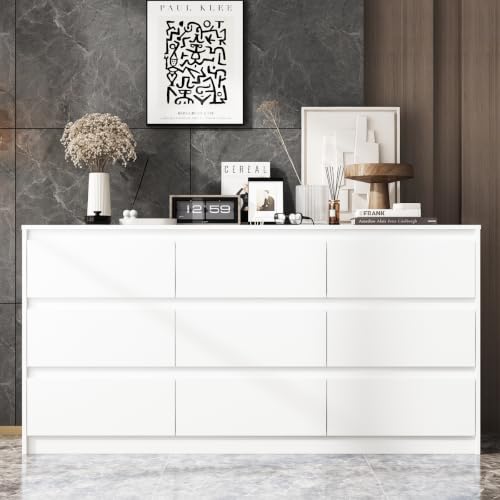
Hitow 9 Drawer Dresser for Bedroom with Deep Drawers, Large Floor Wood Dressers & Chest of Drawers Handle Free, Modern White Long Dressers for Closet Living Room, Euro Slide (63"W x 15.7"D x 31.5"H)
Check price on Amazon
65inch Large Long Wood 8 Drawer Dresser for Bedroom,20" Deep Drawers,Oak | Rustic Wooden 8 Drawer Dresser with Large Capacity for Living Room,Wooden Chest of Drawers for Bedroom,Living Room,Entryway
Check price on Amazon
Huuger 78.7 inch Long Dresser for Bedroom, 15 Drawer Fabric Dresser for Closet, Large TV Stand for 65, 75, 85 inch TV, Wide Chest of Drawer with Storage, 78.7" W x 12.9" D x 26.7" H, Rustic Brown
Check price on Amazon
9 Drawer Dresser for Bedroom,62.99" Long Black Chest of Drawers w/LED Light | Modern Dresser TV Stand with Charging Station,Curved Profile Design,Wooden Closet Storage Cabinet with Deep Drawers
Check price on Amazon
WLIVE Long Dresser TV Stand for 85 Inch TV, 12 Drawer Dresser, Black | Fits TVs up to 85 inch, 12 fabric drawers, 75.5 inch wide tabletop, Living room or bedroom, Chest of drawers
Check price on AmazonFrequently Asked Questions
What is the difference between a long dresser with deep drawers and a standard dresser?
A long dresser with deep drawers prioritizes horizontal width and drawer depth over height. This gives you more usable storage per drawer and a broader top surface, while keeping the overall profile lower, which suits larger bedrooms and end-of-bed placement.
How deep should deep dresser drawers actually be?
Most standard dressers offer interior drawer depths around 13 to 15 inches. Deep drawers typically start at 16 inches and can reach 18 to 20 inches. Anything beyond 20 inches becomes harder to reach at the back, so consider organization inserts if you go that deep.
Do deep drawers need heavy-duty drawer slides?
Yes. Deep drawers hold more weight, so look for full-extension metal ball-bearing slides or undermount soft-close glides rated for the load. Entry-level models often use simpler roller glides, while mid-range and premium tiers typically upgrade to rated ball-bearing or undermount systems.
What is the best material for a long dresser with deep drawers?
Solid hardwood — oak, maple, walnut, or ash — offers the most durable construction for wide, deep drawers because it resists sagging under load. High-grade engineered wood with reinforced drawer boxes is a solid mid-tier option, while entry-level particleboard constructions are best suited to lighter loads.
How do I organize a long dresser with deep drawers?
Deep drawers work best with vertical dividers, drawer dividers for folded clothing, and shallow insert trays for small items. Use the front half for frequently accessed items and the back half for seasonal or bulky clothing. Avoid overloading a single deep drawer to keep glides smooth.
Is a long dresser with deep drawers safe for a nursery?
Yes, provided it is properly anchored to the wall with anti-tip hardware and the drawers are not overloaded. Deep drawers are actually convenient for nursery storage, but safety anchoring is non-negotiable for any dresser used around young children.
Ready to compare options? Use the product grid above to explore long dressers with deep drawers across tiers, then verify the checklist items against each listing. For a broader view of the category, visit our long dressers for sale page or compare with a low chest of drawers if you prefer a slightly taller profile.