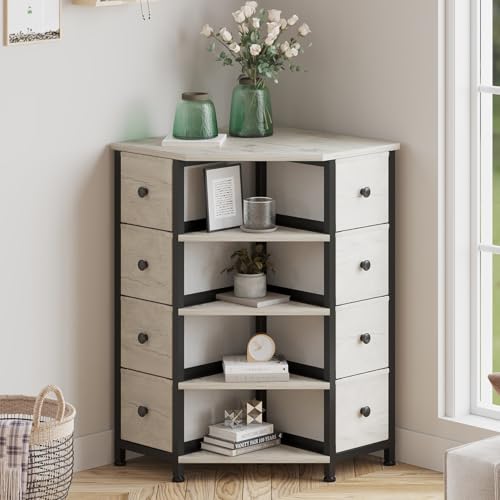
Corner Dresser With Drawers: The Smart Storage Solution
Maximize every inch of your bedroom with a corner dresser that combines clever design, ample drawer space, and a footprint that fits where standard furniture simply cannot.
Explore the GuideWhy corner dressers matter: In compact bedrooms, apartments, and nurseries, the corner is the most underused real estate. A corner dresser with drawers turns that dead space into functional storage — without blocking traffic flow or stealing wall space from beds and windows. This guide covers everything from sizing and drawer configurations to material choices and styling, so you can choose with confidence.
What Is a Corner Dresser With Drawers?
A corner dresser with drawers is a purpose-built storage piece designed to sit flush against two adjoining walls, typically featuring an angled or wedge-shaped front. Unlike a standard rectangular chest of drawers with shelves, a corner unit uses the geometry of the room to eliminate wasted space. Most models come with three to six drawers, and some include a mix of deep drawers for bulky items and shallow drawers for accessories.
The angled front is not just aesthetic — it improves access. Drawers pull out toward the center of the room, so you are never reaching awkwardly into a tight corner. For anyone who has tried to squeeze a standard dresser into a narrow gap, the difference is immediately noticeable.
Corner dressers are especially popular in:
- Small bedrooms where wall space is contested by doors, windows, and the bed
- Nurseries that need safe, reachable storage without sharp protruding edges
- Closets and dressing areas where every square foot counts
- Guest rooms that need functional furniture without visual bulk
Key Benefits of Choosing a Corner Dresser
Space Efficiency
Uses the corner footprint that standard furniture leaves empty. Frees up prime wall space for beds, desks, and doors.
Improved Traffic Flow
Keeps walking paths clear. Ideal for rooms where a rectangular dresser would block movement between door and bed.
Ample Drawer Storage
Most models offer 3–6 drawers with varying depths, giving you dedicated space for folded clothes, linens, and accessories.
Design Flexibility
Available in modern, farmhouse, coastal, and classic styles. Blends into the room rather than dominating it.
Safety for Nurseries
Corner placement reduces tipping risk when properly anchored. Rounded edges are common in nursery-specific models.
Visual Balance
Fills an awkward empty corner that can make a room feel unfinished. Creates a cohesive, intentional layout.
How to Choose the Right Corner Dresser
Before you start shopping, work through these five decision points. They will narrow your options quickly and prevent the most common buying mistakes.
1. Measure the Corner Space Precisely
Corner dressers are not one-size-fits-all. Measure the length of both walls from the corner to the nearest obstruction (door frame, window trim, or bed). Then measure the height clearance and the depth you can afford to lose from the room. Remember that drawers need 18–24 inches of extension space — measure that too.
Common mistake: Buying a corner dresser that fits the wall but leaves no room for the drawers to open. Always account for pull-out clearance before committing.
2. Decide on Drawer Configuration
Corner dressers typically fall into three drawer layouts:
- Stacked drawers (3–4): Best for folded clothing and linens. Simple, clean look.
- Mixed-depth drawers: Deep bottom drawers for bulky items, shallow top drawers for accessories. Most versatile.
- Side-by-side drawers: Two columns of smaller drawers. Great for organization but less useful for large items.
If you are storing primarily clothing, a stacked configuration works well. If you need to organize accessories, jewelry, or small items, consider a drawer divider system alongside a mixed-depth unit.
3. Choose the Right Material Tier
Corner dressers are available across several market tiers. Use this framework to match the material to your expectations:
| Tier | Typical Materials | Best For |
|---|---|---|
| Entry-level | Engineered wood, particleboard with laminate | Guest rooms, temporary setups, light use |
| Mid-range | Engineered wood with veneer, mixed hardwood | Primary bedrooms, everyday use, balanced tier |
| Premium | Solid oak, maple, or walnut; dovetail joints | Long-term investment, heavy use, heirloom quality |
| Luxury | Premium hardwoods, hand-finished, custom hardware | Designer interiors, flagship-tier spaces |
Solid wood construction is the most durable choice for a long-term investment. Engineered wood with quality veneers offers a balanced tier option that performs well in dry, climate-controlled bedrooms. Avoid particleboard in humid rooms unless it is fully sealed.
4. Match the Style to Your Room
Corner dressers come in every major furniture style. A few starting points:
- Modern/contemporary: Clean lines, minimal hardware, flat fronts. Pairs well with contemporary dresser and nightstand sets.
- Farmhouse/cottage: Beadboard details, cup pulls, painted finishes. See cottage-style chest of drawers for reference.
- Coastal: Light woods, whitewashed finishes, breezy hardware. Explore coastal-style chest of drawers.
- Classic/traditional: Molded edges, antique brass hardware, rich wood tones. A classic dresser style translates well to corner configurations.
5. Check Hardware and Safety Features
Drawer glides matter more than most buyers expect. Entry-level models often use basic side-mounted glides, while mid-range and premium tiers typically feature ball-bearing or soft-close mechanisms. If the dresser will be used daily, prioritize smooth, full-extension glides.
For nurseries or homes with children, look for anti-tip hardware and consider a model with rounded edges. Corner placement reduces tipping risk, but anchoring is still essential. A corner chest of drawers for bedroom use should always be secured to the wall.
Corner Dresser Size Guide
Corner dressers are not standardized, but most fall into three size categories. Use this guide as a starting reference, then verify with the product specifications.
| Size Category | Typical Dimensions (W x D x H) | Best For |
|---|---|---|
| Compact | 30–36 in wide, 18–22 in deep, 30–36 in tall | Small bedrooms, nurseries, closets |
| Standard | 36–48 in wide, 20–24 in deep, 36–48 in tall | Primary bedrooms, guest rooms |
| Large | 48–60 in wide, 22–26 in deep, 48–60 in tall | Spacious bedrooms, dressing areas |
If you are working with a very tight footprint, a compact dresser or a corner dresser in the compact category is your best starting point. For larger rooms where the corner is an accent rather than a necessity, a standard or large unit provides more drawer capacity without overwhelming the space.
Placement and Styling Tips
Getting the placement right is as important as choosing the right dresser. Here are practical guidelines:
- Anchor to the wall: Always use anti-tip hardware, especially in homes with children or pets. Corner placement is stable, but anchoring is non-negotiable.
- Leave breathing room: Aim for at least 24 inches of clearance in front of the drawers. More is better if the room allows.
- Consider lighting: A corner dresser often sits away from windows. Add a small lamp or wall sconce to make the area usable in the evening.
- Use the top surface: A corner dresser top is a natural spot for a mirror, a small plant, or a jewelry tray. Keep it intentional rather than cluttered.
- Pair with a nightstand: If space allows, a matching or complementary nightstand completes the look. Browse dresser and nightstand sets for coordinated options.
Pro tip: If your corner dresser sits near a closet, consider a closet dresser configuration that bridges the gap between bedroom and closet storage. It keeps daily items accessible without duplicating furniture.
Common Mistakes to Avoid
- Not measuring drawer clearance: The most common regret. A dresser that fits the wall but cannot open is useless.
- Choosing style over function: A beautiful corner dresser with shallow, sticky drawers will frustrate you daily. Test the glides in person if possible.
- Ignoring the room's traffic pattern: A corner dresser should not force you to sidestep every time you enter the room. Map the path from door to bed before buying.
- Skipping wall anchoring: Corner placement feels stable, but drawers open outward and shift weight. Anchor it.
- Overlooking the top surface: A corner dresser top is visible from multiple angles. Plan how you will use it so it does not become a clutter catch-all.