White Bedroom Dressers & Chests: Bright, Versatile Storage
Everything you need to know before choosing a white dresser or chest of drawers — finishes, drawer configurations, materials, and styling tips for a calm, organized bedroom.
START THE GUIDEWhy white bedroom furniture works: White dressers and chests reflect light, make compact bedrooms feel larger, and pair effortlessly with nearly every color palette. But not all white finishes are equal — the right choice depends on your room's lighting, your storage needs, and how much maintenance you're comfortable with.
Why Choose White Bedroom Dressers and Chests?
White has long been the most popular finish for bedroom storage furniture, and for good reason. In a room where you want to unwind, a white dresser creates a sense of calm and order without demanding attention. It acts as a neutral canvas that lets your bedding, artwork, and accent pieces take center stage.
From a practical standpoint, white furniture is remarkably adaptable. If you redecorate every few years — swapping warm wood tones for cool grays, or bold colors for muted pastels — a white dresser will rarely need to be replaced. It simply works with whatever comes next.
White also performs a visual trick that matters in smaller bedrooms: it reflects ambient light rather than absorbing it. A white bedroom dresser and chest set can make a narrow room feel airier and more open, especially when paired with light walls and sheer window treatments.
That said, white is not a single look. The finish you choose — crisp matte, soft off-white, distressed cottage white, or high-gloss lacquer — dramatically changes the character of the piece. Understanding these differences is the first step toward a purchase you'll be happy with for years.
Popular White Dresser and Chest Styles
Modern & Minimalist
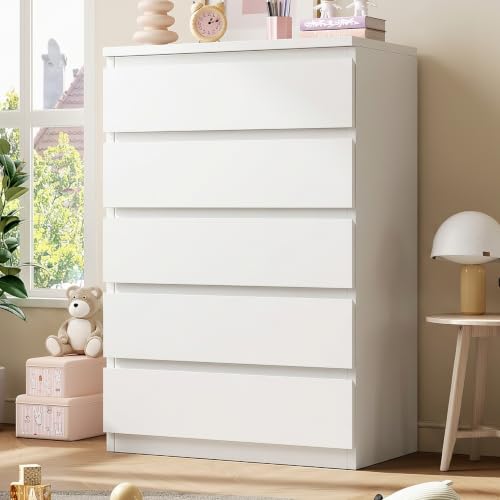
Clean lines, handle-free drawer fronts, and matte or satin white finishes. Often paired with tapered legs or a floating plinth base. Ideal for contemporary and Scandinavian-inspired bedrooms.
Farmhouse & Cottage
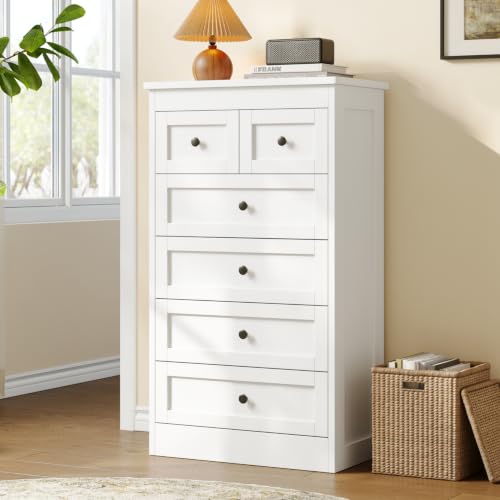
Beadboard details, distressed edges, and warm off-white tones. Frequently features cup pulls or bin-style handles. A natural fit for rustic and shabby-chic interiors.
Glam & Gold-Accented
Crisp white drawer fronts with gold or brass hardware, mirrored accents, and subtle metallic trim. Adds a touch of luxury without overwhelming a room.
Coastal & Natural
White frames combined with rattan, cane, or natural wood drawer fronts. Brings texture and warmth to a white palette, perfect for breezy, light-filled bedrooms.
Traditional & Vintage
Curved profiles, decorative molding, and antique-style white finishes. Often seen in classic bedrooms and as part of matching bedroom sets with nightstands.
Two-Tone & Contrast
White bodies with walnut, natural wood, or black drawer fronts. Offers the brightness of white with visual depth — a smart choice for transitional bedrooms.
White Dresser vs. White Chest of Drawers: What's the Difference?
The terms are often used interchangeably, but in furniture design they describe different proportions. A dresser is typically wider than it is tall, with a broad top surface that can hold a mirror, lamps, or decorative objects. It's the classic bedroom storage piece that doubles as a display surface.
A chest of drawers (sometimes called a tallboy or highboy) is taller and narrower, stacking more drawers vertically while occupying less floor space. In compact bedrooms, a white chest of drawers is often the smarter choice because it frees up wall space for a bed or door swing.
Many households use both: a wide white dresser against one wall for folded clothing and a smaller white chest for accessories, linens, or overflow storage. If you're building a coordinated bedroom, a white bedroom dresser and nightstand set keeps the finish and hardware consistent across the room.
For very small spaces, consider a white 6-drawer dresser — wide enough for folded clothing and a mirror, but shallow enough to fit along a narrow wall. Taller options like a white 9-drawer dresser maximize vertical storage without expanding the footprint.
Choosing the Right Drawer Configuration
Drawer count and layout matter more than most buyers expect. The number of drawers is only half the story — the depth and height of each drawer determines what you can actually store.
- 3-drawer dressers: Best for guest rooms or as an accent piece. A white 3-drawer dresser typically offers one deep bottom drawer and two shallower upper drawers.
- 4-drawer dressers: A balanced choice for single adults or couples who fold most of their clothing. The white 4-drawer dresser format usually provides uniform drawer heights.
- 5-drawer dressers: The most common bedroom configuration. A white 5-drawer dresser offers a mix of shallow and deep drawers for socks, shirts, and bulky items.
- 6-drawer dressers: Two columns of three drawers, or three columns of two. The white 6-drawer dresser is the workhorse of family bedrooms.
- 7 to 9-drawer dressers: Maximum storage for shared bedrooms or households with extensive wardrobes. A white 7-drawer dresser or white 8-drawer dresser works well in larger rooms.
Pay attention to drawer glides. Entry-level dressers typically use basic side-mounted rollers, while mid-range models often feature smoother ball-bearing slides. Premium and luxury tiers generally include soft-close mechanisms and fully extendable drawers — details that make daily use noticeably more pleasant.
If your bedroom lacks a closet, consider a white 6-drawer dresser paired with a white armoire wardrobe to cover both folded and hanging storage.
Materials and Finishes: What to Look For
White furniture is available in a wide range of materials, and the construction quality varies dramatically across tiers. Here's a practical comparison:
| Tier | Typical Materials | Best For |
|---|---|---|
| Entry-level | Engineered wood with white laminate or foil wrap; particleboard core | Guest rooms, first apartments, short-term needs |
| Mid-range | Engineered wood with painted or lacquered finish; solid wood drawer fronts | Primary bedrooms, family use, long-term ownership |
| Premium | Solid wood frame (pine, oak, or maple) with painted white finish | High-traffic bedrooms, heirloom-quality expectations |
| Luxury | Hardwood construction, dovetail joinery, high-gloss or hand-rubbed white finish | Designer interiors, collector-grade furniture |
When evaluating a white finish, look at the drawer interiors. A quality white dresser will have sealed or painted drawer boxes, not raw particleboard. Dovetail or dowel joinery is a sign of sturdy construction; stapled or glued joints are common at the entry level but less durable over time.
If you're considering a natural wood piece with white accents, an white and natural wood dresser combines the brightness of white with the warmth of grain. For a softer, coastal look, explore a white and rattan dresser.
Key Factors Before You Buy
1. Measure your space carefully
Confirm the width, depth, and height of the wall where the dresser will sit, and leave at least 24 inches of clearance for drawers to open fully. For narrow rooms, a white bedroom dresser with mirror adds function without requiring a separate vanity.
2. Match the finish to your lighting
Crisp white can look stark in rooms with cool, north-facing light. Warm off-white or cream tones soften the look. In bright, south-facing bedrooms, a pure white finish stays clean and crisp without appearing washed out.
3. Think about hardware
Hardware is the easiest way to change the personality of a white dresser. A white 6-drawer dresser with gold hardware reads glam, while black pulls feel modern and industrial. Some models, like a white 6-drawer dresser with no handles, use push-to-open mechanisms for an ultra-minimalist look.
4. Consider safety features
Tall chests should include anti-tip hardware. This is especially important in homes with children. A white 6-drawer dresser for nursery use should be wall-anchored and have drawers that stop before pulling completely free.
5. Plan for organization
White dressers show clutter less than dark finishes, but interior organization still matters. Drawer dividers, shallow trays for accessories, and consistent folding techniques keep the interior as tidy as the exterior. For a coordinated bedroom, pair your dresser with a white dresser and nightstand set.
Styling a White Dresser or Chest
A white dresser is a blank canvas, which means the styling choices you make around it have a big impact. A few reliable approaches:
- Layer textures: A white dresser against a white wall can feel flat. Add a woven basket, a ceramic vase, or a linen runner to introduce texture.
- Use contrast: A dark wood mirror or black metal lamp against a white dresser creates visual anchor points.
- Keep the top surface edited: A tray corrals small items and prevents the dresser top from becoming a catch-all.
- Coordinate with bedding: Pull one accent color from your bedding into the dresser styling — a throw blanket, a framed print, or a small plant.
If you're furnishing a guest room or a child's bedroom, a coordinated white dresser and nightstand set creates an instant pulled-together look without requiring matching wall art or bedding.
Ready to Compare White Dressers and Chests?
Browse hand-picked white bedroom dressers and chests across styles, drawer configurations, and construction tiers. Filter by your room size and storage needs.
EXPLORE OPTIONSFrequently Asked Questions
Are white bedroom dressers hard to keep clean?
Not particularly. Most white finishes wipe clean with a damp cloth. High-gloss finishes show fingerprints more readily than matte or satin finishes, but they're also easier to wipe down. Avoid abrasive cleaners that can dull the finish over time.
What's the difference between a white dresser and a white chest?
A dresser is wider than it is tall, with a broad top surface. A chest of drawers is taller and narrower, stacking storage vertically. Both can hold folded clothing; the choice depends on your floor space and whether you want a display surface.
Can I use a white dresser in a small bedroom?
Yes — white is one of the best finishes for small rooms because it reflects light and visually recedes. Choose a narrower model or a taller chest to preserve floor space. A white 6-drawer dresser is a good middle-ground size for compact bedrooms.
Should I anchor a tall white chest to the wall?
Yes. Any chest taller than about 30 inches should be secured with anti-tip hardware, especially in homes with children or pets. Most quality dressers include a wall-anchoring kit; if yours doesn't, a basic furniture strap kit is widely available.
How do I coordinate a white dresser with other bedroom furniture?
You don't need to match everything. A white dresser pairs well with natural wood nightstands, black metal accents, or upholstered benches. The key is repeating one or two materials elsewhere in the room so the white piece feels intentional rather than isolated.