Waterfall Dresser: The Complete Guide to Curved-Front Bedroom Storage
A waterfall dresser is a chest of drawers whose top surface curves downward at the front edge and flows seamlessly into the drawer fronts, creating a continuous cascading line. This distinctive silhouette originated in the Art Deco era and remains one of the most recognizable statement pieces in bedroom furniture. This guide explains the design, the materials to expect at each tier, how to size one for your room, and what to inspect before you commit.
What Is a Waterfall Dresser?
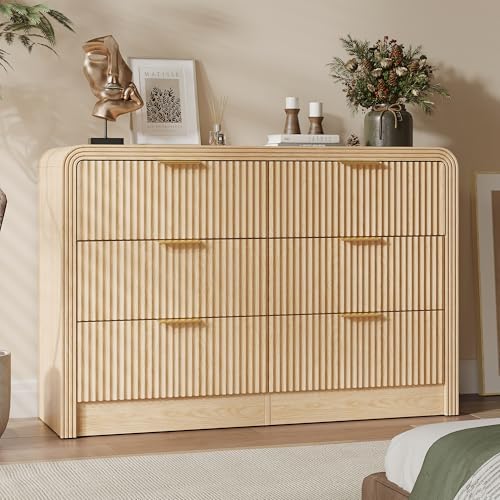
The defining feature of a waterfall dresser is the curved transition between the top and the front face. Instead of a sharp 90-degree corner, the top edge bends smoothly and continues into the uppermost drawer front. The result is a soft, sculptural profile that reads as a single flowing surface rather than a box with a lid.
This construction is more demanding than a standard flat-front case. The curved section requires either a bent lamination, a steam-bent solid wood panel, or a veneered curved substrate. Because of that, waterfall dressers tend to sit in the mid-range to luxury tiers of the market, and the quality of the curve is one of the clearest indicators of overall build quality.
Waterfall dressers are closely related to other curved and sculptural storage pieces. If you are comparing silhouettes across categories, our overview of dresser types is a useful starting point before narrowing down to this specific form.
Design History and Origins
The waterfall silhouette emerged during the Art Deco period of the 1920s and 1930s, when designers embraced streamlined, aerodynamic forms inspired by modern machinery and architecture. Furniture makers applied the same logic to bedroom storage: rounded corners, continuous surfaces, and a sense of forward motion.
The style saw a strong revival in the mid-20th century and again in contemporary interiors, where the curved front softens the visual weight of a large storage piece. Today you will encounter three broad categories:
- Original vintage pieces from the Art Deco and mid-century eras, often veneered in walnut, maple, or mahogany.
- Modern reproductions that adapt the curved silhouette with contemporary hardware and finishes.
- Custom and designer pieces that treat the waterfall curve as a signature architectural detail.
If the vintage route appeals to you, our guide to vintage chest of drawers covers what to inspect on older case goods, and the Victorian dresser overview is helpful for understanding how earlier eras approached drawer fronts and proportions.
Waterfall Dresser Styles
Not every curved-front dresser is styled the same way. The curve is the constant, but the surrounding details determine which interiors it suits.
Art Deco Waterfall
The most recognizable interpretation. Look for bold veneer patterns, stepped or geometric drawer pulls, and contrasting inlays. These pieces pair well with mirrored accents, lacquered finishes, and rich jewel tones. A walnut dresser in this style is a classic pairing, since walnut veneer shows the curve beautifully.
Hollywood Regency
A glossier, more glamorous take with high-shine lacquer, metallic hardware, and often a lighter palette. If you like this direction, the white and gold dresser and white and gold vintage dresser references show how curved and metallic finishes combine.
Modern and Transitional
Contemporary versions simplify the detailing: flush drawer fronts, minimal pulls, and matte or satin finishes. These integrate easily into a modern dresser scheme. A modern walnut dresser is a strong example of how the curve can feel restrained rather than ornate.
Painted and Refinished
Vintage waterfall dressers are popular candidates for refinishing. The smooth curved top takes paint well, and the continuous surface shows fewer seams. Our guides on painting a dresser and using chalk paint on furniture cover the prep work that a curved veneer surface requires.
Materials and Construction Tiers
Because the waterfall curve stresses the material, construction quality matters more here than on a flat-front case. Use the tier system below to frame your research rather than shopping by any single number.
| Tier | Typical Construction | What to Expect | Best For |
|---|---|---|---|
| Entry-level | Engineered wood core with printed or thin veneer, formed curve | Lighter build, simpler drawer slides, curve is decorative rather than structural | Guest rooms, staging, occasional-use spaces |
| Mid-range | Engineered wood with quality veneer, reinforced curve, side-mounted or entry-level ball-bearing slides | Better veneer consistency, smoother drawer action, more stable curve | Primary bedrooms, everyday use |
| Premium | Solid wood frame with quality veneered curve, full-extension ball-bearing slides, dovetailed or reinforced drawer boxes | Durable construction, precise curve, smooth and quiet operation | Long-term use, design-focused bedrooms |
| Luxury / professional-grade | Steam-bent or bent-laminated solid wood, hand-finished veneer, premium hardware, hand-fitted drawers | Exceptional curve integrity, refined joinery, heirloom-level finish | Collectors, statement interiors, long-term investment |
One useful rule of thumb: on a well-built waterfall dresser, the curve should feel like part of the structure, not a skin over a box. Tap the curved section gently — a hollow, thin sound suggests a formed veneer over an engineered core, which is acceptable at entry-level but should be disclosed at higher tiers.
Material choice also affects how the piece ages. Solid wood and quality veneer develop a patina; printed veneer does not. If longevity is your priority, the premium and luxury tiers are the worthwhile investment. For a broader comparison of surface options, see our materials and finishes section.
Sizing and Drawer Configuration
Waterfall dressers come in the same broad size families as conventional dressers, but the curve adds a dimension you must measure: the depth at the widest point of the top, which is greater than the depth at the back.
| Configuration | Typical Width Band | Drawer Count | Best For |
|---|---|---|---|
| Small / accent | Narrow single-column | 3–4 | Small bedrooms, guest rooms, closets |
| Standard double | Medium width, two columns | 6 | Primary bedrooms, couples |
| Wide / triple | Wide footprint, three columns | 8–9 | Large bedrooms, shared storage |
| Tall / vertical | Compact footprint, taller body | 5–6 | Small rooms needing vertical storage |
When measuring your room, add clearance for the curved top and for drawer pull-out. The top overhang means the front of the dresser projects further than a flat-front piece of the same body depth. If space is tight, compare against our guides on small dressers and narrow dressers before committing to a full-width waterfall piece.
If you prefer a taller, more vertical body, the tall dressers and vertical dresser references explain how height affects usability and safety. For rooms where wall space is limited, a wall-mounted dresser is worth considering as an alternative, though true waterfall construction is rarely wall-mounted.
How to Choose the Right Waterfall Dresser
Work through these steps in order. They move from the room outward to the piece itself, which is the order that avoids costly mistakes.
- Confirm the curve fits the room. Measure the widest depth of the top and check clearance in front of the dresser. The curve visually softens a room, but it does not reduce the physical footprint.
- Decide vintage or new. Originals offer character and patina but require inspection; reproductions offer predictable hardware and finishes. Our vintage style dresser guide covers the middle path of new pieces built with retro detailing.
- Match the drawer count to your habits. Six drawers suits most couples; nine drawers suits shared or seasonal storage. If you store folded clothing vertically, a taller configuration works well.
- Evaluate the curve and veneer first, hardware second. Hardware is easy to replace; a failing curve is not. Check drawer boxes, slides, and the curve before you look at pulls.
- Confirm the finish direction. Paint and lacquer are straightforward on a curved top; stained veneer requires matching. If you plan to refinish, read the refinishing guide before buying.
- Plan the surrounding room. A waterfall dresser is a focal piece, so pair it with quieter companions. Our room ideas section has layout inspiration, and the dresser and nightstand sets guide explains how to match a set without making the room feel heavy.
Care and Maintenance
The curved top is the most exposed surface on a waterfall dresser, and it is also the hardest to replace. Protect it.
- Dust with a soft, dry cloth. Microfiber works well. Avoid abrasive pads, which can dull veneer on the curve.
- Keep the top dry. Water rings form easily on a sloping surface where moisture collects at the lowest point of the curve. Use coasters and wipe spills immediately.
- Control sunlight and heat. Veneer on a curve expands and contracts differently from the core, so prolonged direct sun or proximity to a heat source accelerates lifting. Position the dresser away from radiators and strong afternoon light.
- Inspect veneer edges seasonally. Look along the curve-to-drawer transition for lifting or bubbling. Address small lifts promptly with a furniture restorer rather than pressing them yourself, which can crack the veneer.
- Treat the drawer slides. Clean tracks and apply a silicone-based lubricant appropriate to the slide type. Avoid oil-based products that attract dust.
- Use a wood-safe cleaner sparingly. A slightly damp cloth followed by a dry buff is usually sufficient. For deeper cleaning guidance, see our dresser cleaning guide.
If you are restoring a vintage piece, the prep work on a curved surface is the part that determines the final result. Our refinishing guide and chalk paint guide both address curved veneer specifically.
Frequently Asked Questions
What is a waterfall dresser?
A waterfall dresser is a chest of drawers whose top surface curves smoothly downward at the front edge and flows continuously into the drawer fronts. The design originated in the Art Deco era of the 1920s and 1930s.
Are waterfall dressers still in style?
Yes. Original vintage pieces are highly collectible, and modern reproductions adapt the curved silhouette for contemporary interiors. The design works well in Art Deco, Hollywood Regency, mid-century, and transitional bedroom schemes.
What materials are used for waterfall dressers?
Vintage waterfall dressers typically use veneered wood such as walnut, maple, or mahogany over a solid frame. Modern reproductions may use solid wood, engineered wood with veneer, or lacquered finishes. The curved front demands precise joinery and quality veneer work.
How much space does a waterfall dresser need?
Because the top curves outward at the front, a waterfall dresser needs a few extra inches of clearance compared with a flat-front dresser of similar drawer width. Measure the depth at the widest point, not just at the back, and leave room for drawer pull-out.
How do I care for a vintage waterfall dresser?
Dust regularly with a soft cloth, avoid direct sunlight and heat, and use a mild wood-safe cleaner. Check veneer edges for lifting, and have loose veneer professionally re-glued rather than pressing it yourself. Keep the curved top free of standing moisture.
Is a waterfall dresser a good investment?
Premium and luxury tier pieces from reputable makers hold their position well in the market, and well-preserved vintage examples remain collectible. As with any furniture purchase, the condition of the curve and veneer matters more than the label.