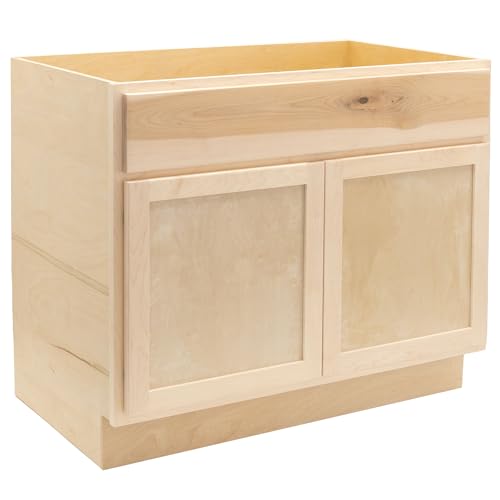
Unfinished Base Cabinets with Drawers: The Complete Buying Guide
Everything you need to evaluate materials, drawer construction, sizing, and finishing before you commit to raw wood cabinetry.
EXPLORE RECOMMENDED OPTIONSWhy unfinished base cabinets with drawers? Raw wood cabinetry gives you full control over the final look and lets you match any color palette, stain tone, or design language in your home. But the open surface also means every construction detail is visible, so understanding what you are buying matters more than ever. This guide walks you through the decisions that separate a long-lasting installation from a frustrating one.
What Are Unfinished Base Cabinets with Drawers?
Unfinished base cabinets with drawers are base-height storage units — typically designed to sit under a countertop — that arrive without paint, stain, or factory finish. The drawer stack provides pull-out storage for utensils, cookware, pantry items, or bathroom essentials, while the open frame accepts the finish of your choice. Because the wood surface is raw, you can match a specific interior design scheme, refresh a dated kitchen with a custom color, or apply a durable clear coat to highlight natural grain.
These cabinets are commonly purchased for kitchen remodels, bathroom vanities, laundry rooms, and home offices. They are also a practical choice for DIY renovators who prefer to handle finishing themselves, and for homeowners working with a cabinet maker or finisher to achieve a precise result. If you are comparing freestanding storage pieces, our guide to unfinished dressers covers a related category with different sizing conventions.
One key distinction: an unfinished base cabinet is not simply a finished cabinet with the paint left off. Quality units are built with joinery, panel stability, and drawer mechanics that are intended to survive decades of use once sealed. The finish is the last step, not a cosmetic afterthought.
Materials: Which Wood Species Should You Choose?
The wood species affects durability, grain appearance, how the cabinet accepts stain, and how it behaves in humid rooms. The table below summarizes the most common options for unfinished base cabinets with drawers.
| Wood Species | Durability & Grain | Best For | Tier Positioning |
|---|---|---|---|
| Oak | Hard, dense, prominent open grain; excellent wear resistance | High-traffic kitchens, rustic and mission styles | Mid-range |
| Maple | Hard, tight grain, smooth sanding; takes paint and clear coat well | Painted cabinets, modern and transitional kitchens | Mid-range |
| Pine | Softer wood, distinctive knots; dents more easily | Farmhouse and cottage aesthetics, low-traffic areas | Entry-level |
| Birch plywood | Stable engineered core, consistent surface, resists warping | Cabinet boxes, drawer boxes, budget-conscious builds | Entry-level |
| Walnut | Hardwood with rich, dark grain; premium appearance | High-end kitchens, statement cabinetry | Premium |
Solid wood faces and frames are generally more durable than veneered panels, but a well-built plywood box with solid wood drawer fronts can still deliver strong performance. For drawer boxes specifically, hardwood (maple or birch) is preferable to particleboard because it holds screws and joints more reliably under load. The unfinished kitchen cabinets with drawers collection on this site shows how these materials translate into real configurations.
Drawer Construction: The Detail That Determines Longevity
The drawer stack is the hardest-working part of a base cabinet, so its construction deserves careful attention. Three factors matter most:
1. Joint type
- Dovetail joints interlock the drawer sides and front mechanically. This is a premium construction detail that resists pulling apart under heavy loads.
- Box joints (finger joints) offer strong, consistent assembly and are common in mid-range cabinetry.
- Stapled or nailed joints are faster to produce and appear most often in entry-level drawer boxes. They are adequate for light use but are the first component to loosen over time.
2. Drawer glide system
- Full-extension glides allow the drawer to pull out completely, so every inch of interior space is accessible. This matters for deep drawers holding cookware.
- Three-quarter extension glides leave a small portion of the drawer inside the cabinet; they work fine for shallow utility drawers.
- Soft-close mechanisms prevent slamming and are increasingly standard in mid-range and premium cabinetry.
- Undermount glides hide the hardware beneath the drawer for a cleaner look and smoother travel.
3. Drawer box material and thickness
Hardwood drawer sides in the range of a half-inch to five-eighths of an inch are the practical standard for durability. Thinner panels or particleboard boxes may be acceptable for very light use but are less forgiving in kitchens and bathrooms. Bottom panels should be captured in a groove rather than stapled flush, which adds rigidity and prevents sagging over time.
These construction details are also relevant when comparing drawer-heavy furniture. Our articles on dresser cabinets and tall bedroom cabinets with drawers explore similar trade-offs in freestanding pieces.
Sizing and Layout: Planning the Drawer Stack
Base cabinets follow standard depth conventions, usually around 24 inches deep for kitchen use and shallower for bathroom vanities. Width and height, however, vary enough that you should measure your space and plan the layout before ordering.
Standard height considerations
- Base cabinet boxes are typically around 34.5 inches tall, allowing a countertop to bring the finished surface to standard work height.
- Drawer stack heights should be planned around what you intend to store: shallow drawers for utensils and cutlery, deeper drawers for pots, pans, and small appliances.
- A common layout pairs one shallow top drawer with two or three deeper drawers below, which balances accessibility and capacity.
Width and spacing
- Drawer widths between 15 and 30 inches are practical for most kitchens; wider drawers can work but require sturdier glides and thicker drawer boxes.
- Plan filler strips and end panels so drawers open without hitting walls, appliances, or adjacent cabinet hardware.
- Allow clearance for door and drawer swings when the cabinet sits near a corner or doorway.
If your space is tight, shallow-depth and narrow storage solutions are worth reviewing; our guides to narrow drawer sets and shallow-depth storage pieces illustrate how depth and width trade off against capacity.
Finishing Options: From Raw Wood to Final Surface
Because the cabinet arrives unfinished, you control the final appearance and protective layer. The most common paths are:
- Paint — the most versatile option. A primer suited to the wood species followed by two top coats gives a durable, uniform surface. Maple and birch sand smoothly and hold paint well.
- Stain and clear coat — ideal for showing grain. Oak and walnut take stain beautifully, while pine may require a pre-stain conditioner to avoid blotchiness.
- Clear seal only — a natural look that works well with high-grade hardwood. It still protects the wood from moisture and grease.
- Custom color matching — useful when the cabinet must coordinate with existing trim, flooring, or adjacent furniture.
What to seal and why
Seal the exterior faces, the interior of the cabinet box, and the drawer boxes. In kitchens and bathrooms, humidity and steam penetrate raw wood quickly, causing swelling, staining, and in some cases mold. Sealing the drawer interiors also makes them easier to wipe clean and protects against spills. Edge-banding or sealed plywood edges should receive the same treatment as face surfaces.
For those exploring the broader category of raw-wood storage, our unfinished cabinet doors and drawer fronts guide explains how front styles affect the finishing process.
Hardware Selection for Drawer-Focused Cabinets
Hardware is usually chosen after the finish, but it influences both function and the finished look. For unfinished base cabinets with drawers, consider:
- Pull style — bar pulls and cup pulls are the most common for drawer stacks. Bar pulls work well on wide drawers; cup pulls suit traditional and farmhouse aesthetics.
- Mounting position — centered pulls are standard for drawer fronts, while edge-mounted pulls can improve grip on wide, deep drawers.
- Finish coordination — satin nickel, matte black, brushed brass, and bronze are the most versatile finishes. Match or deliberately contrast with faucets and lighting.
- Hole spacing — confirm the spacing before drilling; unfinished fronts make layout easier because you can mark and drill before the finish is applied.
If you are sourcing pulls separately, our article on pull handles for drawer fronts covers sizing and style considerations that apply equally to kitchen and bedroom cabinetry.
Unfinished vs. Finished Cabinets: A Practical Comparison
The trade-off is not only about appearance. The table below compares the practical differences that affect planning, installation, and long-term maintenance.
| Factor | Unfinished Base Cabinets with Drawers | Factory-Finished Cabinets |
|---|---|---|
| Customization | Full control over color, stain, and sheen | Limited to available finish options |
| Lead time | Longer, because finishing adds drying and cure time | Ready to install out of the box |
| Skill requirement | Requires prep, sanding, and finishing know-how | Minimal; installation is the main task |
| Inspection advantage | Open surface reveals joinery, knots, and defects | Defects may be hidden under finish |
| Durability | Depends on the quality of the applied finish | Factory finishes are uniform and cured under controlled conditions |
| Best fit | Renovators seeking a specific look or matching existing millwork | Projects on a tight schedule with standard finishes |
Common Mistakes to Avoid
- Finishing before test-fitting. Dry-fit the cabinet and drawers first so any adjustments happen before the finish is applied.
- Skipping sanding between coats. Light sanding between primer and paint coats produces a smoother final surface and better adhesion.
- Ignoring humidity. Wood expands and contracts with moisture. Let unfinished cabinets acclimate in the room where they will be installed before finishing.
- Choosing glides by look alone. Full-extension, soft-close glides cost more but dramatically improve day-to-day use, especially on deep drawers.
- Underestimating drawer count. Plan storage around what you actually own. A stack of three deep drawers often holds more usable volume than five shallow drawers.
- Forgetting the toe kick and end panels. These components need the same finish treatment as the cabinet face for a consistent result.
Ready to Compare Options?
Browse recommended unfinished base cabinets with drawers and check current availability through our curated selection.
VIEW RECOMMENDED CABINETSFrequently Asked Questions
What are unfinished base cabinets with drawers?
They are base-height cabinet units with drawer storage that ship without paint, stain, or a factory finish. The raw wood surface lets you apply a custom color, stain, or clear coat to match your interior.
What wood species are common for unfinished base cabinets?
Oak, maple, pine, birch, and plywood-core cabinets with solid wood faces are the most common. Oak and maple are durable and take stain well, pine is softer and shows character marks, and birch plywood offers stable, consistent panels.
Should I choose full-extension or standard drawer glides?
Full-extension glides let the drawer open completely so you can reach the back, and they are the better choice for deep drawers and heavy cookware. Standard or three-quarter extension glides are adequate for shallow, light-duty drawers.
Do unfinished cabinets need to be sealed?
Yes. Raw wood absorbs moisture and stains easily, so it should be primed and painted, stained and top-coated, or sealed with a clear finish. Sealing also protects the wood from grease and steam in kitchens and bathrooms.
What is dovetail drawer construction and why does it matter?
Dovetail joints interlock the drawer sides and front with wedge-shaped pins and tails, creating a strong mechanical bond. It is considered a premium construction method because it resists pulling apart under heavy loads and daily use.
Can unfinished base cabinets with drawers be used in bathrooms?
Yes, provided the cabinet is properly sealed against moisture. Bathrooms have high humidity, so choose a moisture-resistant core, apply a suitable primer and top coat, and seal all edges and drawer interiors.
Recommended Unfinished Base Cabinets with Drawers
⚠️ AFFILIATE DISCLOSURE: This website contains affiliate links. As an Amazon Associate, we earn from qualifying purchases. If you make a purchase through these links, we may receive a small commission at no additional cost to you. Read our full affiliate policy.

Quicklock RTA (Ready-to-Assemble) | Base Kitchen Cabinets - Shaker Style | Made in America (Raw Maple, 30" W x 34.5" H x 24" D 3 Drawer Pots and Pans)
Check price on Amazon
Quicklock RTA (Ready-to-Assemble) | Base Kitchen Cabinets - Shaker Style | Made in America (Raw Maple, 36" Wx34.5 Hx24 D 3 Drawer)
Check price on Amazon
VEVOR White Shaker Base Cabinet 36-Inch Unassembled Drawer Base Cabinet | 36" W x 24" D x 34.5" H Ready to Assemble, with Soft-Close Doors and Adjustable Shelf for Home Office Storage
Check price on Amazon
Design House Kitchen Base Cabinet, 18", Unfinished Birch | Adjustable Shelves, Floor Mount, Contemporary, Birch, Kitchen, 561464-NAT
Check price on Amazon
VEVOR White Shaker Base Cabinet 24-Inch Unassembled Drawer Base Cabinet | 24" W x 24" D x 34.5" H Ready to Assemble, with Soft-Close Doors and Adjustable Shelf for Home Office Storage
Check price on Amazon
Design House Kitchen Base Cabinet, 12", Unfinished Birch | Adjustable Shelves, Floor Mount, Contemporary, Birch, Kitchen, 561449-NAT
Check price on Amazon