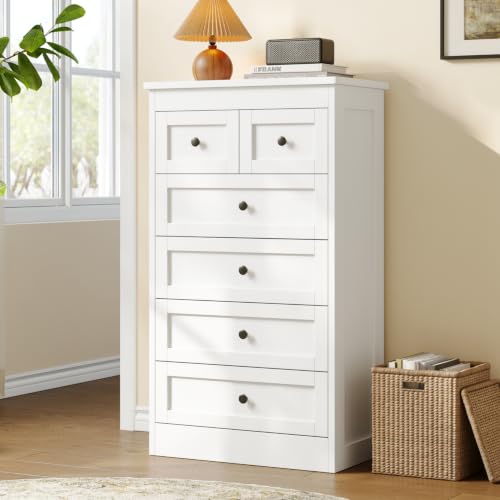
Skinny Dresser for Small Spaces: The Complete Storage Guide
Every inch matters when your bedroom is tight. This guide explains exactly how a narrow, slim, or shallow dresser can hold a full wardrobe routine without swallowing your floor space — and how to choose the right one before you commit.
Explore the Buying FactorsDresserAdvisor Philosophy: A skinny dresser for small spaces is not a compromise — it is a deliberate design decision. When the footprint is narrow and the drawer count is right, a slim unit often organizes clothing more efficiently than a wide, shallow one that forces you to stack sideways.
Why a Skinny Dresser Works in a Small Space
A small bedroom usually fails on one of two dimensions: floor area or walkway clearance. A standard wide dresser consumes 60 to 70 inches of wall and projects 18 to 20 inches into the room. In a compact bedroom, that projection is what makes a room feel cramped — you feel it at the foot of the bed and along the closet door swing.
A skinny dresser flips the geometry. It trades width for height. Instead of spreading storage horizontally across the wall, it stacks drawers vertically, keeping the projection to roughly 14 to 18 inches. The result is a piece that can slip beside a doorway, sit between two windows, or fit inside a closet without blocking movement. If your room is tight on depth rather than wall length, a shallow depth dresser for small spaces is the more precise solution.
The trade-off is real but manageable. Narrow drawers hold less per drawer, so you compensate with drawer count and internal organization. The payoff is a bedroom that reads as open even when the square footage is limited.
Skinny Dresser Dimensions: What Counts as Skinny
There is no single industry definition, but in practical terms, a dresser is considered skinny when its width falls below roughly 36 inches, or when its depth stays under about 18 inches. Most buyers are solving for one of those two numbers. Use the cards below to match the dimension to your actual constraint.
Width: 24–36 inches
The narrow-footprint zone. Ideal for slotting beside a door frame, between a bed and wall, or at the end of a short wall run. Often paired with a tall silhouette.
Depth: 14–18 inches
The projection-saving zone. Keeps walkways clear and closets usable. Anything below 12 inches limits folded-clothing depth noticeably.
Height: 40–60 inches
The vertical-storage zone. Recovers capacity lost to a narrow width. Tall units must be wall-anchored without exception.
A unit that is narrow in both width and depth is the most space-efficient option, but it usually carries the fewest drawers. If you need more capacity, prioritize a tall dresser that is skinny in width but standard in depth, and accept a slightly larger projection. For rooms where the closet itself is the problem, a narrow dresser designed to sit inside or beside a closet opening often solves more than a bedroom-floor unit would.
Drawer Layout and Capacity Planning
A skinny dresser lives or dies on drawer configuration. Because each drawer is narrower, the internal layout matters more than the external dimensions. The most useful configuration combines shallow drawers for folded tops with deeper drawers for bulky items, rather than a uniform stack of identical drawers.
- Five to six drawers is the practical minimum for one adult's folded clothing and accessories.
- Mixed depths — two shallow top drawers for socks and undergarments, three or four deeper drawers below for tops and knitwear.
- Interior width of at least 18 inches so folded shirts fit without folding twice.
- Metal ball-bearing glides with soft-close, since narrow drawers rack sideways under frequent pulling.
- Full-extension slides so you can see the back of the drawer, which matters when the drawer is deep but narrow.
If you prefer a shallower overall piece, a shallow dresser for a small bedroom combined with drawer dividers can match the usable capacity of a deeper unit. For closets specifically, a short dresser for closet placement avoids blocking hanging space above.
Pro Tip: Measure the Drawer Opening, Not Just the Unit
The exterior width tells you whether the dresser fits the room. The interior drawer width tells you whether your clothes fit the dresser. A 30-inch-wide dresser with thick side panels can leave only 22 inches of usable drawer width — enough for folded t-shirts, not enough for a neatly folded sweater without creasing.
What to Check Before You Buy
Buyers researching a skinny dresser are usually past the browsing stage — they know they want a narrow unit and need to confirm the details. These are the factors that separate a well-specified unit from one that disappoints after a month of use.
Stability & Anchoring
Tall, narrow units tip more easily than wide ones. Confirm the unit ships with an anti-tip strap and use it. In households with children, anchoring is non-negotiable.
Material & Build
Solid wood and high-grade engineered panels hold screws and glides far better than thin particleboard. Check that drawer boxes are joined, not stapled.
Hardware Quality
Side-mounted metal slides with ball bearings outlast plastic rollers. Soft-close prevents the slam that loosens narrow drawer boxes over time.
Finish & Coating
A sealed, moisture-resistant finish protects against humidity in small rooms where air circulation is limited. Painted finishes should be factory-applied, not touch-up.
Placement Clearance
Leave at least 24 inches of clear floor in front of any drawer you pull open. A skinny unit in a tight corner still needs swing room.
Assembly & Delivery
Flat-pack narrow dressers are common. Confirm the box dimensions fit your stairwell and doorway before ordering a tall unit.
Style is the last filter, not the first. A mid-century dresser or a Scandinavian dresser silhouette often translates well to a skinny footprint because both styles favor clean vertical lines. If you want a softer look, a ribbed dresser adds texture without adding width.
Skinny Dresser Tiers Compared
Not every narrow dresser is built to the same standard. The table below groups units by construction tier so you can match the build quality to how hard you plan to use the piece. Descriptors are relative to the category, not to any specific retailer.
| Tier | Typical Construction | Best For | Durability Outlook |
|---|---|---|---|
| Entry-Level | Engineered wood panels, roller glides, stapled drawer boxes | Guest rooms, dorm rooms, short-term rental setups | Serviceable for light use; expect glide wear within a few years |
| Mid-Range | Thicker engineered panels or wood veneer, metal ball-bearing slides, screwed joinery | Primary bedrooms, daily-use closets, shared apartments | Solid choice for the tier; glides and joinery hold up to daily pulling |
| Premium | Solid wood or high-grade plywood, soft-close full-extension slides, dovetail or dowel joinery | Long-term primary bedroom use, heirloom-style setups | Long-term investment; hardware is replaceable and construction tolerates re-tightening |
| Luxury | Hardwood solids, hand-finished surfaces, premium soft-close hardware, reinforced drawer bottoms | Design-led interiors, high-frequency use, statement placement | Flagship tier; built to outlast multiple room redesigns |
As a general rule, a mid-range skinny dresser is the most sensible starting point for a primary bedroom. The jump from entry-level to mid-range buys you better glides and joinery — the two failure points that matter most on a narrow unit. Moving from mid-range to premium is worthwhile if you plan to keep the piece through several moves. A solid wood chest in the premium tier is the most repair-friendly option over time.
Placement Strategies for Tight Bedrooms
Where you put the dresser determines whether the skinny footprint actually helps. A narrow unit placed badly can still block a walkway or make a room feel closed in. These placements work reliably in small bedrooms:
- Between the bed and the wall — use a unit no taller than the mattress line so the room stays visually open.
- Flanking the doorway — a 24-inch-wide unit can sit beside a door frame without interfering with the swing.
- Inside the closet — a dresser for closet placement frees bedroom floor space entirely.
- At the foot of the bed — only if 24 inches of clearance remains for drawer pull-out; otherwise choose a shallower unit.
- Under a window — a short, wide-capped skinny unit works if the sill height allows it; verify the height first.
Pro Tip: Anchor Before You Style
Install the anti-tip strap before you load the drawers. A tall skinny dresser with empty drawers is easy to shift into place; once loaded, it is heavy and awkward to reposition for anchoring.
When a Skinny Dresser Is Not the Right Answer
A skinny dresser solves narrow-width and shallow-depth problems, but it is not the only space-saving storage format. If your constraint is different, one of these alternatives may fit better:
If the room is short on wall space but has unused vertical room, a tallboy chest offers more drawer capacity in the same footprint. If the closet is the bottleneck, a slim chest of drawers for the bedroom paired with closet shelving often works better than a freestanding unit. If you need a piece that does double duty, a side dresser for bedroom placement can serve as both nightstand and secondary storage.
And if you are working with a genuinely tiny footprint — a studio, a converted attic, a dorm — a small 3 drawer dresser is often the more honest choice than forcing a five-drawer skinny unit into a space that cannot support it.
Ready to Compare Skinny Dresser Options?
Browse curated narrow and slim dressers selected for small-space bedrooms, closets, and tight floor plans.
View Recommended OptionsFrequently Asked Questions
What is the ideal depth for a skinny dresser in a small space?
A depth of 14 to 18 inches is the sweet spot for most tight bedrooms. Anything shallower than 12 inches limits folded-clothing capacity, while depths beyond 20 inches begin to crowd narrow walkways and closet openings.
Is a tall skinny dresser stable enough for a bedroom?
Yes, provided the unit is anchored to the wall with an anti-tip strap. Tall narrow chests have a smaller footprint, so the wall anchor is not optional — it is essential, especially in homes with children or pets.
How many drawers should a skinny dresser have?
For a single adult, four to six drawers is typical. Couples sharing a narrow unit should lean toward five or six drawers with a mix of shallow top drawers and deeper lower drawers.
Can a skinny dresser double as a nightstand?
A narrow dresser of 24 to 30 inches wide can work beside a bed if it is short enough to keep the mattress line clear. Taller slim chests are better placed against an empty wall or inside a closet.
Does drawer glide quality matter more on a narrow dresser?
It matters more, not less. Narrow drawers are pulled more frequently in tight quarters and can rack sideways if the glides are weak. Metal ball-bearing slides with a soft-close mechanism hold up best in daily use.
This guide is editorial and educational. Product availability and specifications change; always confirm dimensions and safety certifications with the retailer before ordering.