
Room Dresser: The Complete Guide to Choosing the Right Dresser for Your Space
Every room tells a story, and the right dresser helps write it. From compact guest rooms to spacious primary bedrooms, this guide walks you through size, style, storage, and placement so you can choose a room dresser that fits your space and your life.
Start the GuideWhat a Room Dresser Is and Why It Matters
A room dresser is more than a piece of storage furniture — it is the anchor of daily routines in a bedroom, nursery, or guest room. It holds folded clothing, accessories, and linens while also serving as a surface for lighting, décor, and personal items. When chosen well, a room dresser reduces clutter, improves the flow of a room, and makes getting dressed easier every morning.
The challenge is that no two rooms are the same. A dresser that works beautifully in a spacious primary bedroom may overwhelm a compact guest room or a nursery with a changing station. That is why the smartest approach is to start with the room itself — its dimensions, traffic patterns, and storage demands — and then select a dresser that supports those realities.
This guide is designed for readers in the research phase who already know they need a dresser and want to make a confident, informed decision. If you are still narrowing down the broader category, our overview of room dresser options is a helpful starting point, and our dresser types guide covers the full spectrum of styles and configurations.
Matching a Dresser to Each Room Type
Different rooms place different demands on a dresser. A piece that suits a primary bedroom may be too large for a guest room or too delicate for a shared children's room. The table below summarizes how room type typically influences dresser choice.
| Room Type | Best For | Typical Configuration | Tier Consideration |
|---|---|---|---|
| Primary Bedroom | Daily clothing storage and a styled surface | Wide six- to nine-drawer dresser | Mid-range to premium |
| Guest Room | Occasional storage and guest comfort | Three- to five-drawer dresser | Entry-level to mid-range |
| Nursery | Baby clothing and changing station support | Wide dresser with changing topper | Mid-range to high-end tier |
| Small Bedroom | Compact storage with minimal footprint | Tall or slim dresser | Entry-level to mid-range |
| Shared Children's Room | Durable, easy-to-organize storage for two | Wide dresser with labeled drawers | Mid-range |
Primary Bedroom
In a primary bedroom, the dresser is often the second-largest piece of furniture after the bed. This room can handle a wider footprint, so a six- to nine-drawer dresser provides generous storage and a comfortable surface for a mirror, lamp, and decorative accents. Consider a wide dresser if the wall opposite the bed is long, or a tall dresser if floor space is limited but vertical space is available.
Guest Room
Guest rooms need practical, welcoming storage without crowding the space. A three- to five-drawer dresser gives guests a place for folded clothing and keeps the room tidy between visits. If the room also serves as a home office or reading nook, choose a compact piece that doubles as a surface for a lamp and a small tray of essentials.
Nursery
A nursery dresser must balance storage and safety. A wide dresser with a secured changing pad creates a functional diapering station, while deep drawers hold baby clothing, blankets, and supplies. Anchor the dresser to the wall and avoid stacking heavy items on the top surface. Our guide to nursery dressers covers safety and layout in more detail.
Small Bedroom
Small bedrooms reward vertical thinking. A tall, narrow dresser uses wall height instead of floor width, preserving walkways and making the room feel less cramped. Slim and shallow options are especially effective — explore shallow-depth dressers and slim dressers for small bedrooms to find a footprint that fits.
Key Factors When Choosing a Room Dresser
Once you know the room, the next step is evaluating the dresser itself. Five factors matter most: dimensions, drawer configuration, material quality, hardware, and style alignment. Each one influences how well the dresser will perform over years of daily use.
Dimensions
Measure the wall, doorway, and clearance space before shopping. Drawers need room to open fully, and a dresser that blocks a walkway will quickly become a frustration.
Drawer Configuration
Deep drawers suit bulky items like sweaters, while shallow drawers work better for folded shirts and accessories. Mixed configurations offer the most flexibility.
Material Quality
Solid wood offers durability and repairability, while engineered wood with quality veneers can deliver a stable, consistent finish. Check drawer glides and joinery as closely as the exterior.
Hardware
Knobs and pulls affect daily comfort as much as appearance. Metal hardware in a finish that matches your other furniture creates visual cohesion.
Style Alignment
The dresser should feel like it belongs in the room. Match wood tones and finishes to existing furniture, or use the dresser as a deliberate accent piece.
Safety Features
Anti-tip hardware, sturdy construction, and smooth drawer stops are essential, especially in homes with children or pets.
Room Dresser Size and Placement Guide
Size and placement are closely linked. A dresser that fits the wall but leaves no room for drawers to open is not a good fit, no matter how attractive it looks. Use the guidance below to match dresser dimensions to the room.
| Room Size | Suggested Dresser Width | Suggested Style | Placement Priority |
|---|---|---|---|
| Compact (under 100 sq ft) | 30 to 44 inches | Tall or slim dresser | Narrow wall or corner |
| Standard (100 to 150 sq ft) | 44 to 60 inches | Five- to six-drawer dresser | Wall opposite the bed |
| Spacious (over 150 sq ft) | 60 to 72 inches | Wide six- to nine-drawer dresser | Long wall with mirror above |
Clearance and Traffic Flow
Leave at least 24 to 30 inches of clearance in front of the dresser so drawers can open fully and people can move comfortably. In bedrooms, avoid placing the dresser where it blocks the path between the door and the bed. If the room has a closet with sliding doors, ensure the dresser does not obstruct the door track.
Placement Ideas by Room
- Opposite the bed: The most common and visually balanced placement, leaving space for a mirror or artwork above.
- Beside the window: Natural light helps with visibility and makes the dresser surface useful for grooming items.
- Along a narrow wall: A slim or shallow dresser keeps walkways open in compact rooms.
- Inside a closet: A short dresser can turn a walk-in closet into a complete dressing area.
- As a room divider: In open-plan or studio spaces, a dresser with a finished back can separate zones.
Style, Material, and Finish Considerations
Style is personal, but cohesion is universal. A room dresser should relate to the other pieces in the room — the bed frame, nightstands, and any seating — through shared wood tones, hardware finishes, or design language. The good news is that "matching" does not mean "identical." A mid-century dresser can sit comfortably beside a traditional bed if the wood tones and scale are complementary.
Popular Style Directions
Modern and Minimalist
Clean lines, flat fronts, and integrated handles. A strong choice for contemporary bedrooms where visual calm matters.
Farmhouse and Rustic
Warm wood tones, paneled fronts, and simple metal hardware. Works well in relaxed, textured rooms.
Mid-Century Modern
Tapered legs, angled profiles, and walnut or teak finishes. Pairs naturally with low-profile beds and open space.
Traditional
Detailed molding, curved fronts, and classic hardware. Suits rooms with layered textiles and formal furniture.
Scandinavian
Light woods, white finishes, and functional simplicity. Ideal for bright, airy bedrooms with limited space.
Industrial
Metal frames, exposed hardware, and dark finishes. A confident accent in loft-style or urban rooms.
Material and Finish Notes
Solid wood dressers are a long-term investment that can be sanded and refinished if the surface wears. Engineered wood with quality veneers offers stability and consistent color, and modern finishes resist everyday wear. Painted finishes are easy to refresh in a new color, which makes them a practical choice for children's rooms and guest spaces. If you plan to refinish a second-hand piece, our guide to sanding and repainting furniture covers the process step by step.
Storage Strategy for Every Room
A dresser only works as well as the system inside it. Assigning a purpose to each drawer — and sticking to it — prevents the dresser from becoming a catch-all. The approach below works across room types.
Drawer Assignment by Room
- Primary bedroom: Top drawer for accessories and delicates, middle drawers for folded shirts and trousers, bottom drawers for bulky knitwear and linens.
- Guest room: One drawer for bed linens, one for towels, and one or two empty drawers for guest use. A small tray on top for essentials.
- Nursery: Top drawers for diapering supplies within easy reach of the changing pad, lower drawers for clothing sorted by size.
- Small bedroom: Use drawer dividers to create zones within each drawer, maximizing every inch of vertical and horizontal space.
Organization Accessories That Help
Drawer dividers, drawer liners, and small bins turn a single large drawer into several defined compartments. They are especially useful in shallow drawers where folded items can slide around. For deeper storage planning across the whole room, our bedroom storage ideas collection includes closet, under-bed, and dresser-specific solutions.
Recommended Room Dressers and Bedroom Storage
⚠️ AFFILIATE DISCLOSURE: This website contains affiliate links. As an Amazon Associate, we earn from qualifying purchases. If you make a purchase through these links, we may receive a small commission at no additional cost to you. Read our full affiliate policy.

OLIXIS 9 Drawer Black Dresser for Bedroom, Closet Organizer Storage Tower | Easy-Pull Chest of Fabric Drawers, Lightweight Clothes Organizer, Anti-Tip Design, Space-Saving Storage for Dorm, Apartments
Check price on Amazon
OneBlis 6 Drawer Dresser with LED Lights & Charging Station, Modern Floating Black Dresser for Bedroom, Smart Storage Chest with 2 AC Outlets & USB Ports for Living Room, Closet, Entryway (Black)
Check price on Amazon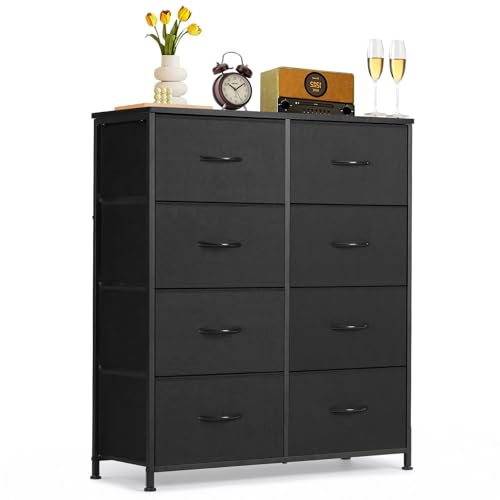
8-Drawer Dresser for Bedroom, Anti-Tip Tall Storage Organizer | Chest of Drawers with Wooden Top and Metal Frame Fabric Bins for Closet, Living Room, Hallway, Entryway, Black
Check price on Amazon
SONGMICS Dresser for Bedroom, Wide Dresser with 5 Fabric Drawers | Chest of Drawers with Steel Frame, for Closet & Entryway, Ink Black and Ebony Black, BELLAH Collection ULGS322B01S
Check price on Amazon
Jocoevol Black 5 Drawer Dresser for Bedroom, 15" D x 23.7" W x 40.4" H in Simply Chest of Drawers, Wood Storage Dresser with Drawers for Living Room Hallway Entryway, Black
Check price on Amazon
VASAGLE 6-Drawer Dresser, Chest of Drawers, 46.9 x 15.8 x 30.7 Inches | Storage Tower Unit, Modern Basic Style, for Bedroom, Closet, Living Room, Ink Black, CUSTOS Collection ULTS416BC01S
Check price on Amazon
OLIXIS Black Dresser for Bedroom with 7 Fabric Drawers Storage Organizer | Wardrobe Closet for Clothes Storage, Steel Frame & Wooden Top, Cabinet Vertical Dresser for Living Room, Entryway Hallway
Check price on Amazon
MapleGrace 53" Wide 6 Drawer Dresser for Bedroom, Modern Simple Wood Dresser Chest of Drawers Closet Store Organizer for Living Room, Hallway (White, 15.4" D x 53.1" W x 30.9" H (6 Drawers))
Check price on AmazonFrequently Asked Questions
What size room dresser should I choose for a standard bedroom?
For a standard bedroom, a wide dresser between 50 and 70 inches is a solid choice, while a tall chest works well in rooms with limited floor space. Always leave at least 24 to 30 inches of clearance for drawers to open fully.
Where should I place a dresser in a small bedroom?
In a small bedroom, place the dresser on the wall opposite the bed or beside the window where natural light helps with visibility. A slim or shallow dresser along a narrow wall keeps the room feeling open.
Is a dresser necessary in a guest room?
A dresser in a guest room is not strictly necessary, but it adds practical storage and helps guests feel settled. A small three-drawer dresser or a dual-purpose piece works well without crowding the space.
How do I match a room dresser to my existing furniture?
Match the dresser to your existing furniture through consistent wood tones, hardware finishes, and scale. Blending styles is acceptable as long as the proportions and color palette feel cohesive.
Should I choose a dresser with a mirror for my room?
A dresser with a mirror is helpful in rooms where you get dressed and check your appearance, and it also makes a space feel larger by reflecting light. However, mirrors can overwhelm small rooms, so consider a separate wall mirror if space is limited.
Ready to Choose Your Room Dresser?
Use the sizing and placement guidance in this guide to narrow your options, then explore curated dressers and bedroom storage picks to complete your space.
Explore Recommended Options