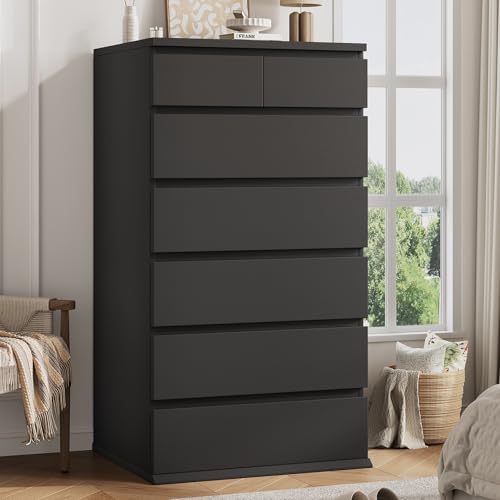
Large Tall Dresser for Bedroom: The Complete Buying Guide
Maximize vertical storage without sacrificing floor space. Learn how to choose a large tall dresser that fits your room, your wardrobe, and your long-term needs.
Explore Buying Factors
Why a large tall dresser deserves a closer look: In bedrooms where floor space is limited but clothing volume is not, a tall dresser delivers the storage of a wide unit while occupying a compact footprint. This guide walks you through sizing, materials, drawer layouts, safety, and styling so you can make a confident decision before you shop.
What Makes a Dresser "Large" and "Tall"?
Furniture terminology can be inconsistent across retailers, so it helps to anchor the definition in measurable terms. A large tall dresser for bedroom use generally combines two characteristics: a vertical profile that puts the top edge between 48 and 60 inches above the floor, and a footprint wide enough to accommodate five or more drawers in a stacked configuration. Width typically ranges from 36 to 48 inches, while depth stays between 18 and 22 inches—deep enough for folded garments but shallow enough to keep the unit from dominating the room.
This combination distinguishes a tall dresser from a low, wide dresser that prioritizes horizontal surface area, and from a compact chest that sacrifices capacity for portability. If you are still weighing categories, our overview of large dressers and the comparison between large tall chest of drawers for bedroom layouts can help clarify which form factor suits your routine. Many shoppers discover that a tall configuration is the more efficient choice for rooms with limited wall width.
Key Buying Factors to Evaluate Before You Shop
1. Height and Reachability
The top of a tall dresser should be reachable without a step stool for everyday items. A height of 48 to 54 inches works well for most adults, while units approaching 60 inches are better suited to storing seasonal or occasional items in the uppermost drawer. If the dresser will sit beside a bed, check that the top surface aligns comfortably with the mattress height for a balanced visual line and convenient access to a lamp or alarm clock.
2. Drawer Count and Configuration
Drawer layout matters as much as drawer count. A typical large tall dresser offers five to eight drawers arranged in two columns or a single wide column. Smaller top drawers suit accessories, socks, and folded delicates, while deeper lower drawers handle sweaters, jeans, and bulkier items. Look for drawer interiors that are at least 14 inches deep front-to-back so folded stacks do not exceed the drawer's capacity and jam against the frame.
3. Material and Construction Quality
Solid wood—oak, maple, walnut, or pine—remains the benchmark for durability and repairability. Engineered wood with quality veneers offers a balanced tier option with consistent finishes and good dimensional stability. At the high-end tier, look for dovetail drawer joinery, reinforced corner blocks, and metal drawer glides rated for frequent use. If you are comparing finishes and wood types, our large solid wood chest of drawers guide digs into grain, hardness, and maintenance differences.
4. Finish and Aesthetic Fit
Finish choices range from natural wood tones to painted surfaces and lacquered finishes. A lacquer dresser brings a smooth, reflective surface that suits modern and transitional bedrooms, while a natural wood finish warms up rustic and farmhouse schemes. Keep the finish consistent with nearby furniture and consider how it will age in sunlight.
5. Safety and Stability
Tall furniture carries a higher tip-over risk than low units, so wall anchoring is non-negotiable. Choose a dresser with an anti-tip kit included or compatible with standard wall straps. Avoid loading the top drawers with heavy items, and confirm that the unit meets recognized furniture stability standards. If the dresser will be used in a nursery or a child's room, prioritize models with interlocking drawer mechanisms and rounded edges.
Large Tall Dresser Categories at a Glance
| Tier |
Best For |
Typical Construction |
Drawer Features |
| Essential tier |
Guest rooms, first apartments, secondary bedrooms |
Engineered wood with laminated or veneered surfaces |
Standard roller glides, four to six drawers |
| Balanced tier |
Primary bedrooms with daily use |
Mixed solid wood and engineered components |
Smooth metal glides, five to seven drawers, dovetail front joints |
| Premium tier |
High-traffic bedrooms, long-term ownership |
Solid hardwood frame with reinforced joinery |
Full-extension ball-bearing glides, six to eight drawers |
| Luxury tier |
Statement bedrooms, design-led interiors |
Solid hardwood with hand-finished detailing |
Soft-close mechanisms, custom drawer dividers, seven or more drawers |
Use this table to orient yourself before browsing specific products. The right tier depends on how intensively the dresser will be used, how long you plan to keep it, and how much storage capacity your wardrobe requires. A balanced-tier model often offers the most sensible combination of durability and refined hardware for a primary bedroom.
How to Organize a Tall Dresser Efficiently
A tall dresser rewards a deliberate approach to drawer organization. Because the vertical stack compresses many storage zones into a narrow column, assigning specific categories to each drawer prevents the unit from becoming a catch-all. A practical pattern for a five-to-seven-drawer dresser looks like this:
- Top drawers: socks, underwear, belts, and small accessories in dividers.
- Upper-middle drawers: folded shirts, t-shirts, and lightweight knitwear.
- Lower-middle drawers: jeans, trousers, and structured garments that benefit from a deeper tray.
- Bottom drawers: bulkier sweaters, seasonal items, or spare linens.
For deeper drawers, vertical folding—sometimes called file folding—keeps every item visible and prevents stacks from collapsing. Drawer dividers and shallow trays are especially useful in narrow tall dressers where the drawer width is limited. If you are refining the interior further, our guide on large capacity dresser layouts explores how to partition deep drawers for maximum usable volume.
Placement Tips for Bedroom Layouts
Positioning a tall dresser well is a matter of both function and visual balance. The unit should sit against a wall with at least 24 to 30 inches of open floor in front so the drawers can extend fully. In narrow bedrooms, a tall dresser placed perpendicular to the bed can act as a subtle room divider while keeping the walking path clear. Avoid placing the dresser directly beside a window if the finish is sensitive to prolonged sunlight, or use a sheer curtain to diffuse exposure.
For rooms with limited wall width, a large walk-in closet dresser or a tall unit tucked into a closet alcove can absorb overflow clothing without crowding the sleeping area. If you are planning a broader bedroom refresh, the ideas in our large bedroom dresser with mirror article show how a mirrored top surface can add light and depth without requiring extra floor space.
Quick Quality Checklist Before You Commit
- Open and close every drawer—glides should move smoothly without wobble.
- Check that drawer fronts align evenly and gaps are consistent.
- Confirm the unit includes or supports an anti-tip wall anchor.
- Inspect the back panel for a sturdy, fully attached construction.
- Verify that the finish is sealed and free of rough edges.
- Measure your doorway and stairwell before delivery day.
Frequently Asked Questions
What defines a large tall dresser for a bedroom?
A large tall dresser typically stands between 48 and 60 inches high with a footprint of at least 36 inches wide and 18 inches deep. It usually offers five or more drawers stacked vertically, providing substantial storage without consuming much floor space.
How much floor space does a tall dresser need?
Plan for a footprint of roughly 36 to 48 inches wide and 18 to 22 inches deep, plus at least 24 to 30 inches of clearance in front so drawers can open fully. Always account for wall clearance behind the unit and room to walk past it.
Are tall dressers safe for bedrooms?
Yes, when properly secured. Tall dressers should always be anchored to the wall using anti-tip straps or brackets. Avoid overloading upper drawers and choose units that meet recognized furniture stability standards. This is especially important in homes with children or pets.
What materials are best for a large tall dresser?
Solid wood such as oak, maple, or walnut offers the most durable construction and longevity. Engineered wood with quality veneers provides a balanced alternative with consistent finishes. For high-end tier pieces, solid hardwood with dovetail joinery and metal drawer glides is the benchmark of quality.
How many drawers should a tall dresser have?
Most large tall dressers feature five to eight drawers. A common layout pairs two or three smaller top drawers for accessories with three to five deeper drawers below for clothing. The ideal count depends on your storage needs and how you organize garments.
Explore Related Dresser Guides