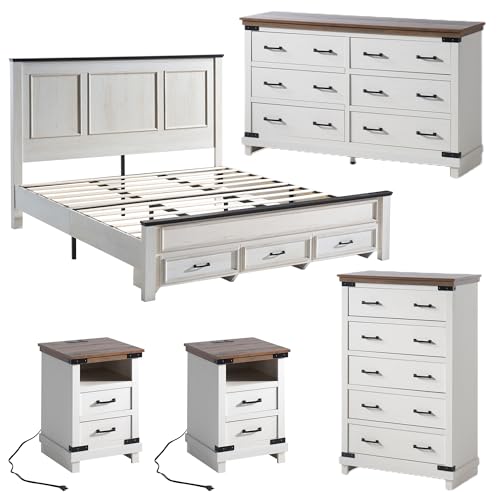
King Size Headboard and Dresser Set: The Complete Guide
Everything you need to know before choosing a matching king headboard and dresser set — sizing, materials, style coordination, storage features, and the details that separate a well-specified set from an entry-level one.
Explore the Buying FrameworkWhy a coordinated set matters: A king size headboard and dresser set anchors the visual language of your bedroom. When the headboard silhouette, wood tone, and hardware of the dresser share a design family, the room reads as intentional rather than assembled piecemeal. This guide walks you through the practical decisions — measurement, material tier, storage layout, and style pairing — so you can evaluate any set on the market with confidence.
What Exactly Comes in a King Size Headboard and Dresser Set?
Terminology in bedroom furniture is loose, and that is the first trap for buyers. A "king size headboard and dresser set" can mean several different bundles depending on the retailer. Before you commit, confirm the component list, because a set that looks like a full bedroom collection in a product photo may ship as only two pieces.
Most commonly, these sets fall into three configurations:
- Two-piece core set: a king-sized headboard plus one dresser. This is the cleanest interpretation and the most common on major marketplaces.
- Expanded set: headboard, dresser, and a matching nightstand. Often marketed as a headboard, dresser, and nightstand set for buyers who want coordinated bedside storage.
- Full bedroom bundle: headboard, dresser, mirror, nightstand, and sometimes a bed frame or chest. If you are comparing a broader package, look at king bedroom sets with dresser options, which typically list every included component explicitly.
A related but distinct category is the king size bed and dresser set, which includes a complete bed rather than only a headboard. If your existing bed frame is sound and you only want to upgrade the visual anchor and storage, the headboard-focused set is usually the more efficient path. If you are furnishing from scratch, a full bundle avoids the risk of a mismatched frame.
Verify before you order
Check three things in every listing: (1) the exact component list, (2) whether the headboard is freestanding or requires a bed frame attachment, and (3) whether the dresser arrives assembled or flat-packed. These three details cause the majority of post-purchase surprises with coordinated bedroom sets.
Sizing and Fit: Getting the Measurements Right
A standard king mattress measures 76 inches wide by 80 inches long. A king headboard should be at least as wide as the mattress and is often one to four inches wider on each side for visual balance. Anything narrower than the mattress will look undersized and leave the bedding edges exposed.
Headboard height is where personal preference meets practical function. Low-profile headboards in the 36 to 44 inch range suit modern and minimalist rooms. Mid-height designs around 48 to 56 inches work well with most upholstered and panel styles. Tall statement headboards of 60 inches and above create a dramatic focal point but demand higher ceilings and more wall clearance.
For the dresser, the two numbers that matter are wall width and clearance. Measure the available wall segment, then subtract a few inches of breathing room on each side. In front of the dresser, allow 24 to 36 inches of walking space plus the full drawer extension depth — a wide dresser with deep drawers needs substantially more floor clearance than its footprint suggests. If your room is tight, our guide to how to choose a dresser covers proportional sizing in more detail.
| Bedroom Size | Recommended Dresser Width | Recommended Headboard Height | Best For |
|---|---|---|---|
| Compact (under 120 sq ft) | 48–56 inches | 36–44 inches | Narrow wall segments, apartment bedrooms |
| Standard (120–180 sq ft) | 56–66 inches | 44–56 inches | Most primary bedrooms |
| Spacious (180+ sq ft) | 66–72 inches | 56–68 inches | Statement focal walls, suite-style rooms |
Materials and Construction Quality
Construction quality is the single biggest determinant of how a set will look and function after five years of daily use. Because the headboard and dresser are used differently — one is largely static against a wall, the other cycles through drawers every day — evaluate them on separate criteria.
Headboard Construction
- Solid wood: the most durable choice and the most refinishable. A high-quality solid wood dresser paired with a solid wood headboard will age consistently as both pieces develop patina.
- Engineered wood with veneer: stable and resistant to seasonal movement. Mid-range sets in this category are well-specified for the tier and hold up well when the veneer is thick and properly bonded.
- Upholstered panels: adds acoustic softness and reading comfort. Check that the frame beneath the fabric is hardwood rather than particleboard, since the fabric hides structural shortcuts.
- Metal: a professional-grade metal frame with reinforced joints is the most stable option for tall headboards, and it pairs naturally with industrial dresser styles.
Dresser Drawer Mechanics
Drawer hardware is where entry-level sets reveal themselves. Basic sets use stapled particleboard drawer boxes on simple wooden runners. Mid-range sets typically upgrade to metal ball-bearing slides. High-end tiers use dovetail joinery with undermount soft-close slides and a reinforced bottom panel.
A practical stress test: open the heaviest drawer fully loaded and check for side-to-side wobble. If the drawer box flexes, the slides and bottom panel are under-specified for daily use. For buyers who expect to store heavy items like denim, linens, or books, our guide to heavy-duty drawer slides explains the load ratings and extension types worth prioritizing.
Style Coordination: Matching Headboard and Dresser
A coordinated set should share at least two of three visual signals: wood tone or finish, hardware style, and silhouette language. When all three align, the pairing reads as a designed set. When only one aligns, the room can feel accidental.
Start with the finish. A painted headboard pairs cleanly with a painted or natural wood dresser in a complementary tone. A stained headboard pairs best with a dresser in the same wood family or a deliberately contrasting painted finish. If you are drawn to darker wood, a walnut dresser often partners well with a walnut or upholstered headboard for a cohesive, grounded look.
Hardware is the second signal. Brass and gold pulls lend warmth to mid-century and transitional sets; matte black hardware suits industrial and modern farmhouse rooms; natural wood knobs keep Scandinavian and japandi spaces restrained. Matching hardware finishes across the headboard and dresser is the fastest way to create visual unity in a two-piece set.
Silhouette is the third. A tall, arched headboard with a low, wide dresser creates a deliberate contrast of scale. A linear, rectangular headboard pairs most naturally with a clean-lined horizontal dresser. Neither approach is wrong — the goal is that the relationship looks chosen rather than coincidental.
| Style Direction | Headboard Signal | Dresser Signal | Best For |
|---|---|---|---|
| Mid-Century | Tapered legs, walnut frame, low profile | Angled legs, brass pulls, warm veneer | Open, airy bedrooms |
| Modern Minimalist | Flat panel, neutral upholstery | Handleless drawers, matte finish | Small and mid-size rooms |
| Farmhouse | Plank detailing, painted or reclaimed wood | Cup pulls, distressed finish, wide top | Cozy primary suites |
| Transitional | Arched or shaped top, subtle molding | Framed drawer fronts, mixed-metal hardware | Formal bedrooms |
| Industrial | Metal frame, riveted panels | Metal trim, exposed hardware, dark finish | Loft and urban bedrooms |
Storage Features Worth Prioritizing
A dresser in a king set carries most of the bedroom's storage load, so drawer layout matters more than drawer count alone. Six to eight drawers is the practical sweet spot for a couple sharing a king bed: one side for folded tops, the other for bottoms, with the top drawer reserved for smaller items.
Look for these features when comparing sets:
- Felt-lined top drawer: protects jewelry, watches, and delicates without a separate organizer.
- Full-extension slides: lets you reach the back of deep drawers. Our comparison of heavy-duty full-extension drawer slides explains the difference in usable capacity.
- Soft-close mechanism: prevents slam damage and is standard on high-end tiers.
- Dust panels between drawers: keeps stored clothing clean and adds structural rigidity.
- Anti-tip hardware: non-negotiable for tall dressers and essential in households with children.
If you need additional capacity beyond the dresser, consider whether the headboard itself offers storage. A headboard with storage adds concealed compartments without consuming floor space, which is especially useful in rooms where the dresser must sit close to the bed. For rooms with very tight footprints, our ideas for guest bedroom storage translate well to compact primary bedrooms.
Quality Tiers: How Sets Differ Across the Market
Because bedroom sets vary enormously in construction, it helps to classify them by tier rather than by individual features. The descriptors below describe relative market position and are consistent regardless of retailer or region.
| Tier | Headboard Construction | Dresser Construction | Best For |
|---|---|---|---|
| Entry-level | Engineered wood panel, fabric wrap | Particleboard box, wooden runners | Guest rooms and short-term setups |
| Mid-range | Hardwood frame with upholstery or veneer | Plywood box, ball-bearing slides | Daily use in primary bedrooms |
| Premium | Solid hardwood frame, quality fabric | Dovetail joinery, soft-close slides | Long-term primary suite investment |
| Luxury | Kiln-dried hardwood, designer upholstery | Full hardwood, undermount slides, dust panels | Heirloom-quality furnished suites |
The jump from entry-level to mid-range is the most consequential for daily satisfaction: slides become smooth, drawer boxes stop flexing, and the finish resists chipping at the edges. The jump from premium to luxury is more about longevity and refinement than function. For buyers planning to keep a set for a decade or more, the premium tier is generally the most efficient long-term investment.
Assembly, Placement, and Care
Most flat-packed sets assemble in two to four hours with basic tools. Two adults are recommended for anything involving a king headboard, since the panel is wide and awkward to balance alone. Anchor the headboard to the wall or bed frame using the supplied hardware, and attach anti-tip straps to the dresser regardless of its height.
Placement follows a simple rule: the dresser should not block the natural walking path between the bed and the door. If the room allows only one wall for both pieces, put the headboard on the longest uninterrupted wall and the dresser on an adjacent wall with drawer clearance.
For care, dust weekly with a microfiber cloth and avoid silicone-based polishes on wood finishes. Upholstered headboards benefit from a vacuum with a brush attachment every few weeks, and spot cleaning should follow the fabric code on the tag. If the set will sit in a humid room, a dehumidifier extends the life of both wood and fabric.
Common Buying Mistakes to Avoid
- Assuming "king set" means a full bed. Many listings include only the headboard. Confirm the component list before ordering.
- Buying the dresser before measuring the wall. A 66-inch dresser will not fit a 58-inch wall segment, and returns on oversized furniture are costly in time and effort.
- Ignoring drawer extension clearance. A wide dresser needs 20 to 24 inches of open floor in front when drawers are fully extended.
- Mixing three different wood tones. Two tones can be intentional; three usually reads as mismatched.
- Skipping anti-tip hardware. Tall dressers without wall anchoring are a known safety hazard.
If you are comparing a headboard set against other bedroom configurations, our overview of headboard and dresser sets covers the broader category, and the headboard with drawers guide is useful if you want storage integrated into the headboard itself.
Frequently Asked Questions
What is included in a king size headboard and dresser set?
A typical set includes a king-sized headboard and a coordinating dresser. Some bundles add a nightstand, mirror, or bed frame. Always verify the exact component list, because retailers use the same phrase for different configurations.
How do I measure for a king headboard and dresser set?
Measure the wall width for the headboard, confirm the mattress is a standard king at 76 by 80 inches, and leave 24 to 36 inches of walking clearance around the dresser. Add the full drawer extension depth to the dresser's footprint when checking floor clearance.
Should the headboard and dresser match exactly?
Exact matching creates a cohesive look, but coordinated contrast works well too. Pairing a solid wood headboard with a complementary finish dresser looks intentional when the wood tone, hardware, and silhouette share a common design language.
What materials are best for a king size headboard and dresser set?
Solid wood offers durability and refinishability for long-term use. Engineered wood with quality veneers delivers stable construction at a mid-range tier. Upholstered headboards add comfort and acoustic softness but require fabric care.
Is a headboard and dresser set enough for a primary bedroom?
For many couples, yes — a six to eight drawer dresser plus closet space covers most storage needs. If you need more capacity, add a nightstand or a storage headboard rather than a second dresser, which can overcrowd the room.
Ready to Compare King Headboard and Dresser Sets?
Use the framework above to evaluate any set on the market: confirm the component list, measure your wall and drawer clearance, match two of three style signals, and check the drawer mechanics. The recommended sets below are selected to cover entry-level, mid-range, and premium tiers so you can compare construction and features side by side.
View Recommended Sets