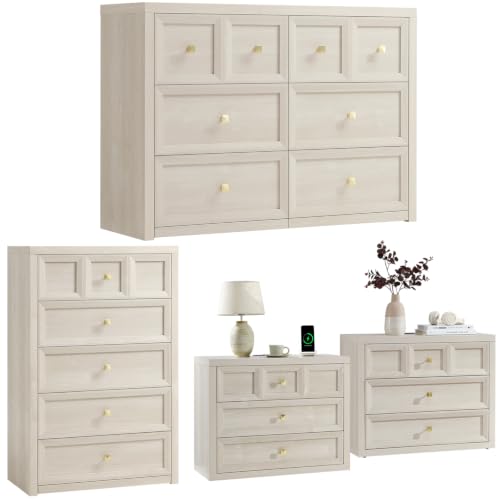
4 Piece Dresser and Nightstand Set: The Complete Buyer's Guide
A coordinated four-piece bedroom set removes the guesswork from furniture shopping. Learn what each configuration includes, how to judge build quality, and how to choose a set that fits your room and storage needs.
Explore Recommended SetsWhy a four-piece set makes sense: Buying a dresser, chest, and two nightstands separately often leads to mismatched finishes and inconsistent hardware. A curated 4 piece dresser set delivers a unified look, simplifies delivery, and usually includes a shared design language across every drawer front and pull.
What Is Included in a 4 Piece Dresser and Nightstand Set?
The term "four-piece set" is not standardized across the furniture industry, so the first step is confirming the exact component list. Most configurations fall into one of three patterns, each with a different storage profile and room footprint.
| Configuration | Typical Components | Best For | Storage Profile |
|---|---|---|---|
| Classic Dresser Set | 1 dresser + 1 chest + 2 nightstands | Primary bedrooms with two sleepers | Highest drawer count, broadest coverage |
| Dresser and Nightstand Pair | 1 wide dresser + 1 tall dresser + 2 nightstands | Rooms with a long empty wall | Wide horizontal storage, shallow depth |
| Mirror-Added Set | 1 dresser + 1 mirror + 2 nightstands | Bedrooms without a built-in vanity | Moderate storage, adds a grooming station |
If you need a different combination, similar curated bundles exist. A 3 piece dresser and nightstand set drops the chest for smaller rooms, while a 2 piece dresser and nightstand set works well for guest bedrooms or apartments where a single dresser and one nightstand are sufficient.
How to Plan Storage Around Your Set
Drawer count is the most practical metric for comparing sets, but distribution matters just as much as the total. A six-drawer dresser with two wide bottom drawers handles folded clothing differently than six equal shallow drawers.
Match Drawer Depth to What You Store
- Shallow drawers (4–6 inches): Ideal for folded shirts, underwear, and accessories. These benefit from dividers and keep small items visible.
- Mid-depth drawers (7–9 inches): The most versatile size. Suitable for sweaters, jeans, and most everyday clothing.
- Deep drawers (10+ inches): Best for bulky items such as bedding, winter coats, and off-season clothing. A 12 deep dresser configuration is a practical reference point for this category.
Consider Nightstand Functionality
Nightstands in a four-piece set are often treated as an afterthought, but they carry daily-use items. Check whether each nightstand includes at least one drawer for privacy plus an open shelf or surface for a lamp and phone. Two-drawer nightstands are the most common pairing; single-drawer designs with an open cubby suit minimalist rooms.
Practical rule of thumb: For two adults sharing a primary bedroom, aim for a minimum of 12 total drawers across the set. A 4-piece set with a 6-drawer dresser, a 4-drawer chest, and two 2-drawer nightstands delivers 14 drawers and comfortably covers most couples' needs without overflow into closets.
Materials and Build Quality: What Separates Tiers
Furniture sets are commonly grouped into three quality tiers. Understanding the differences helps you judge whether a set is well-specified for its class rather than relying on surface appearance alone.
| Tier | Typical Construction | Drawer Mechanics | Longevity Outlook |
|---|---|---|---|
| Entry-Level | Engineered wood panels with printed or thin veneer finishes | Standard side-mount slides, stapled or glued joints | Suitable for temporary or light-use rooms |
| Mid-Range | Engineered wood core with solid wood veneers, some solid wood components | Ball-bearing side-mount or basic undermount slides | Solid choice for the tier, reliable for years of daily use |
| Premium / Luxury | Solid wood frames, dovetail drawer boxes, reinforced corner blocks | Soft-close undermount slides with full extension | Long-term investment, serviceable and refinishable |
Details Worth Inspecting
- Drawer joints: Dovetail joints signal higher-grade construction. Box joints and stapled joints are common at entry-level.
- Drawer bottoms: A captured or dadoed bottom resists sagging better than a stapled panel.
- Slide extension: Full-extension slides let you reach the back of the drawer. Three-quarter extension leaves rear items harder to access.
- Finish consistency: On a set, all four pieces should share the same sheen and grain direction. Slight variations are normal in real wood veneers.
- Back panels: A rigid back panel prevents racking and keeps the piece square over time.
If you are comparing materials in more depth, our guide to solid wood versus engineered construction breaks down how each behaves under humidity changes and daily use.
Sizing the Set to Your Room
A four-piece set adds furniture to multiple walls, so measure before you commit. The dresser usually anchors one wall, the chest occupies a corner or secondary wall, and the nightstands flank the bed.
Key Measurements to Take
- Bed wall width: Leave at least 24 inches of clearance on each side of the bed for nightstands and walking space.
- Dresser wall length: A standard six-drawer dresser runs roughly 58 to 64 inches wide. Confirm there is room for drawer pull-out plus walking clearance in front.
- Door and hallway width: Wide dressers often ship in one piece. Measure entryways and stair turns before ordering.
- Ceiling height: Tall chests should not crowd low ceilings. Leave visual breathing room above the top surface.
For rooms with limited floor space, narrower alternatives such as a 36 inch wide dresser or a 30 inch wide dresser can be substituted within a coordinated collection. If the room is generous, a 48 inch dresser provides substantially more surface area and drawer width.
Style Coordination Across All Four Pieces
The main advantage of a set is visual consistency. To preserve that consistency, think about how the pieces will relate to the rest of the room.
Finish and Hardware
Matching wood tones across four pieces creates a calm, unified backdrop. If the room already has a strong wood floor or an heirloom bed frame, choose a set with a complementary rather than identical tone. Hardware should repeat across the dresser, chest, and nightstands; mixed pulls within a set usually look accidental rather than intentional.
Style Families That Work Well as Sets
- Modern: Clean lines, minimal ornamentation, often paired with flat-front or recessed-pull drawers.
- Mid-century: Tapered legs, warm wood tones, and angled drawer fronts.
- Farmhouse: Planked surfaces, distressed finishes, and cup or bar pulls.
- Transitional: A blend of traditional moldings and simplified silhouettes, which suits most homes.
You can explore these directions further in our overview of dresser types and the modern dressers collection.
Placement Strategies for a Four-Piece Set
Not every set needs to live in one room. Because the pieces share a finish, they can be distributed across the home without losing cohesion.
Primary Bedroom Layout
Place the dresser on the longest uninterrupted wall opposite the bed. Position the chest perpendicular to it, ideally near a closet entrance so it functions as a secondary staging area. Nightstands should sit flush with the mattress height for easy reach.
Distributed Layout
Use the dresser and one nightstand in the primary bedroom, place the second nightstand in a guest room, and move the chest into a hallway, nursery, or walk-in closet. This approach maximizes the value of the set in smaller homes. A dresser for closet placement works especially well for the chest component.
Anchor point: Whichever room receives the dresser becomes the visual anchor. Keep that room's palette restrained so the wood finish reads as intentional rather than competing with other strong colors.
Four-Piece Sets vs. Other Set Sizes
Buyers often weigh a four-piece set against smaller or larger bundles. The right choice depends on room count and how much drawer storage you actually need.
| Set Size | Coverage | Consider When |
|---|---|---|
| 2-Piece Set | One dresser plus one nightstand or mirror | Guest rooms, apartments, or single-occupant bedrooms |
| 3-Piece Set | Dresser, chest, and one nightstand (or similar) | Primary bedrooms with one occupant or compact layouts |
| 4-Piece Set | Dresser, chest, and two nightstands (or mirror variant) | Couples' bedrooms and rooms needing full coverage |
Larger households sometimes step up to a two nightstands and dresser set with additional components, or combine a four-piece set with a separate 10 drawer dresser for high-volume storage.
Common Mistakes When Buying a Four-Piece Set
- Assuming all sets contain the same pieces. Always read the component list; some "four-piece" sets include a mirror instead of a chest.
- Ignoring drawer slide quality. Slides are the most frequent failure point on dressers. Confirm the slide type and weight rating.
- Overlooking delivery logistics. Oversized dressers may require room-of-choice delivery. Verify what the retailer includes.
- Skipping wall anchoring. Dressers and chests should be anchored to the wall, especially in homes with children. Confirm the set includes or supports anti-tip hardware.
- Buying for looks alone. A set that fits the room's dimensions and storage needs will always serve better than one chosen purely on style.
Frequently Asked Questions
What is included in a 4 piece dresser and nightstand set?
A typical set includes one dresser, two nightstands, and either a matching chest of drawers or a mirror. Some configurations swap the chest for a second dresser or a bench. Always confirm the exact component list before purchasing, since definitions vary between brands.
How much storage space does a 4 piece set provide?
Storage volume depends on drawer count and dresser width. A standard set with a 6-drawer dresser, a 4-drawer chest, and two 2-drawer nightstands typically offers between 14 and 18 drawers in total. That is usually enough for one to two adults in a primary bedroom.
Do all four pieces have to be placed in the same room?
No. Many buyers place the dresser and one nightstand in the primary bedroom, then use the second nightstand in a guest room and the chest in a hallway or closet. Matching finishes keep the look cohesive even when the pieces are separated.
What is the difference between mid-range and premium sets?
Mid-range sets typically use engineered wood with solid wood veneers and standard side-mount drawer slides. Premium and luxury sets usually feature solid wood construction, dovetail drawer joints, soft-close undermount slides, and reinforced corner blocks. The difference shows up in drawer smoothness, structural rigidity, and long-term durability.
Related Guides
Ready to Compare Sets?
Browse recommended four-piece dresser and nightstand configurations below. Each selection is evaluated on construction, drawer mechanics, and coordination across the set.
View Recommended Sets