Oval Dresser: The Complete Guide to Curved Bedroom Storage
Oval dressers bring soft, sculptural lines to bedroom storage. This guide explains the different oval silhouettes, drawer configurations, materials, and placement strategies so you can decide whether a curved dresser fits your space and style.
Jump to Buying ChecklistWhat Is an Oval Dresser?
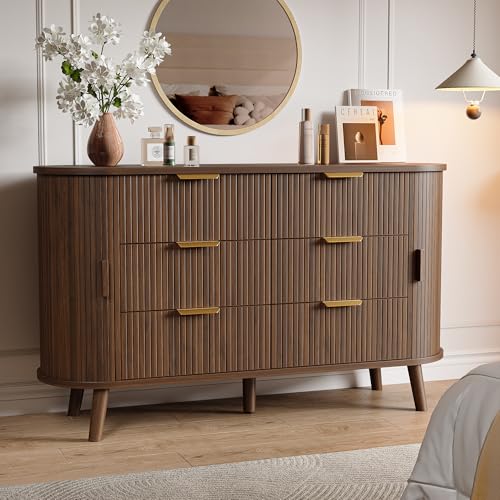
An oval dresser is a bedroom storage piece built with a rounded, curved front profile instead of the flat rectangular face found on conventional dressers. The curve can apply to the entire cabinet body, producing a soft elliptical silhouette, or only to the drawer fronts, which bow outward in a gentle arc while the carcass stays relatively straight. Some designs combine both approaches, using a curved body with individually bowed drawers.
Because curved forms require more complex joinery, oval dressers sit in the mid-range to premium tier of the dresser market. They are often treated as statement furniture rather than purely utilitarian storage, and many designs draw on mid-century modern, Art Deco, and French provincial influences. If you are comparing shapes more broadly, the overview of dresser types explains how oval profiles relate to standard rectangular and tallboy formats.
The practical appeal is twofold. First, the absence of sharp front corners creates a softer visual weight in a bedroom, which helps a large storage piece feel less blocky. Second, rounded edges are a genuine safety benefit in homes with toddlers, which is why some families pair an oval dresser with a nursery dresser setup.
Key point: An oval dresser is defined by its curved front, not by its overall footprint. Many oval models have a standard rectangular back and sides, so they still sit flat against a wall while presenting a curved face to the room.
Oval Silhouette Variations
The term "oval dresser" covers several distinct shapes. Knowing which one you are looking at helps you judge how much floor space the piece will need and how it will interact with the rest of the room.
Bowed Front
The cabinet body is rectangular, but the drawer fronts curve outward in a shallow arc. This is the most common oval dresser type because it delivers the soft look with minimal loss of usable interior space.
Full Elliptical Body
The entire cabinet is built as an ellipse or oval in plan view. These are true statement pieces, but they project further into the room and cannot sit flush in a corner.
Rounded End Panels
Flat drawer fronts are framed by curved side panels that roll into the front face. The oval impression comes from the edges rather than the drawers, giving a cleaner, more architectural look.
Demilune Half-Oval
A half-oval or demilune dresser has a flat back and a semicircular front. These are usually smaller accent pieces and work well in dressing areas or hallways.
If you prefer a subtler curve, a bowed-front model is the safest choice. If you want the dresser to function as the focal point of the room, a full elliptical body delivers more visual impact. Curved-front designs also pair naturally with soft, rounded lighting and mirrors, which you can explore in the dresser mirror ideas guide.
Materials and Construction
Curved furniture is harder to build than rectangular furniture, so material quality matters even more than usual. The way the curve is formed affects both durability and how smoothly the drawers operate over time.
Solid Wood and Bentwood
High-grade solid wood and bentwood are the most durable options for an oval dresser. Bentwood is produced by steaming and bending layers of wood, which produces a strong, stable curve without visible seams. These pieces sit in the premium and luxury tiers and are typically the best long-term investment if you plan to keep the dresser for many years.
Veneer Over Engineered Core
Many mid-range oval dressers use a wood veneer laminated over a curved engineered core. This allows complex curves at a lower tier than solid bentwood. Quality varies widely: look for thick, evenly matched veneer with no lifting at the edges, and check that the curve feels rigid rather than springy when you press it.
Painted Hardwood
Painted oval dressers in white, off-white, or soft neutral finishes are common in nursery and cottage-style rooms. A painted finish hides minor joinery imperfections, but it also makes flaws harder to spot before purchase. If you are leaning toward a light finish, the off-white dresser guide covers finish and care considerations.
Hardware and Drawer Glides
On a curved dresser, drawer glides carry more stress because the drawer path is not always perfectly linear. Metal side-mounted or under-mounted glides with a smooth, quiet action are preferable to simple wood-on-wood runners. Soft-close mechanisms are a worthwhile feature in the mid-range tier and above. If you plan to change the look later, the guide to pull handles for dresser drawers explains how to choose hardware that suits a curved front.
| Construction | Tier | Best For | Durability Notes |
|---|---|---|---|
| Solid bentwood | Premium to luxury | Long-term primary bedroom storage | Excellent; curves stay true for decades with normal care |
| Veneer over curved core | Mid-range | Balanced option for most bedrooms | Good; watch for edge lifting and veneer seams |
| Painted hardwood | Mid-range | Nursery and cottage-style rooms | Good; paint can chip at high-contact edges |
| Engineered board with laminate | Entry-level | Guest rooms and temporary setups | Fair; curves may be less crisp and glides less smooth |
Sizes and Drawer Counts
Oval dressers are available in a range of widths and drawer counts, but the curved front changes how you should measure for fit. Always measure the widest point of the curve, not just the back panel, and allow extra clearance in front so the drawers can open fully.
Compact Oval Dressers
Compact models with three or four drawers are typically around the same width as a small rectangular dresser but project further forward because of the bow. These suit guest rooms, small bedrooms, and dressing areas. If space is tight, compare with the options in the small dressers collection before committing to a curved shape.
Standard Oval Dressers
Five- and six-drawer oval dressers are the most common configuration. They offer a similar storage capacity to a standard double dresser and work well as the primary storage piece in a main bedroom. A six-drawer layout with two wide top drawers and four deeper lower drawers is a practical split for clothing of different sizes.
Oversized and Wide Oval Dressers
Wider oval dressers with eight or more drawers exist but are less common because large curved panels are harder to manufacture. When they are available, they sit in the high-end tier and are best suited to spacious primary bedrooms where the dresser can stand alone on a long wall. The oversized dresser guide covers clearance and proportion rules that apply equally to curved models.
Measuring tip: Note three dimensions for an oval dresser: the width at the widest point of the curve, the depth at the center of the bow, and the height. Add at least 24 inches of clear floor space in front of the deepest point for comfortable drawer access.
Placement and Room Fit
Because the front of an oval dresser curves outward, placement requires a little more planning than a flat-front piece. The goal is to give the curve room to breathe while keeping the dresser functional.
Against a Long Wall
A long, uninterrupted wall is the ideal position for an oval dresser. Centering the piece gives the curve visual symmetry and leaves clearance on both sides. Avoid pushing the dresser into a corner, where the curved front will look cramped and the side clearance will be uneven.
As a Standalone Statement Piece
In larger bedrooms, an oval dresser can float slightly off the wall or sit perpendicular to the bed as a room divider. This works best with a full elliptical body, where the curve is visible from multiple angles. Keep the back of the dresser finished if it will be seen from the side.
In a Dressing Area or Walk-In Closet
Oval dressers suit dressing areas and large walk-in closets because the curved front is comfortable to stand close to and the soft shape reduces visual clutter. A demilune half-oval model is particularly efficient here, as its flat back sits against the wall while the curved front faces the room.
In a Nursery
Rounded edges make oval dressers a natural fit for nurseries. If you are furnishing a nursery, pair the dresser with a coordinating nursery wardrobe set and secure the dresser to the wall with an anti-tip strap, which is essential for any tall storage piece in a child's room.
For broader layout guidance, the bedroom dresser ideas collection includes proportion and spacing advice that applies to curved furniture as well.
Styling an Oval Dresser
The curve of an oval dresser already provides visual interest, so styling works best when it follows the shape rather than fighting it. A few principles keep the top surface balanced and functional.
- Use round or soft-edged accessories. Circular mirrors, rounded vases, and curved lamps echo the dresser's silhouette and create a cohesive look.
- Keep the center clear. The highest point of the bow is the most visually prominent area. Leave it open or place a single low tray there rather than a cluster of tall objects.
- Layer heights at the ends. Taller lamps or plants at the outer edges frame the curve without obscuring it.
- Choose a mirror that follows the arc. A round or arched mirror above the dresser reinforces the shape. The dresser wall decor guide has more ideas for pairing art and mirrors with curved furniture.
- Control surface clutter. Because the curved top can be harder to organize than a flat rectangular surface, use a small tray or divided organizer. The on top of dresser storage ideas guide offers practical layouts.
If you prefer a specific aesthetic, an oval dresser adapts well to several styles. A mid-century dresser with tapered legs and a bowed front is a classic pairing, while a painted oval model suits farmhouse dressers and cottage-inspired rooms. For a softer, more relaxed look, the boho chests collection shows how curved pieces fit into layered, textured interiors.
Oval Dresser Buying Checklist
Before you commit to an oval dresser, run through these checks. They cover the issues that are most likely to cause regret after delivery.
- Measure the widest point and the deepest point. Curved fronts project further than flat ones, so confirm the dresser will not block a doorway, closet, or walking path.
- Confirm drawer clearance. Allow at least 24 inches in front of the deepest part of the curve so drawers can open fully without hitting the bed or a wall.
- Test the drawer action. Open and close every drawer. On a curved dresser, a binding glide is a sign of poor construction and will worsen over time.
- Inspect the curve for consistency. Run your hand along the front. The arc should be smooth and symmetrical, with no ripples, flat spots, or uneven veneer seams.
- Check the back and sides. If the dresser will be visible from the side, confirm the side panels and back are finished to the same standard as the front.
- Verify stability. A curved base can feel less stable than a rectangular one. Press down on one corner and check for rocking or flex.
- Plan for anchoring. Any dresser taller than about 30 inches should be secured to the wall. Confirm the model includes or accepts an anti-tip strap.
- Match the tier to the room. An entry-level oval dresser is fine for a guest room, while a premium or luxury model is a better long-term choice for a primary bedroom you plan to keep furnished for years.
Ready to Compare Oval Dresser Options?
Browse curated oval dressers and curved storage pieces, then check availability and read the full specifications before you decide.
View Recommended Oval DressersFrequently Asked Questions
What is an oval dresser?
An oval dresser is a storage piece with a curved, rounded front profile that softens sharp edges and creates a sculptural focal point. The oval shape can apply to the overall silhouette, the drawer fronts, or both, and is typically paired with three to six drawers.
Are oval dressers practical for everyday use?
Yes. Despite the curved design, oval dressers usually offer the same drawer depth and capacity as rectangular models. The main trade-off is that curved fronts may require slightly more floor space and can be harder to align flush against a wall.
What materials are best for an oval dresser?
Solid wood, wood veneer over engineered core, and painted hardwood are the most durable options. Curved forms are often built with bentwood or laminated veneer techniques, so check that the curves are smooth and the drawer glides operate without binding.
Where does an oval dresser fit best in a bedroom?
Oval dressers work well as a standalone statement piece against a long wall, paired with a mirror in a dressing area, or placed in a nursery where rounded edges add a safety benefit. They are less suited to tight corners because of their curved footprint.
Is an oval dresser the same as a bow-front dresser?
They overlap but are not identical. A bow-front dresser has drawer fronts that curve outward while the cabinet body stays rectangular. An oval dresser may use a bow front, or it may have a fully elliptical body or rounded end panels. The distinction matters mainly for how much floor space the piece needs.
For related comparisons, the dresser vs chest guide explains how drawer count and height differ between formats, and the buying guides collection covers material and size decisions in more depth. If you are still deciding between curved and conventional shapes, the modern dressers and vintage dressers collections show how oval profiles fit into each style category.