
Cabinet Doors and Drawer Fronts: The Complete Guide
Everything you need to know about styles, materials, and finishes before you upgrade your dresser or cabinet. Make a confident, informed decision with our expert breakdown.
Why cabinet doors and drawer fronts matter: The doors and drawer fronts are the face of your furniture. They define the style, protect your belongings, and bear the brunt of daily use. Whether you are refreshing a bedroom dresser, building a custom storage piece, or replacing worn-out fronts, understanding the differences between door styles, materials, and finishes is the key to a result you will love for years. This guide walks you through every decision point so you can choose with confidence.
What Are Cabinet Doors and Drawer Fronts?
Cabinet doors and drawer fronts are the visible panels attached to the front of a cabinet or dresser. Doors cover larger compartments, while drawer fronts attach to the drawer box and slide in and out. Together, they determine how your furniture looks, how easily it opens, and how well it protects what is inside. On dressers and chests, drawer fronts are usually the dominant visual element, so their style and material have an outsized effect on the overall look of a bedroom. If you are also rethinking the interior, our guide on bureau drawer organization pairs well with this topic.
Many people replace only the fronts rather than the whole piece. This is a smart approach when the cabinet box is still solid but the fronts are dated or damaged. Our article on cabinet drawer face replacement explains when replacement makes sense versus buying new furniture.
Cabinet Door Styles Explained
Door style is the single biggest factor in the final look of your cabinet. The main categories are slab, shaker, raised panel, and glass-front doors. Each has distinct advantages depending on your room's aesthetic and how much maintenance you are willing to accept.
Slab (Flat-Panel) Doors
Slab doors are a single flat panel with no frame or molding. They suit modern, minimalist, and contemporary interiors. Because there are no recesses to collect dust, they are easy to clean. Slab fronts are also the easiest style to refinish or repaint, which makes them a favorite for DIY upgrades.
Shaker Doors
Shaker doors feature a flat center panel surrounded by a simple five-piece frame. They are versatile enough for farmhouse, transitional, and even modern rooms. Shaker remains one of the most popular choices because it balances visual interest with a clean, timeless profile. The recessed panel does collect a little dust, but the trade-off in style is usually worth it.
Raised-Panel Doors
Raised-panel doors have a center panel that projects above the frame, often with decorative molding. They read as traditional, formal, and classic. These doors are heavier and more complex to manufacture, so they tend to sit in the premium and luxury tiers of the market. They suit period homes and formal bedrooms.
Glass-Front Doors
Glass-front doors add lightness and display value. They work well on upper cabinets in kitchens and on display cabinets, but are less common on dressers where privacy and dust protection matter. Frosted or textured glass offers a middle ground.
Drawer Front Styles and Profiles
Drawer fronts follow similar logic but with additional practical considerations. The three common profiles are flat slab fronts, raised or molded fronts, and overlay versus inset mounting.
- Slab drawer fronts: Flat, clean, and modern. Ideal for a minimalist bedroom dresser and very easy to keep tidy.
- Molded or raised drawer fronts: Add depth and a traditional feel. Best for formal or classic interiors.
- Overlay fronts: Sit on top of the cabinet face frame, hiding the frame edges. They are forgiving of small measurement errors and are the most common configuration on ready-made dressers.
- Inset fronts: Sit flush inside the face frame. They look refined and custom but demand precise construction and consistent gaps. Inset fronts are typically found in the high-end and luxury tiers.
If you are planning a full cabinet with both storage types, our page on a cabinet with drawers and doors covers how to balance the two in one piece.
Materials for Cabinet Doors and Drawer Fronts
Material choice affects durability, weight, finish options, and long-term performance. Here is how the main options compare.
Solid Wood
Solid wood fronts are the benchmark for durability and repairability. Oak, maple, cherry, and walnut are common. Solid wood can be sanded and refinished multiple times, making it a long-term investment. It does expand and contract with humidity, so quality construction with proper panel floating matters. Wood fronts suit both painted and stained finishes.
Plywood with Veneer
Engineered panels with a real wood veneer offer a stable core and a genuine wood surface. They resist warping better than solid wood in wide panels and sit in the mid-range to premium tiers. Veneer fronts cannot be sanded as aggressively as solid wood, so refinishing options are more limited.
MDF and Particleboard
MDF is dense, smooth, and excellent for painted finishes because it takes paint evenly and does not show grain. It is common in entry-level and mid-range products. Particleboard is lighter and more sensitive to moisture; it is best reserved for dry bedrooms rather than bathrooms or kitchens. Both are stable but less repairable than solid wood.
Thermofoil and Laminate
These are factory-applied finishes over a core panel. They are easy to wipe clean and resist moisture, making them practical for busy households. The trade-off is that damage is hard to repair and the look can feel flatter than real wood or painted MDF.
Finishes, Paints, and Stains
Finish determines both the look and the protection level of your fronts. Painted finishes hide grain and suit modern and farmhouse styles; stains highlight natural grain and suit traditional and rustic rooms. A quality topcoat — lacquer, polyurethane, or a conversion varnish — is what actually protects the surface from wear and moisture.
If you are weighing whether to paint or replace, consider that repainting existing fronts is the most efficient route when the panels are structurally sound. Replacing the fronts makes sense when the style is wrong or the panels are damaged. For a matching look across a bedroom set, review our guide on replacing drawer faces before committing.
Hardware and Drawer Slides
Hardware is the jewelry of a cabinet. Pulls and knobs should match the style of the fronts: simple bar pulls for modern slab fronts, cup pulls or bin pulls for farmhouse, and decorative pulls for traditional raised panels. Mid-century rooms often benefit from tapered or angled pulls; our page on mid-century modern cabinet pulls has styling guidance.
Behind the front, the drawer slide does the heavy lifting. Standard slides suit light bedroom use, while heavy-duty slides are worth considering for deep or frequently used drawers. Our article on heavy-duty cabinet drawer slides explains load ratings and extension types so you can match the slide to the drawer's contents.
How to Measure for Replacement Doors and Fronts
Accurate measurement is the difference between a smooth upgrade and a frustrating return. Follow these steps:
- Measure the opening (the face frame opening) width and height, not the old door itself.
- Decide on overlay amount. For full overlay, the door typically covers the entire frame edge; for partial overlay, it covers part of it.
- Record the drawer box width and height so the new front attaches correctly.
- Note the hinge type for doors — concealed cup hinges, exposed hinges, or pivot hinges — since the drilling pattern must match.
- Check that the new fronts will clear adjacent doors and drawers when opened.
When in doubt, order a single test front first and confirm the fit before ordering the full set.
Choosing the Right Fronts for Your Room
Context matters. A bedroom dresser sees lighter use than a kitchen cabinet, so material and finish priorities differ. In bedrooms, style and touch comfort matter more; in kitchens and bathrooms, moisture resistance and cleanability take priority.
If the piece is a dresser, drawer fronts dominate. If it is a cabinet, doors dominate. For a mixed piece, keep the style consistent so the unit reads as one design. You can also explore related storage ideas in our buying guides hub for a broader comparison across furniture categories.
Cabinet Door and Drawer Front Tiers Compared
Use this table to align your expectations with the market tier. It focuses on construction quality and features rather than any figure.
| Tier | Typical Construction | Best For |
|---|---|---|
| Entry-level | MDF or particleboard core with thermofoil or laminate; standard hinges and slides | Light-use bedrooms, starter furniture, quick refreshes |
| Mid-range | Painted MDF or plywood with veneer; concealed hinges; smoother slides | Family bedrooms, balanced durability and style |
| Premium | Solid wood or high-grade plywood; quality topcoat; soft-close hardware | Daily-use dressers and cabinets, long-term use |
| Luxury / professional-grade | Solid hardwood, inset construction, precision joinery, premium hardware | Custom furniture, formal rooms, heritage homes |
Across every tier, the descriptor should match actual construction, not just appearance. A mid-range front with a quality topcoat can outlast a premium-looking front with poor sealing.
Common Mistakes to Avoid
- Measuring the old door instead of the opening. Always measure the opening and apply the overlay rule.
- Ignoring hinge compatibility. A new door with a different drilling pattern may not fit existing hinges.
- Mixing styles across one unit. Keep slab, shaker, or raised-panel consistent across all fronts on the same piece.
- Skipping the topcoat. Paint without a protective topcoat wears quickly on high-touch fronts.
- Overlooking slide capacity. Heavy contents need slides rated for the load; otherwise drawers sag and stick.
Frequently Asked Questions
Can I replace only the drawer fronts and keep the doors?
Yes, as long as the style, finish, and material match closely enough that the piece reads as one design. Replacing only the fronts is common when fronts are damaged but doors are intact.
Are cabinet doors and drawer fronts the same material?
They can be, and usually should be for visual consistency. However, drawer fronts sometimes use a lighter core because they carry less structural load than a full door.
How do I choose between overlay and inset fronts?
Overlay is more forgiving and more common on ready-made furniture. Inset looks more custom but requires precise construction. Choose inset only when the cabinet box is built to tight tolerances.
What is the most durable finish for drawer fronts?
A catalyzed lacquer or conversion varnish over a properly prepared surface offers the best wear and moisture resistance. Polyurethane is a strong DIY-friendly alternative.
Can I paint over existing fronts instead of replacing them?
Yes, if the fronts are structurally sound and the existing finish is compatible. Light sanding and a bonding primer are essential for adhesion. Replacement makes more sense when the style is wrong or the panels are damaged.
Recommended Cabinet Doors, Drawer Fronts & Hardware
⚠️ AFFILIATE DISCLOSURE: This website contains affiliate links. As an Amazon Associate, we earn from qualifying purchases. If you make a purchase through these links, we may receive a small commission at no additional cost to you. Read our full affiliate policy.
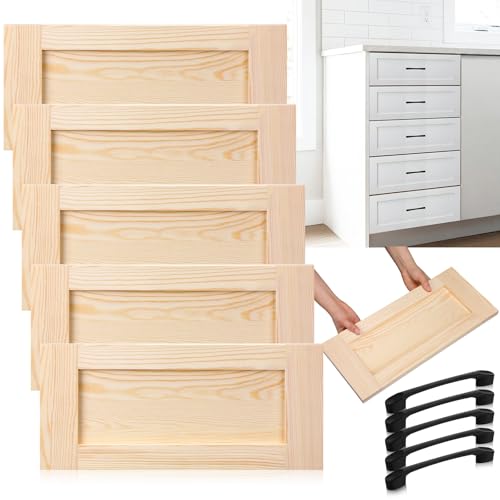
Sintuff 5 Pcs Unfinished Wood Cabinet Drawer Front Replacement, Solid Wood Drawer Front for Kitchen Cabinets, Bathroom Vanities, Closets, Ready to Paint or Stain(18 x 8 Inches)
Check price on Amazon
EXPRESS KITCHENS Custom Cut-to-Size Cabinet Doors & Drawer Fronts, Modern Flat Panel Slab, 3/4" Thick, 12 Colors, Optional Hinge Boring, Replacement Doors for Kitchen, Bathroom & Closet, Made in USA
Check price on Amazon
Cinnvoice 2 Pcs 17.5'' Wx6'' H Unfinished Kitchen Drawer Front Replacement | Pine, Solid Wood Cabinet Drawer Front Replacement to Paint or Stain, for Closets Kitchen Cabinets Bathroom Vanities
Check price on Amazon
Raw Maple Shaker Replacement Drawer Front - 6H X 16.5W | Ready to Paint | Solid Wood| American Made | Cabinet Refacing Doors
Check price on Amazon
homdiy 15 Pack Brushed Nickel Cabinet Pulls 3 Inch Handles Stainless Steel Cabinet Hardware for Kitchen and Bathroom Cabinets, 5 Inch Overall Drawer Pull
Check price on Amazon
ONESTOCK Unfinished Maple Shaker Cabinet Drawer Front Replacement - 11.5W x 7.25H | Ready to Paint or Stain | Solid Wood | Cabinet Drawer Front Replacement
Check price on Amazon
Raw Maple Shaker Replacement Drawer Front - 6H X 13.5W | Ready to Paint | Solid Wood| American Made | Cabinet Refacing Doors
Check price on Amazon