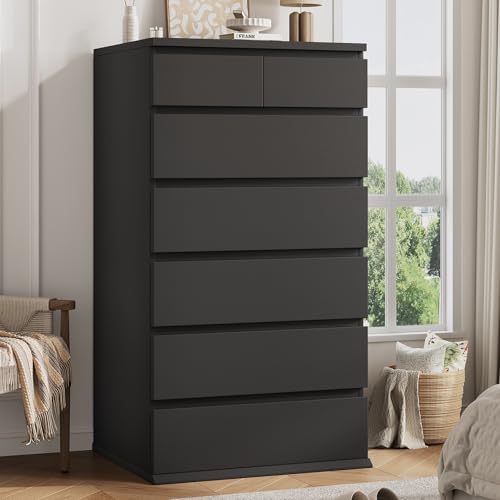
Black Tall Dresser with Deep Drawers: The Complete Buying Guide
A tall black dresser with deep drawers combines vertical storage efficiency with a bold, modern presence. This guide explains how to evaluate depth, materials, drawer hardware, and styling so you can choose a piece that fits your room and your daily routine.
If you have already decided that a tall black dresser belongs in your bedroom, the remaining questions are practical ones: How deep should the drawers be? Which materials hold up over years of daily use? Will a tall silhouette work with your ceiling height and floor plan? This guide answers those questions with clear, research-stage information you can act on before you buy.
A tall dresser, sometimes called a tallboy or highboy, stacks four to six drawers vertically. Deep drawers add usable volume for folded clothing, linens, and bulky items. Together, height and depth create substantial storage in a footprint that fits compact bedrooms, apartments, and shared spaces. Black finishes, meanwhile, ground the piece visually and pair easily with both neutral and bold color schemes.
Quick orientation: A tall black dresser with deep drawers is a strong fit for rooms where floor space is limited but storage demands are high. The vertical layout keeps the footprint narrow, while deep drawers compensate for the reduced width.
What Defines a Tall Dresser with Deep Drawers?
Terminology in bedroom furniture can be loose, so it helps to set expectations. A tall dresser generally stands between roughly 40 and 60 inches high, with drawers stacked in a single column or a narrow two-column layout. Width is usually narrower than a wide dresser, often in the range of 30 to 44 inches. Depth refers to the front-to-back measurement of the cabinet, while drawer depth refers to the usable interior space.
Deep drawers typically offer interior depth in the range of 15 to 18 inches. That is enough to hold folded sweaters, jeans, bedding, and stacked linens without cramming. Shallower drawers suit accessories and folded tops, while deeper drawers handle bulkier items. A well-designed tall dresser may combine both: a few deep drawers at the bottom and shallower drawers near the top.
Height also affects safety. Tall, narrow furniture should be anchored to the wall, and many manufacturers include anti-tip hardware. If you are furnishing a child's room or a rental where anchoring is tricky, check the stability of the base and the availability of wall-anchoring kits before committing. For related storage pieces in the same finish family, you may also want to compare a black tall narrow chest of drawers for a slimmer alternative.
Why Choose a Black Tall Dresser?
Black furniture has practical and aesthetic advantages that go beyond trend cycles. On the practical side, a dark finish hides minor scuffs and fingerprints better than very light finishes, and it reads as a deliberate design choice rather than a default. On the aesthetic side, black creates contrast. In a room with light walls and pale bedding, a black tall dresser becomes an anchor point. In a darker, moodier room, it blends into the scheme and lets texture and hardware take the lead.
Tall dressers also solve a specific spatial problem. When a room has limited floor area but adequate wall height, vertical storage is the efficient answer. A tall black dresser with deep drawers can replace a wide, low unit and free up floor space for movement, a reading chair, or a larger bed. The same vertical logic applies to other bedroom categories, and our broader guide to black tallboy drawers explores additional configurations if you are comparing silhouettes.
Finally, black is versatile across styles. It works with mid-century modern, industrial, transitional, and contemporary interiors. Hardware choice, leg shape, and surface finish determine whether the piece reads as sleek and minimal or warm and traditional.
How Deep Should the Drawers Be?
Drawer depth is the specification most often overlooked during research, yet it has the biggest effect on daily usability. Deep drawers are not automatically better; the right depth depends on what you plan to store and how you access it.
| Drawer Type | Typical Interior Depth | Best For |
|---|---|---|
| Shallow | Up to about 12 inches | Accessories, folded tops, socks, undergarments, jewelry trays |
| Standard | Around 12 to 15 inches | Everyday folded clothing, shirts, workout wear |
| Deep | Around 15 to 18 inches | Sweaters, jeans, bedding, linens, bulky items |
| Extra Deep | Beyond about 18 inches | Seasonal storage, blankets, rarely accessed items |
For a tall dresser, deep drawers at the lower levels are especially useful because they carry heavier loads close to the floor, which improves stability. Upper drawers can be shallower for items you reach frequently. If you plan to store bedding or winter layers, prioritize interior depth of at least 15 inches and check the drawer's internal height as well, since volume is a product of depth, width, and height.
Drawer slides matter as much as depth. Deep drawers carry more weight, so full-extension slides and reinforced bottoms are worth checking. A heavy-duty slide rated for the load will feel smoother over time and reduce sagging. Our note on bottom drawer slides heavy duty covers the hardware side in more detail.
Materials and Construction to Look For
Black finishes can hide poor construction, so it pays to look past the surface. The core material, joinery, and drawer box construction determine how the piece performs over years of use.
Solid Wood and Engineered Wood
Solid wood, such as oak, maple, or pine, offers durability and a finish that can be refinished later. Engineered wood with quality veneers can deliver a consistent black finish and stable panels at a lower position in the market. Both can be good choices depending on tier. If you want the long-term character of solid timber, a black solid wood dresser is the category to research. If you prefer a distinctive grain and tone, a black oak dresser may suit your taste.
Drawer Boxes and Joinery
Look for dovetail or reinforced box joints at the drawer corners, solid bottoms rather than thin panels, and smooth-glide slides. Metal runners with ball bearings generally feel smoother than basic side-mounted slides. Deep drawers benefit from center support and a bottom panel that does not flex under load.
Finish Quality
A good black finish is even, with no visible drips, thin patches, or overspray. Matte and satin finishes tend to show fewer fingerprints than high-gloss surfaces. Painted finishes and stained finishes age differently, so consider which look you prefer over time.
Design and Style Considerations
Black tall dressers come in several design families. Understanding the differences helps you match the piece to your room.
- Modern and minimalist: clean lines, flat fronts, integrated or recessed handles, often on slim legs or a plinth base.
- Mid-century modern: tapered legs, warmer wood tones under the black finish, and hardware with a retro feel. See our guide to a black mid-century modern dresser for reference.
- Industrial and metal-accented: visible hardware, steel frames, and matte finishes. A black metal dresser suits this direction.
- Traditional and vintage: molding, carved details, and antique-inspired hardware. A black vintage chest of drawers captures this look.
- Textured and soft: upholstered or velvet fronts add tactile interest. A black velvet dresser is one example.
Hardware is an easy way to shift the character of a black dresser. Warm metallic pulls soften the look, while matte black hardware keeps it understated. If you plan to customize later, our guide to black hardware dressers and black knobs for dresser drawers can help you coordinate.
Size, Placement, and Room Fit
Before you commit, measure the intended wall space, the doorway clearance, and the ceiling height. A tall dresser needs enough clearance above it to open the top drawer without obstruction, and it should sit flush against the wall for stability. Leave at least a few inches of space between the dresser and adjacent furniture so drawers can open fully.
In a small bedroom, a tall black dresser can sit on the wall opposite the bed or beside a window. In a larger room, it can anchor a dressing area or pair with a mirror. If your room is narrow, compare the footprint with a black small dresser for bedroom or a black long dresser for bedroom depending on whether you prefer vertical or horizontal storage.
Placement check: Confirm that the top drawer, when fully extended, does not collide with a ceiling fan, light fixture, or curtain rod. Tall dressers with deep drawers need clearance both above and in front.
Organizing Deep Drawers Effectively
Deep drawers can become disorganized without a system. The extra depth is useful only if you can reach what you stored. A few practical approaches help:
- Use drawer dividers to create zones for folded categories.
- Place frequently used items near the front and seasonal items toward the back.
- Stand folded items upright, file-style, so you can see everything at a glance.
- Use shallow trays inside deep drawers for small accessories.
- Rotate seasonal clothing to keep the deepest space purposeful.
If drawer organization is a priority, our broader resources on drawer dividers and folding techniques complement this guide. Pairing a tall dresser with a matching nightstand or a black nightstands set of 2 can also create a cohesive bedroom storage plan.
Comparing Black Tall Dresser Options by Tier
Rather than focusing on numerical figures, it helps to think in terms of market tiers. Each tier reflects construction, materials, and hardware quality relative to the category.
| Tier | Typical Characteristics | Best For |
|---|---|---|
| Entry-level | Engineered wood core, basic side-mounted slides, simpler joinery | Guest rooms, rentals, first apartments |
| Mid-range | Sturdier engineered or mixed materials, smoother slides, better finish consistency | Primary bedrooms with everyday use |
| Premium | Solid wood elements, dovetail joinery, full-extension slides, refined finish | Long-term use and design-focused rooms |
| Luxury | High-grade hardwood, hand-finished surfaces, premium hardware, artisan details | Statement pieces and heirloom-style furnishing |
As a rule, mid-range models usually offer smoother drawer mechanisms and more consistent finishes than entry-level options, while premium and luxury tiers invest in joinery and materials that extend service life. Choose the tier that matches how intensively the dresser will be used and how long you plan to keep it.
Coordinating with the Rest of the Bedroom
A black tall dresser rarely stands alone. It sits alongside a bed frame, nightstands, and sometimes a vanity or bench. Consistency in finish and hardware keeps the room cohesive. If you are building a coordinated set, you might compare the dresser with a black wood dresser or consider a black wide dresser for a complementary low piece. For a mirrored accent, a black mirrored dresser adds reflectivity without breaking the dark palette.
Balance is the guiding principle. A tall black dresser carries visual weight, so pair it with lighter bedding or a pale rug if you want an airy feel, or lean into the contrast with dark bedding and metallic accents. Lighting also matters: a lamp or wall sconce near the dresser improves usability and highlights the finish.
Safety and Maintenance
Anchor tall furniture to the wall, especially in homes with children or pets. Check that the dresser's base sits level on your floor and that drawers open and close without wobbling. Avoid overloading the top drawers, which can shift the center of gravity.
For maintenance, dust with a soft cloth and avoid abrasive cleaners on painted or veneered surfaces. Matte finishes generally tolerate mild soap and water, while high-gloss surfaces may need a specialized polish. Tighten hardware periodically, and lubricate metal slides sparingly if they begin to feel stiff.
Frequently Asked Questions
What is the difference between a tall dresser and a wide dresser?
A tall dresser stacks drawers vertically, occupying a smaller footprint and reaching higher, while a wide dresser spreads drawers horizontally across a longer surface. Tall models suit compact rooms and vertical storage, while wide models offer more usable top space.
How deep should drawers be on a black tall dresser?
Deep drawers typically range from 15 to 18 inches in interior depth, which accommodates folded clothing, linens, and bulky items comfortably. Anything shallower may limit what you can store, while overly deep drawers can make back items harder to reach.
Is a black tall dresser suitable for a small bedroom?
Yes. Tall dressers use vertical space efficiently and typically have a smaller footprint than wide models, making them well suited to compact bedrooms, apartments, and dorm rooms where floor area is limited.
What materials are best for a black tall dresser?
Solid wood and high-grade engineered wood with quality veneers offer the best balance of durability and finish consistency. Metal and metal-accented designs are also available for industrial or modern styles. Check drawer glides and joinery for long-term reliability.
How many drawers should a tall dresser have?
Most tall dressers have four to six drawers, often arranged in a single column or a narrow two-column layout. The ideal count depends on how you separate categories such as everyday clothing, bedding, and accessories.