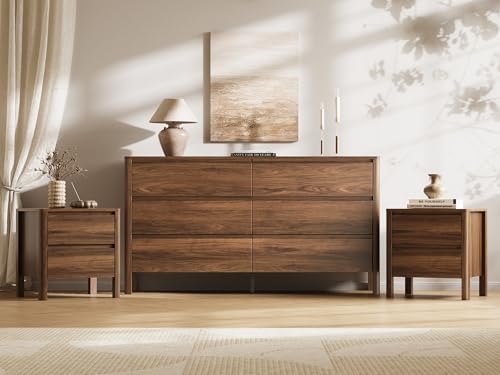
6 Drawer Dresser with Matching Nightstand: The Complete Buying Guide
A six-drawer dresser paired with a matching nightstand is one of the most practical and visually cohesive bedroom furniture sets you can choose. This guide explains drawer configurations, dimensions, materials, finishes, and nightstand pairing so you can choose a set that fits your room and your storage routine with confidence.
Why Choose a Six-Drawer Dresser
Six drawers strike a useful balance between capacity and footprint. Compared with a three- or four-drawer dresser, a six-drawer model offers more separation for different clothing categories without demanding the wall space of an eight- or nine-drawer unit. For a single adult, a couple sharing a bedroom, or a guest room that needs versatile storage, six drawers is often the most efficient choice.
The additional drawers make it easier to assign zones: one column for tops and folded shirts, another for bottoms, activewear, or linens. That organization advantage is the main reason buyers researching a 6 drawer dresser often end up preferring it over smaller alternatives. When the same unit is paired with a nightstand in a coordinated set, the bedroom gains both visual balance and a more complete storage system.
A matched set also simplifies shopping. Instead of hunting for a nightstand that happens to share a wood tone or hardware finish, you get pieces designed together. The result is a bedroom that looks intentional rather than assembled piece by piece. If you are comparing set options, our overview of a 6 drawer dresser and nightstand set explains the trade-offs between coordinated collections and mix-and-match furniture.
What Makes a Matching Dresser and Nightstand Set
A true matching set shares more than a similar color. The dresser and nightstand should align on material, finish, hardware, drawer-front profile, and leg or base design. When those elements repeat, the eye reads the two pieces as a family, which makes the room feel calmer and more deliberate.
- Finish consistency: The stain, paint, or veneer should match across both pieces, including sheen level. A matte dresser paired with a glossy nightstand can look mismatched even in the same color.
- Hardware continuity: Knobs, pulls, and handles should share the same shape, metal tone, and spacing. This is one of the clearest signals of a coordinated set.
- Proportional design: Drawer fronts, edge profiles, and trim should repeat. A dresser with chamfered edges pairs naturally with a nightstand that uses the same detail.
- Material consistency: Solid wood with solid wood, veneer with veneer. Mixed constructions can work, but matching material families keeps the set looking unified over time.
Sets sold as a single collection also tend to share manufacturing standards, which means drawer glides, joinery, and finishing quality are usually consistent between the dresser and the nightstand. That consistency is a real advantage when you want the two pieces to age and wear at the same rate.
Understanding Six-Drawer Configurations
Six drawers can be arranged in several ways, and the layout has a major effect on how the dresser fits your room and how you use it. Before choosing a set, decide which configuration matches your storage habits.
| Configuration | Typical Layout | Best For | Considerations |
|---|---|---|---|
| Double dresser | Two columns of three drawers side by side | Folded clothing, shared bedrooms, wide wall placement | Wider footprint; needs generous wall space |
| Tall chest | Six drawers stacked vertically in one column | Small rooms, narrow walls, deep storage | Smaller footprint; upper drawers need reach |
| Mixed layout | Combination of wide and narrow drawers | Varied items such as linens and accessories | Drawer sizes vary; check internal dimensions |
| Dresser with doors | Drawers plus a cabinet section | Display items, larger bulky storage | Less drawer volume than a pure six-drawer unit |
Double dressers are the most common pairing with a nightstand because their lower, wider profile leaves wall space above for art or a mirror. Tall chests suit compact rooms where floor area matters more than wall width. If you are leaning toward a taller unit, our guide to a 6 drawer dresser tall model covers vertical storage in more detail.
Also consider the internal dimensions of the drawers, not just the count. A six-drawer dresser with deep drawers can hold bulky knitwear, while shallow drawers are better for accessories and folded tees. Measure the interior height and depth of the drawers you plan to use most, and check whether the drawer glides are full-extension or partial. Full-extension glides make it easier to reach items at the back of each drawer.
Dimensions and Room Fit
A six-drawer double dresser typically measures between 48 and 60 inches wide, 18 to 20 inches deep, and 30 to 36 inches tall. A tall six-drawer chest usually falls between 36 and 48 inches wide and can be 50 inches or more in height. These ranges are starting points, not guarantees, so always confirm the exact dimensions of a specific set before you commit.
Leave at least 24 inches of clearance in front of the dresser for drawers to open fully and for comfortable standing room. If the dresser sits opposite the bed, check that the open drawer does not block the walking path. For narrow rooms, a tall chest may fit where a wide double dresser will not. Our size-focused guides on a 6 drawer dresser 48 inches wide and a 6 drawer dresser 50 inches wide show how small differences in width affect placement.
Nightstand height deserves equal attention. The top of the nightstand should sit close to the height of your mattress top, usually 24 to 28 inches, so a lamp, book, or glass of water is easy to reach while lying down. Measure your mattress and bed frame before choosing a set, and confirm the nightstand height in the product specifications.
Materials and Construction Quality
The material of a six-drawer dresser set determines durability, weight, and how the pieces age. Solid wood, such as oak, maple, walnut, or pine, offers the strongest long-term investment and can often be refinished. Engineered wood with quality veneers provides a stable, uniform finish at a mid-range tier. Particle board is common in entry-level sets and suits light use, provided the joinery and hardware are adequate.
- Solid wood: Best for durability and repairability; heavier and typically positioned in the premium to luxury tiers.
- Engineered wood with veneer: Balanced tier; stable, consistent appearance, and resistant to seasonal movement.
- Particle board: Entry-level tier; acceptable for light use but sensitive to moisture and heavy loads.
- Metal and mixed materials: Suitable for modern and industrial styles; check for rust-proof finishes and reinforced joints.
Construction details matter as much as the outer material. Look for dovetail or box joints on drawer boxes, drawer bottoms that are set into a groove rather than stapled, and glides rated for repeated use. Metal-on-metal glides and ball-bearing slides are more durable than simple wood-on-wood runners. If the set will be used daily, these details separate a solid choice for the tier from a piece that will loosen over time.
For a deeper comparison of wood options, see our guide to a 6 drawer chest of drawers solid wood and the broader notes on a 6 drawer wood dresser.
Styles and Finishes for a Coordinated Bedroom
The style of the set should follow the tone of the room. A modern bedroom benefits from clean lines, handleless drawer fronts, and a matte finish. Traditional rooms suit raised panel details, bracket feet, and classic metal pulls. Mid-century designs favor tapered legs, warm wood tones, and understated hardware.
- Modern: Minimal profiles, flat fronts, integrated or slim hardware, matte finishes.
- Mid-century modern: Tapered legs, walnut or acorn tones, angled details, simple pulls.
- Farmhouse: Painted finishes, beadboard or plank details, cup pulls, and distressed edges.
- Traditional: Raised panels, curved fronts, bracket feet, and ornate metal hardware.
Color choice affects how the set integrates with the rest of the room. White and gray finishes brighten small spaces, while natural wood tones add warmth and texture. If you prefer a specific color direction, our guides to a 6 drawer chest of drawers white and a 6 drawer dresser mid century modern show how finish and style interact in practice.
When the nightstand matches the dresser in finish, hardware, and leg style, the pair reads as one piece of furniture. That visual continuity is the main reason matched sets remain popular even when mix-and-match furniture is widely available.
Pairing the Nightstand with the Dresser
The nightstand is not just a smaller companion piece; it is the furniture you interact with most often. A well-matched nightstand should offer at least one drawer for essentials, a stable top for a lamp and a phone, and a height that aligns with the mattress. Sets usually include a nightstand with one or two drawers, sometimes with an open shelf for books.
Proportion is the key visual rule. A large six-drawer double dresser pairs best with a nightstand that is at least two-thirds its width. If the nightstand is too small, it can look lost beside a wide dresser. If it is too large, it competes with the bed. A matched set solves this by design, but if you are buying separately, measure both pieces against the bed width.
Consider practical placement as well. If the bed sits against a wall with limited space on one side, a single nightstand may be enough, and the dresser can carry the rest of the storage. In larger rooms, two nightstands create symmetry around the bed. Our guide to a 6 drawer dresser and nightstand pairing covers these layout decisions in more detail, and the overview of a 5 drawer dresser and nightstand set is useful if you are comparing set sizes.
Planning Storage Inside the Drawers
A six-drawer dresser gives you enough drawers to assign a purpose to each one. A practical starting point is to dedicate the top drawers to accessories, socks, and small items, the middle drawers to folded tops and bottoms, and the bottom drawers to bulkier items such as knitwear or linens. If the set includes a deep bottom drawer, reserve it for items you use less often.
- Top drawers: Socks, underwear, accessories, small electronics.
- Middle drawers: Folded shirts, tops, activewear.
- Lower drawers: Jeans, knitwear, linens, seasonal items.
- Nightstand: Bedside essentials, reading material, charging cables.
Drawer dividers and shallow organizers make a six-drawer unit far more efficient, especially in the top drawers where small items tend to scatter. If you are planning a shared bedroom, assign each person a column of drawers so the division stays clear. The goal is a system you can maintain without rearranging the entire dresser every season.
Buying Checklist Before You Decide
Use this checklist to compare sets on the factors that matter most. It keeps the decision focused on fit, quality, and daily use rather than surface appearance alone.
- Measure the wall: Confirm the dresser width plus clearance for drawers and walking space.
- Check nightstand height: Aim for a top close to mattress height for comfortable reach.
- Confirm drawer layout: Decide between a double dresser and a tall chest based on room shape.
- Inspect construction: Look for dovetail joints, grooved drawer bottoms, and durable glides.
- Verify the finish match: Confirm the dresser and nightstand share stain, sheen, and hardware.
- Check safety features: Anti-tip straps are essential for tall units, especially in homes with children.
- Plan assembly: Some sets ship ready to assemble; others arrive already assembled. Confirm before ordering.
If you need a set that arrives fully built, our notes on a 6 drawer dresser already assembled explain what to check. Buyers who want a wider footprint can compare the guidance on a 6 drawer dresser 60 inches wide with the smaller configurations described above.
Frequently Asked Questions
What is a 6 drawer dresser with matching nightstand?
It is a coordinated bedroom furniture set that pairs a six-drawer dresser with a complementary nightstand. Both pieces share the same design language, finish, hardware, and material, creating a cohesive look and balanced storage on both sides of the bed.
How wide is a typical 6 drawer dresser?
A typical six-drawer dresser ranges from about 48 to 60 inches wide. Double dressers with two columns of drawers usually fall in the 50 to 60 inch range, while tall chest-style six-drawer dressers are narrower, around 36 to 48 inches wide.
Should the nightstand match the dresser exactly?
Exact matching creates the most unified look, but it is not mandatory. A nightstand that shares the same wood tone, finish, or hardware style can look equally cohesive. A matched set removes the guesswork and guarantees visual harmony.
What drawer configuration is best for a 6 drawer dresser?
It depends on your storage needs. A double dresser with two columns of three drawers offers wide, shallow drawers ideal for folded clothing. A tall chest with six stacked drawers provides deep storage in a smaller footprint. Consider what you plan to store before choosing.
What materials are best for a six drawer dresser set?
Solid wood sets such as oak, maple, or walnut offer the best durability and long-term investment. Engineered wood with quality veneers provides a stable, consistent finish at a mid-range tier. Particle board is common in entry-level sets and works well for light use, while metal and mixed-material sets suit modern or industrial styles.
How do I choose the right nightstand size for my dresser set?
Choose a nightstand that is roughly the same height as your mattress top, typically 24 to 28 inches tall, so items are within easy reach. The nightstand should also be proportionate to the dresser: a large six-drawer dresser pairs well with a nightstand that is at least two-thirds its width.
Bottom line: A six-drawer dresser with a matching nightstand is a practical investment in bedroom organization. Focus on drawer layout and room fit first, then confirm construction quality and finish consistency. A set that matches your space and your daily routine will serve you far longer than one chosen on appearance alone.