32 Inch Wide Dresser: The Complete Guide to Compact Storage
A 32 inch wide dresser is the sweet spot between meaningful storage and space-saving design. This guide breaks down sizing, drawer layouts, materials, and the best configurations so you can choose with confidence.
Start the GuideWhat Is a 32 Inch Wide Dresser?
A 32 inch wide dresser is a compact horizontal storage piece designed for bedrooms where floor space is limited but real storage is still a priority. At roughly 32 inches in width, it sits comfortably between a small nightstand-sized unit and a full-size double dresser, making it one of the most versatile footprints in bedroom furniture.
This width class is especially popular for apartments, guest rooms, dorms, and secondary bedrooms, where a wider dresser simply will not fit against the available wall. It is also a common choice for a 30 inch wide dresser buyer who decides they can spare two extra inches for a more comfortable drawer span.
Despite the compact width, a well-designed 32 inch dresser can hold a surprising amount. The key is understanding drawer depth, internal height, and how the drawer layout is divided — topics covered in detail below.
Who Is a 32 Inch Wide Dresser Best For?
Before comparing models, it helps to confirm that this size class actually matches your situation. A 32 inch wide dresser tends to be the right fit for:
- Single adults and couples in small bedrooms who need one dedicated clothing storage piece without overwhelming the room.
- Guest rooms and spare bedrooms that need functional storage without consuming too much wall space.
- Dorm rooms and studio apartments where every inch of floor area is shared with a bed, desk, or seating.
- Nurseries and kids' rooms as a first dresser that can later transition to a child's room — look for models with anti-tip hardware.
- Hallways and closet-adjacent spaces where a narrow footprint allows the dresser to sit outside a walk-in closet.
If you need to store clothing for two people, or you keep bulky items like sweaters and bedding in your dresser, a wider option such as a 36 inch wide dresser may serve you better. Conversely, if even 32 inches feels tight, a 28 inch wide dresser or 24 inch wide dresser keeps storage in the room without crowding it.
Dimensions and Drawer Layouts
Width alone does not tell the whole story. Two dressers can both measure 32 inches across yet offer very different usable capacity depending on depth, height, and how the drawers are divided. Here is what to expect from the main configurations.
Typical 32 inch wide dresser dimensions
| Configuration | Typical Height | Typical Depth | Drawer Count | Best For |
|---|---|---|---|---|
| Low dresser | 28–32 in | 16–18 in | 4–6 | Under windows, at the foot of a bed |
| Standard dresser | 32–38 in | 18–20 in | 4–6 | General bedroom storage |
| Tall chest | 42–52 in | 16–18 in | 5–8 | Narrow walls, small footprints |
| Deep dresser | 30–36 in | 20–24 in | 4–6 | Bulky clothing, extra capacity |
Common drawer layouts at 32 inches
- 3-drawer layout: Three full-width drawers. Simple and easy to organize, but fewer separation options for small items.
- 4-drawer layout: Often two smaller top drawers plus two full-width drawers below. A practical balance for most users.
- 5-drawer layout: Usually one or two top drawers plus three or four larger drawers. Good for separating accessories from clothing.
- 6-drawer layout: Two columns of three drawers, or a top row of two plus four full-width drawers. Best for detailed organization.
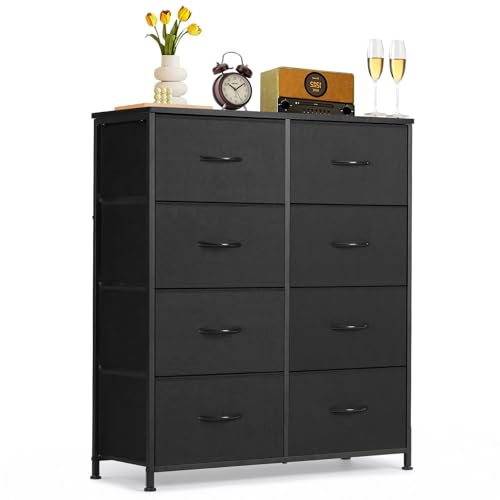
- 8-drawer tall layout: Two narrow columns stacked vertically. Maximizes vertical space but each drawer is narrower.
If drawer depth matters to you — for example, if you store folded sweaters or linens — consider a deep model. Our guide to the 12 deep dresser and 12 inch deep dresser explains how shallow and deep drawers change what you can realistically store. For tighter rooms, the 32 inch dresser overview covers the most common compact configurations.
32 Inch Wide Dresser vs 32 Inch Wide Chest of Drawers
The terms are often used interchangeably, but at the 32 inch width they describe two different shapes. A 32 inch wide dresser is wider than it is tall and spreads storage horizontally. A 32 inch wide chest of drawers keeps the same width but stacks drawers vertically, often reaching 45–55 inches in height.
When to choose a dresser
- You want a surface for a mirror, lamp, or decor at a comfortable height.
- The room has horizontal wall space but limited vertical space — for example, under a window.
- You prefer side-by-side drawer organization over deep vertical stacking.
When to choose a chest
- You have a narrow wall and want to use vertical space efficiently.
- You need more drawers in the same footprint.
- The room has no room for a wide dresser but plenty of height.
If you are still weighing the two shapes more broadly, the dresser vs chest comparison guide breaks down the trade-offs in detail.
Materials and Construction to Look For
At 32 inches wide, construction quality matters as much as it does on larger pieces — perhaps more so, because compact dressers are often moved, loaded heavily, and used in tight spaces where wobble is immediately noticeable.
Frame and case materials
- Solid wood: The most durable option. Oak, maple, and walnut are the most stable; pine is softer but widely used for entry-level and mid-range pieces. Solid wood holds screws and hardware better over years of use.
- Engineered wood with veneer: Common in entry-level to mid-range dressers. Quality depends heavily on the veneer thickness and the density of the core board. Look for descriptions of "high-density" or "furniture-grade" cores.
- Metal: Powder-coated steel dressers are durable, rust-resistant, and well-suited to modern or industrial interiors. They are often a good choice for dorms and rental spaces.
- Bamboo: A sustainable option with good hardness. Bamboo dressers are typically mid-range and pair well with light, airy room styles.
Drawer construction
- Dovetail joints: The strongest drawer box joinery, typically found on premium and high-end tier dressers.
- French dovetail or pinned joints: Durable mid-tier construction that holds up well under regular use.
- Stapled or glued boxes: Common on entry-level pieces. Acceptable for light use but more prone to loosening over time.
- Drawer slides: Ball-bearing slides with full-extension travel are the benchmark for smooth, complete access. Look for side-mounted or undermount slides rated for the drawer's expected load.
- Stops and anti-tip hardware: Important for any dresser, and essential for nursery or kids' room use. Check for drawer stops that prevent accidental pull-out and a wall-anchoring kit.
For a deeper explanation of what separates well-built pieces from the rest, see our dresser quality guide and the solid wood vs engineered wood comparison.
Placement and Room Planning
A 32 inch wide dresser is flexible, but it still needs planning. Here are the placement scenarios that work best and the measurements to confirm before you buy.
Where a 32 inch dresser fits best
- Beside the bed as a large nightstand: A 32 inch dresser can double as a bedside surface if the height matches the mattress top. This is a common space-saving move in small bedrooms.
- Against a short wall: Many bedrooms have one wall segment that is too narrow for a wider dresser. A 32 inch model fills it without blocking traffic flow.
- Under a window: Low-profile 32 inch dressers can sit beneath a window if the sill height allows. Measure from the floor to the sill and leave a few inches of clearance.
- Inside or beside a closet: A narrow dresser placed just outside a closet keeps folded clothing accessible without consuming closet depth.
- At the foot of the bed: A 32 inch dresser can act as a low storage console at the foot of a bed, provided there is enough walking clearance.
Clearance rules of thumb
- Leave at least 24–30 inches of walking space in front of the dresser.
- Allow 2–3 inches on each side so drawers can be pulled out fully.
- Confirm the dresser height relative to nearby furniture — a surface used as a nightstand should sit close to mattress height.
- Anchor to the wall whenever possible, especially in homes with children or pets.
If you are furnishing a small bedroom from scratch, our small bedroom storage ideas and dressers for small spaces guides pair well with this page. For nursery-specific planning, see the nursery dressers overview.
Market Tiers Explained
Rather than comparing models by any single figure, it helps to think in tiers. The tiers below describe relative market position and construction expectations, and the same classification is used throughout this guide.
| Tier | Typical Construction | Best For | What to Expect |
|---|---|---|---|
| Entry-level | Engineered wood, stapled drawer boxes, basic slides | Guest rooms, dorms, temporary setups | Light-to-moderate use; simple assembly; fewer finish options |
| Mid-range | Engineered wood with quality veneer or solid wood accents, ball-bearing slides | Primary bedrooms, long-term daily use | Smoother drawer travel, better hardware, broader finish selection |
| Premium | Solid wood case, dovetail or pinned drawer boxes, full-extension slides | High-use bedrooms, buyers prioritizing longevity | Heavier build, tighter tolerances, refinishable surfaces |
| High-end tier | Solid hardwood, hand-finished, premium hardware and joinery | Primary suites, design-led interiors | Long-term investment piece, consistent finish quality, detailed hardware |
Most buyers shopping a 32 inch wide dresser land in the entry-level to mid-range tiers, because compact dressers are frequently bought for secondary rooms. That said, a premium solid wood piece is worthwhile if the dresser will be in daily use for years. The dresser budget guide explains how to think about tier selection by use case rather than by any single number.
Buying Checklist for a 32 Inch Wide Dresser
Use this checklist to narrow your options before comparing specific models.
- Measure the wall: Confirm 36–38 inches of usable width to allow drawer clearance.
- Measure the height: If the dresser will double as a nightstand, check it against mattress height.
- Confirm depth: Make sure the depth leaves enough walking space in the room.
- Count your storage needs: Estimate how many drawers you need for clothing, accessories, and linens.
- Check drawer layout: Prefer a layout with at least one or two smaller top drawers for accessories.
- Inspect construction: Look for solid wood or high-density engineered wood, ball-bearing slides, and dovetail or pinned drawer boxes.
- Check safety features: Confirm drawer stops and an included anti-tip kit, especially for kids' rooms.
- Review the finish: Matte and textured finishes hide scratches better; gloss finishes are easier to wipe clean.
- Plan assembly: Compact dressers often ship flat-packed; check whether assembly is required and what tools are needed.
- Confirm delivery and anchoring: Verify that the assembled unit can fit through doorways and stairwells, and plan to anchor it to the wall.
For a broader checklist that applies across sizes, see the complete dresser buying guide and the how to choose a dresser walkthrough.
Ready to Compare 32 Inch Wide Dressers?
Browse recommended compact dressers and storage pieces below. Every option is selected for real-world bedroom use, with drawer layouts and construction details that match the guidance in this guide.
View Recommended DressersFrequently Asked Questions
Is a 32 inch wide dresser big enough for one person?
What is the difference between a 32 inch wide dresser and a 32 inch wide chest of drawers?
How many drawers does a 32 inch wide dresser usually have?
Can a 32 inch wide dresser fit in a small bedroom?
What materials are best for a 32 inch wide dresser?
Should I anchor a 32 inch wide dresser to the wall?
Final Thoughts
A 32 inch wide dresser is one of the most practical compact storage pieces you can put in a bedroom. It is wide enough to hold real clothing, shallow enough to fit where a full dresser cannot, and adaptable enough to work as a primary dresser, a bedside console, or a guest room workhorse.
The key is to match the drawer layout and construction tier to how you will actually use it. Start with measurements, confirm drawer depth and slide quality, and use the tier framework above to compare options on equal footing. From there, the recommended dressers below give you a curated starting point.