
24 Inch Wide Chest of Drawers: The Complete Buyer's Guide
Everything you need to know about narrow chests of drawers — dimensions, drawer counts, materials, and how to choose the right compact storage for a small bedroom, nursery, or closet.
Explore Top PicksWhy a 24 inch wide chest of drawers? In small bedrooms, apartments, and tight closets, every inch of floor space matters. A 24 inch wide chest delivers serious storage without dominating the room. This guide walks you through the exact dimensions to measure, the drawer configurations that work best, and the materials worth investing in — so you can buy with confidence.
What Exactly Is a 24 Inch Wide Chest of Drawers?
A 24 inch wide chest of drawers is a compact storage unit that measures roughly 24 inches across its front face. That width places it firmly in the narrow furniture category — slim enough to squeeze beside a bed, into a closet alcove, or along a short hallway wall, yet wide enough to hold drawers with usable interior space.
Unlike a full-size dresser, which often spans 50 to 70 inches, a 24 inch wide chest stacks its drawers vertically. This design trades horizontal surface area for vertical capacity, which is exactly what you want when floor space is the limiting factor. If you are still weighing formats, our breakdown of dresser vs chest of drawers explains the functional differences clearly.
These narrow chests are especially common in three scenarios: small primary bedrooms where a bed and nightstand consume most of the wall, nursery and guest rooms where storage needs are lighter, and closet systems where a slim chest replaces built-in shelving.
Key Dimensions to Check Before You Buy
Width alone does not tell the whole story. Before ordering any narrow chest, confirm four measurements: width, depth, height, and interior drawer depth. The table below shows the typical ranges you will encounter for a 24 inch wide unit.
| Measurement | Typical Range | Why It Matters |
|---|---|---|
| Overall width | 23–25 inches | Confirm the true footprint, including drawer pulls and overhanging tops |
| Overall depth | 14–18 inches | Determines walkway clearance and whether the chest fits a closet niche |
| Overall height | 30–55 inches | Tall models maximize storage; low models double as surfaces |
| Interior drawer depth | 12–16 inches | Deep drawers hold folded sweaters; shallow drawers suit accessories |
| Drawer count | 3–5 drawers | Matches the volume of clothing you need to store |
A crucial detail many buyers overlook: the listed width usually refers to the cabinet body, not the full footprint. Drawer pulls and a slightly overhanging top can add an inch or more on each side. If your space is truly tight, measure the intended gap and subtract at least two inches of clearance for pulls and airflow.
Depth is equally decisive. A 14 inch deep chest slides easily into narrow hallways and closet runs, but its drawers will not hold bulky knitwear stacked more than two high. An 18 inch deep model offers much more usable drawer volume but needs a wider walkway in front of it. Our guide to 18 inch deep chests of drawers covers that trade-off in detail.
For height, tall narrow models — sometimes called tallboys — are the most space-efficient option. They keep the footprint small while adding drawers upward. If you have vertical clearance, a tall 24 inch wide chest can store as much as a much wider low dresser.
How Many Drawers Do You Actually Need?
The drawer count on a 24 inch wide chest directly affects how much clothing it can hold and how you organize it. Here is how the common configurations break down:
- Three-drawer models: The essential tier. Best for linens, accessories, baby clothes, or a guest room where storage volume is modest. Often the lowest height, making them useful as a nightstand replacement or nursery changing surface.
- Four-drawer models: The balanced tier. A solid choice for a single adult's folded wardrobe — one drawer for tops, one for bottoms, one for undergarments, one for overflow. This is the most common configuration in the 24 inch category.
- Five-drawer models: The high-capacity tier for the footprint. Usually taller, with a mix of small top drawers and deeper lower drawers. Ideal when the chest is the only storage piece in a small bedroom.
If you need more capacity than five drawers can offer, consider stepping up to a taller unit such as a 30 inch high chest of drawers or exploring 6 drawer dressers in a similar narrow profile. And if your priority is deep, bulk-friendly drawers rather than drawer count, our guide to 12 deep dressers explains how depth changes storage behavior.
Materials and Build Quality
In a narrow chest, build quality matters more than in a wide dresser because every drawer carries proportionally more load and the tall, slim frame is more sensitive to wobble. Here is how the main material categories compare:
Solid Wood
Solid wood — oak, maple, walnut, pine, or mahogany — remains the top-tier choice for durability. A solid wood chest resists racking, supports heavier drawer loads, and can be refinished decades later. The trade-off is weight and a higher position in the market. For a long-term investment piece, solid wood is the benchmark. Explore solid wood chests if this is your priority.
Engineered Wood with Veneer
High-grade engineered wood with a real wood veneer sits in the mid-range tier. It offers a stable, flat surface that resists warping, and modern veneers are convincingly realistic. Check the drawer box construction and the joinery — dovetail joints signal a sturdier build than stapled butt joints, regardless of the exterior material.
Metal and Mixed Materials
Metal chests in a 24 inch width are popular in modern and industrial interiors. They are typically lightweight, easy to clean, and excellent in humidity-prone spaces. Rattan and bamboo options bring texture and suit coastal or boho rooms, though they are generally lighter-duty. If you want a natural-fiber look, our rattan dressers guide is a useful starting point.
Build-quality checklist for narrow chests:
✔ Dovetail or reinforced drawer joints | ✔ Metal drawer glides with a smooth, full-extension action | ✔ Anti-tip strap included | ✔ Back panel that is stapled or screwed, not just tacked | ✔ Feet or levelers to compensate for uneven floors
Matching a Narrow Chest to Your Room
A 24 inch wide chest is a problem-solver, and the right configuration depends on where it will live:
Small Bedrooms
Pair a tall 24 inch chest with a bed and skip the traditional nightstand — the chest's top surface can hold a lamp and phone. If you need bedside storage on both sides, look at compact 3 drawer dresser nightstands that match the chest's footprint. For rooms where the chest is the primary piece, prioritize four or five drawers.
Nurseries
Nursery use changes the requirements: stability and safety come first. Choose a chest with an anti-tip strap, rounded corners, and drawer glides that stop firmly. A three-drawer model at a comfortable height can double as a changing surface with a topper. See our nursery dressers collection and the 3 drawer dresser changing table options for configurations built around this dual purpose.
Closets and Hallways
In a walk-in closet, a slim chest adds drawer storage without eating the aisle. A 14 inch deep model is usually the better fit here. In hallway alcoves, a narrow chest works as a linen and utility storage unit; just confirm the drawers clear any door swing.
Apartments and Dorms
For renters, a lighter engineered-wood or metal chest is easier to move between units. Prioritize models that arrive flat-packed but include sturdy hardware — the assembly quality of a chest often predicts how well it will hold up after multiple moves.
Tier Comparison: Entry-Level vs Mid-Range vs Premium
Rather than shopping by number, classify candidates by their position in the market. This table summarizes what each tier typically delivers in the 24 inch category.
| Tier | Typical Construction | Best For |
|---|---|---|
| Entry-level | Particleboard or thin engineered wood, stapled joints, basic side-mount glides | Guest rooms, dorms, seasonal storage, first apartments |
| Mid-range | Thicker engineered wood or veneer, dovetail-style joints, ball-bearing glides, anti-tip hardware | Primary bedrooms, nurseries, daily-use storage |
| Premium | Solid wood, dovetail drawer boxes, full-extension soft-close glides, hand-finished surfaces | Long-term investment, heirloom use, high-traffic bedrooms |
Within a given tier, look for "good value for its tier" signals: full-extension glides, a sturdy back panel, and included anti-tip straps. A mid-range chest with those features will outperform a premium-looking unit with thin drawer boxes. If you want a deeper comparison framework, our dresser quality guide walks through the checks step by step.
Common Mistakes to Avoid
- Measuring only the wall, not the swing. Drawers need room to pull out. A 16 inch deep chest needs at least 16 inches of clear space in front, plus a few inches for your feet.
- Ignoring the overhang. A 24 inch wide cabinet with a 26 inch top will not fit a 25 inch gap. Check the full footprint, including hardware.
- Skipping the anti-tip strap. Tall, narrow chests are more prone to tipping than wide dressers. Always anchor the unit to the wall, especially in homes with children or pets.
- Overloading the top drawers. Narrow drawers carry less weight. Keep heavy items in the bottom drawers where the frame is most stable.
- Mismatching depth to the room. An 18 inch deep chest in a 30 inch hallway leaves too little clearance. Match depth to walkway width first, then choose the drawer count.
Top Picks for 24 Inch Wide Chests of Drawers
The products below are selected for their fit within the compact category — narrow footprint, sensible drawer counts, and construction that holds up to daily use. Use the tier labels to match your budget position, then open the product pages to confirm current dimensions and availability.
When comparing, keep these priorities in mind: a chest that will sit in a nursery should have anti-tip hardware and rounded edges; a chest for a closet should prioritize shallow depth; a chest for a primary bedroom should favor four or five drawers with full-extension glides.
Recommended 24 Inch Wide Chests of Drawers
⚠️ AFFILIATE DISCLOSURE: This website contains affiliate links. As an Amazon Associate, we earn from qualifying purchases. If you make a purchase through these links, we may receive a small commission at no additional cost to you. Read our full affiliate policy.
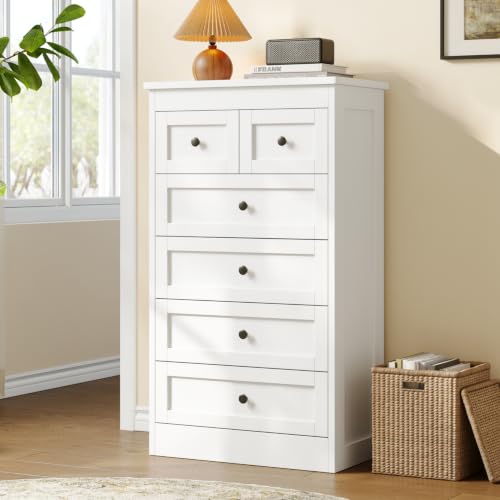
wanan Tall 6 Drawer Dresser for Bedroom, White Modern 43.3'' Tall Wood Chest of Drawers, Storage Organizer with Smooth Metal Rails & Anti-Tip Kit for Closet, Hallway, Living Room
Check price on Amazon
VASAGLE 4-Drawer Dresser, Chest of Drawers, 23.6 x 15.7 x 38.3 Inches | Storage Tower Unit, Modern Basic Style, for Bedroom, Closet, Living Room, Cloud White, KAILYN Collection ULTS614W01
Check price on Amazon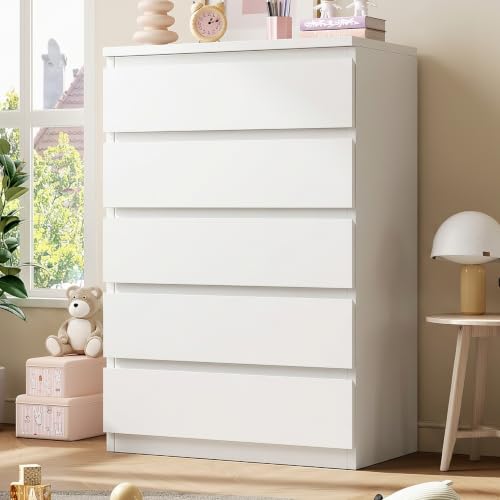
5 Drawer Dresser for Bedroom, White Dresser Chest of Drawers, Tall Dressers for Bedroom with Handleless Drawers, 15" D x 23.7" W x 40.4" H Storage Dressers for Living Room, Hallway and Entryway-White
Check price on Amazon
Pipleo White Drawer Dresser for Bedroom, Modern 6 Tall Chest of Drawers, Wood Storage Organizer with Curved Edge & Anti-Tip Kit for Closet, Hallway, Living Room
Check price on Amazon
EazeHome Farmhouse 4 Drawer Dresser for Bedroom, Vertical Wide Chest of Drawers with Metal Handle, Wooden Storage Organizer for Living Room, Hallway, Brown
Check price on Amazon
GEPELCN Farmhouse 4 Drawers Dresser for Bedroom Rustic Chest of Drawers with Natural Texture White Drawers Organizer for Living Room Hallway
Check price on AmazonThe Verdict: Who Should Buy a 24 Inch Wide Chest of Drawers?
A 24 inch wide chest of drawers is the right purchase if floor space is your constraint and you need vertical storage that fits a narrow wall, closet alcove, or bedside gap. It suits small primary bedrooms, nurseries, guest rooms, apartments, and organized closets equally well.
Choose a three-drawer model for light storage and surface use, a four-drawer model for a single adult's folded wardrobe, and a five-drawer model when the chest is your only storage piece. Confirm depth before anything else, then match materials to how long you plan to keep the piece.
Ready to narrow down your options? Browse our related guides on 24 inch wide dressers, narrow dressers, and dressers for small spaces for more configurations, or jump straight to the top picks above to compare models side by side.
Compare Top PicksFrequently Asked Questions
What is the standard depth of a 24 inch wide chest of drawers?
Most 24 inch wide chests of drawers have a depth between 14 and 18 inches. Compact models sit around 14 to 15 inches deep, while standard-depth units range from 16 to 18 inches. Shallower depths suit narrow hallways and closets, while deeper units hold bulkier clothing.
How many drawers does a 24 inch wide chest typically have?
A 24 inch wide chest of drawers usually comes with three to five drawers. Three-drawer models suit light storage such as linens and accessories, while four- and five-drawer configurations handle a full wardrobe for one person.
Is a 24 inch wide chest of drawers good for a small bedroom?
Yes. A 24 inch wide chest is one of the most space-efficient storage pieces available. It fits alongside a bed in compact rooms, works as a nightstand replacement, and slots into closets or hallway alcoves without crowding the floor plan.
What materials are best for a narrow chest of drawers?
Solid wood and high-grade engineered wood with wood veneer offer the best balance of durability and stability in a narrow footprint. Metal chests suit modern or industrial rooms, while rattan and bamboo models work well in relaxed, coastal, or boho interiors.
Should I choose a tall or short 24 inch wide chest of drawers?
Choose a tall model when floor space is limited but vertical space is available, such as in a closet or beside a doorway. Choose a shorter, wider-stance model when the chest doubles as a surface for decor or as a changing table in a nursery.