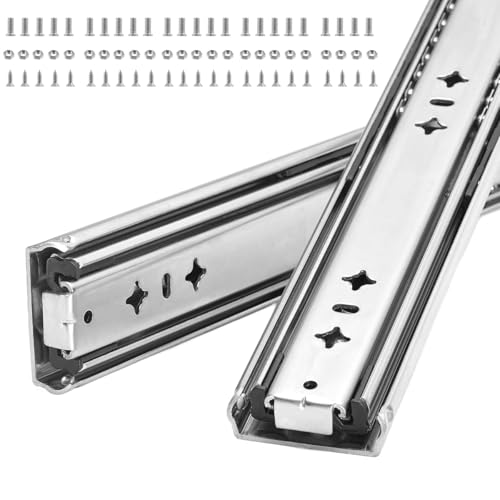
40 Inch Full Extension Drawer Slides: The Complete Guide
When you need smooth, reliable access to a deep drawer, 40 inch full extension drawer slides are the hardware that makes it possible. Unlike standard slides that only allow the drawer to open partially, full extension slides let the drawer pull out completely, giving you unobstructed access to every item inside. For wide dressers, deep storage cabinets, and custom furniture builds, a quality set of 40 inch slides can transform a frustrating drawer into a pleasure to use.
This guide walks you through everything you need to know before choosing a set: how full extension mechanisms work, what weight capacities to expect across quality tiers, how to measure correctly, and what installation pitfalls to avoid. Whether you are replacing worn-out hardware on an existing piece or planning a new build, the information below will help you make a confident, well-informed decision.
What Are 40 Inch Full Extension Drawer Slides?
Drawer slides, also called drawer runners or glides, are the mechanical tracks that connect a drawer to its cabinet. A full extension slide allows the drawer to travel out far enough that the entire drawer box clears the cabinet opening. This is especially valuable on deep drawers, where a three-quarter extension would leave the rear contents hidden in shadow and difficult to reach.
The 40 inch measurement refers to the collapsed length of the slide. These are long slides, typically used on deep dressers, wardrobe drawers, tool cabinets, and built-in storage where the drawer depth exceeds what a standard 16 to 24 inch slide can accommodate. If you are working with a deep chest or a custom piece, you may also want to compare specifications with 36 inch full extension drawer slides or step up to 48 inch full extension drawer slides depending on your drawer depth.
How Full Extension Mechanisms Work
Most modern full extension slides use a three-member telescoping design: a cabinet member, an intermediate member, and a drawer member. Ball bearings housed in a retainer cage allow these members to glide over one another with minimal friction. The result is a drawer that opens smoothly and stops precisely when fully extended, often with a built-in detent or hold-in feature to prevent accidental roll-out.
Some slides incorporate soft-close dampers that cushion the final few inches of travel, while others offer push-to-open functionality for handle-free drawer fronts. These features are more common in mid-range and premium tiers, where the internal mechanisms are engineered for repeatable performance over thousands of cycles.
Key Factors to Consider Before Buying
Weight Capacity and Load Rating
Weight capacity is the single most important specification to match to your intended use. Drawer slides are rated in pairs, and the rating reflects the total load the pair can support when properly installed. Entry-level slides often handle lighter loads suitable for clothing and linens, while heavy-duty and commercial-grade slides are built for tools, files, or dense storage.
As a rule of thumb, choose a slide rated above your expected load rather than right at it. A drawer that is routinely loaded near its maximum rating will wear faster and may develop sag or rough travel over time. If you are building a heavy-duty drawer for a workshop or a deep dresser packed with denim and winter layers, a reinforced slide with a higher rating is a worthwhile investment.
Side-Mount vs. Under-Mount
Side-mount slides attach to the sides of the drawer box and the inside faces of the cabinet. They are easier to retrofit and generally more forgiving of minor measuring errors. Under-mount slides attach beneath the drawer box and are largely hidden from view, giving a cleaner look inside the cabinet. Under-mount slides often include integrated soft-close and self-closing features, but they require more precise installation and are less adaptable to non-standard drawer boxes.
For a 40 inch slide, side-mount designs are common in deep dressers and utility cabinets, while under-mount designs appear more often in premium furniture where concealed hardware is part of the design intent.
Material and Finish
High-grade steel is the standard material for quality drawer slides. Look for slides with a rust-proof finish such as zinc plating or a powder-coated surface, especially if the furniture will be used in a humid environment like a bathroom or laundry area. Stainless steel slides are available for marine or outdoor applications, though they are typically positioned in the premium tier.
The ball bearings themselves matter too. Dense, well-seated bearings in a sturdy retainer cage produce quieter, smoother travel. Cheaper slides may use fewer or lower-grade bearings, which can result in a gritty feel and faster wear.
Extension Type and Travel
Full extension is the right choice when you need to reach the back of a deep drawer. However, not every application requires it. Three-quarter extension slides are shorter-travel options that keep the drawer partially supported by the cabinet, which can be useful in tight spaces where a fully extended drawer would block a walkway. If you are comparing options, our guide to 16 inch full extension drawer slides explains how extension type affects access in smaller drawer formats.
Measuring for 40 Inch Slides
Correct measurement is the difference between a drawer that glides and one that binds. To determine whether a 40 inch slide fits your project, measure the drawer box depth from the front edge to the back edge. The slide length should match this depth closely, though some slides allow for minor adjustment. Also measure the cabinet opening depth to confirm the slide will not interfere with the back panel or any internal structure.
For side-mount slides, check the clearance between the drawer side and the cabinet wall. Most side-mount slides require roughly half an inch of clearance on each side. Under-mount slides require specific drawer bottom dimensions and a notch cut into the drawer back, so consult the manufacturer's template before cutting.
Installation Best Practices
Even the best slide will underperform if installed poorly. Follow these practices to get smooth, long-lasting results:
- Square the cabinet first. A cabinet that is out of square will cause the drawer to bind no matter how carefully you align the slides.
- Use a spacer or template. Most manufacturers provide a mounting template or specify a setback distance. Follow it precisely so the drawer front sits flush.
- Pre-drill screw holes. This prevents splitting, especially in solid wood drawer boxes, and ensures screws seat firmly.
- Check parallel alignment. Both slides must be level and parallel to each other. A slight tilt will cause uneven travel and premature wear.
- Test before final tightening. Open and close the drawer several times before fully torquing screws. Adjust as needed, then secure.
If you are retrofitting slides onto an existing dresser, our guide to 24 inch heavy-duty drawer slides covers how weight rating and mounting style interact in smaller formats, and the same principles apply when scaling up to a 40 inch slide.
Quality Tiers: What to Expect
Drawer slides are available across a wide spectrum of quality. Understanding the tiers helps you match the hardware to the project without over- or under-specifying.
| Tier | Typical Characteristics | Best For |
|---|---|---|
| Entry-level | Basic ball-bearing mechanism, lighter load rating, standard zinc finish, minimal travel adjustment | Light-duty dresser drawers, occasional-use storage, starter furniture projects |
| Mid-range | Smoother bearing travel, higher load rating, soft-close or self-close options, better corrosion resistance | Everyday bedroom dressers, deep wardrobe drawers, family furniture |
| Premium | Heavy-duty steel construction, high load rating, precision bearings, integrated damping, close-tolerance manufacturing | Custom furniture, high-use dressers, workshop storage, long-term installations |
| Commercial-grade | Maximum load ratings, reinforced members, tested cycle life, corrosion-resistant finishes | Institutional furniture, tool cabinets, file storage, demanding environments |
For most residential dresser applications, a mid-range slide offers the best balance of smooth operation, durability, and ease of installation. Premium and commercial-grade slides make sense when the drawer will be opened frequently, loaded heavily, or expected to last for decades without service.
Common Mistakes to Avoid
Several recurring errors account for most drawer slide problems:
- Choosing a slide that is too short or too long. A slide that does not match the drawer depth will either leave the drawer unsupported or prevent it from closing fully.
- Ignoring the load rating. Overloading a slide leads to sagging, rough travel, and eventual failure.
- Mixing slide types on one drawer. Always install a matched pair from the same model and batch.
- Skipping the cabinet squareness check. A racked cabinet will fight even the best slide.
- Overtightening screws. This can deform the slide profile and cause binding.