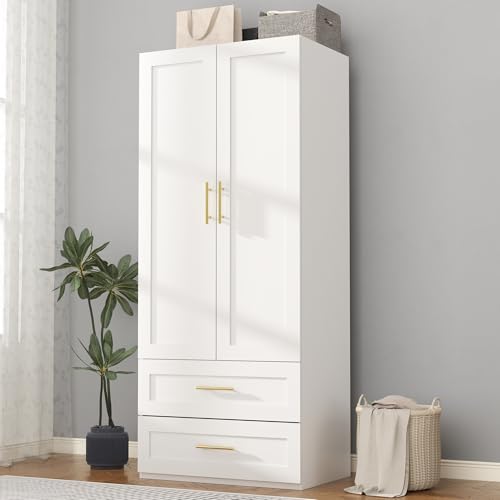
Extra Tall Armoire with Drawers: The Complete Buyer's Guide
If you are short on floor space but rich in wardrobe volume, an extra tall armoire with drawers is one of the most efficient storage pieces you can add to a bedroom. This guide walks you through sizing, drawer layouts, materials, stability, and room planning so you can choose with confidence.
Explore Recommended ModelsWhat Counts as an Extra Tall Armoire?
Standard armoires usually stand between 60 and 72 inches high. Once a unit moves past roughly 72 inches, retailers and furniture makers generally classify it as extra tall. Most extra tall models on the market sit somewhere in the 78 to 90 inch band, which places the top section comfortably above eye level and turns the full vertical face of the unit into usable storage.
That extra height is not just cosmetic. A taller carcass means more hanging length for dresses, coats, and long shirts, plus additional shelf zones near the top for out-of-season items. When drawers are integrated into the lower half, the unit effectively combines a wardrobe, a chest, and a shelving tower in a single footprint — which is exactly why tall armoires with drawers have become a favorite in apartments and compact primary bedrooms.
Why Choose an Extra Tall Armoire with Drawers?
The case for going tall is mostly about efficiency. Floor space in bedrooms is finite, but walls are often underused. A tall armoire converts that vertical real estate into storage without widening the unit's footprint, which matters in rooms where the bed, nightstands, and a dresser already compete for space.
Key advantages
- Vertical storage without extra floor area. A tall unit stores roughly the same volume as a much wider, shorter piece while occupying a narrower strip of wall.
- Combined hanging and folded storage. The drawer bank handles folded clothing, linens, and accessories while the upper section holds hanging garments.
- Better use of dead wall space. Tall walls that would otherwise stay empty become functional, which is especially useful in rooms with high ceilings.
- Cleaner visual line. A single tall piece often reads as less cluttered than a dresser plus a separate wardrobe side by side.
- Good fit for narrow rooms. If you cannot place a wide dresser, a tall armoire uses the one dimension most bedrooms have in abundance: height.
If you are comparing this format against a pure drawer stack, it helps to understand the trade-offs between an armoire and a traditional dresser. Our guide to dresser vs armoire breaks down when each format makes more sense for a bedroom.
Height, Width and Depth: Planning Your Dimensions
Sizing is where most tall armoire purchases go wrong. Because these units are tall and often narrow, the margin for error on height and depth is small. Measure first, then shop.
Height clearance
Measure the ceiling height at the exact spot where the unit will stand. Then subtract a few inches of breathing room for assembly, moving, and any crown molding. If you have ceiling fans, pendant lights, or air vents overhead, account for them as well. A unit that clears the ceiling by only an inch is difficult to install and nearly impossible to reposition later.
Width and door swing
Extra tall armoires are often narrow to preserve floor space, but door swing needs to be checked carefully. Measure the space in front of the unit and confirm that the doors can open fully without hitting the bed, a nightstand, or a doorway. If the armoire sits in a tight corner, consider a model with sliding doors or a narrower door profile.
Depth
Depth determines both hanging capacity and how much the unit protrudes into the room. Standard wardrobe depth is around 22 to 24 inches, which accommodates most hangers. Shallow units in the 16 to 18 inch range save floor space but may require angled hangers or front-facing hanging. Deep drawer sections add a few inches of usable storage but also increase the footprint.
| Dimension | Typical Extra Tall Range | What to Verify |
|---|---|---|
| Height | 72" – 90" | Ceiling clearance, fixtures, molding |
| Width | 30" – 48" | Door swing, adjacent furniture, walkway |
| Depth | 18" – 24" | Hanger clearance, protrusion into room |
| Drawer interior height | 4" – 10" | Folded clothing, linens, bulky items |
For broader guidance on matching furniture to room dimensions, see our dresser size guide. If your room is especially tight, the strategies in dressers for small spaces apply equally well to tall armoires.
Drawer Layouts and Interior Design
The drawer bank is what separates a tall armoire with drawers from a plain wardrobe. Layout matters more than drawer count, because the way the space is divided determines what you can actually store.
Common layouts
- Two deep lower drawers plus full-height hanging. The classic configuration. Deep drawers handle bulky items like sweaters and jeans, while the upper section handles dresses and long garments.
- Three to four drawers with a split hanging section. A good middle ground if you have a mix of long and short garments. A half-width hanging section above the drawers and a full-height section beside it covers both needs.
- Five to six drawers with a short hanging zone. Best for people whose wardrobe is mostly folded clothing. The shorter hanging area suits shirts, blouses, and jackets rather than full-length dresses.
- Drawers plus adjustable shelves. Flexible for linens, shoes, and accessories. Shelves can often be repositioned as storage needs change.
Drawer mechanics
Drawer hardware is where build quality shows. Entry-level units often use basic side-mounted rollers, which work but can feel loose over time. Mid-range and premium models typically use ball-bearing side slides or under-mount slides with soft-close mechanisms, which feel smoother and reduce slam noise. High-end and luxury units may use full-extension, heavy-duty slides rated for daily use in deep drawers.
On an extra tall unit, drawer boxes sit lower than on a standard dresser, so smooth-glide hardware matters more for comfort. Look for drawer bottoms that are at least 3/8 inch thick on deep drawers; thin bottoms tend to flex under the weight of folded denim or linens.
For a deeper dive into organizing a drawer stack, our dresser organization guide covers folding techniques and zone planning that work just as well in an armoire drawer bank.
Materials and Build Quality
A tall armoire carries more structural load than a low dresser because the carcass is taller and the doors are larger. Material choice affects stability, longevity, and how well the unit handles daily use.
Solid wood
Solid hardwood — oak, maple, walnut, mahogany — offers the most durable construction and the best long-term investment profile. It resists warping, holds screws and hinges securely, and can be refinished if the finish wears. Solid wood units tend to fall in the premium to luxury tiers and are heavier, which is generally a good sign for stability.
Engineered wood
MDF, particleboard, and plywood with veneers are common in entry-level and mid-range units. Well-made engineered wood can be perfectly serviceable, especially when the carcass is reinforced at stress points. The key checks are edge banding quality, back panel thickness, and whether the drawer boxes are solid wood or thin composite.
Metal accents and mixed materials
Some tall armoires pair wood carcasses with metal frames, glass doors, or metal drawer fronts. These designs can be visually striking, but check that the frame is reinforced and that the glass is tempered if used on doors. Mixed-material units in the mid-tier often deliver a strong balance of style and durability.
| Tier | Typical Construction | Best For |
|---|---|---|
| Entry-level | Engineered wood, basic slides, thinner panels | Guest rooms, temporary setups, light use |
| Mid-range | Reinforced engineered wood or mixed solid/composite, soft-close slides | Primary bedrooms, daily use |
| Premium | Solid wood frames, quality veneers, under-mount slides | Long-term daily use, family homes |
| Luxury | Full solid hardwood, hand-finished, heavy-duty hardware | Heirloom-quality purchases, high-use rooms |
If you want to compare material classes in more depth, our guide to solid wood vs engineered furniture explains the practical differences. For wood-specific options, see oak dressers and walnut dressers for reference on how these materials present in bedroom furniture.
Stability and Anti-Tip Safety
This is the single most important section for anyone buying an extra tall armoire. Tall, narrow furniture has a higher center of gravity, and an open drawer shifts the unit's weight forward. Without anchoring, a fully loaded tall armoire can tip if someone leans on an open drawer or a child tries to climb it.
Anti-tip anchoring is not optional
Most reputable manufacturers include an anti-tip kit with the unit. Use it. Anchor the armoire to a wall stud using the provided bracket and hardware. If the wall is drywall without a convenient stud, use appropriate heavy-duty anchors rated for the load. This step takes minutes and eliminates the most serious safety risk associated with tall storage furniture.
Other stability factors
- Base design. A wide, solid base distributes weight better than small feet. Units with a continuous plinth tend to feel more planted.
- Back panel rigidity. A thick, well-attached back panel prevents the carcass from racking or twisting over time.
- Drawer stops. Drawer stops prevent drawers from pulling completely free and shifting weight unexpectedly.
- Leveling feet. Adjustable levelers compensate for uneven floors and keep the unit from rocking.
Room Placement and Layout
Where the armoire goes affects both function and the visual balance of the room. A few placement principles help you avoid a unit that feels cramped or out of proportion.
Wall selection
Choose a wall with enough uninterrupted height and width for the unit plus door clearance. Avoid placing a tall armoire directly beside a window if door swing would block light or access. In rooms with sloped ceilings, only the tallest wall section can host an extra tall unit — measure clearance at the installation spot, not at the room's peak.
Traffic flow
Leave at least 30 inches of walkway in front of the unit so doors and drawers can open comfortably. If the armoire sits opposite the bed, check that the open door does not intrude into the path between bed and bathroom or closet.
Visual balance
Tall units can dominate a small room. Pairing the armoire with lower furniture nearby — a bench, a low nightstand, or a slim dresser — softens the visual weight. In larger rooms, the armoire can serve as a focal point, especially if it sits on a blank wall opposite the bed.
If you are planning the whole room around a tall storage piece, our bedroom dresser ideas and bedroom storage guides cover complementary layouts. For rooms where the armoire doubles as a media or display surface, see entertainment dresser for bedroom.
What to Check Before You Buy
Extra tall armoires are a bigger commitment than a standard dresser — they are harder to move, harder to return, and more sensitive to room dimensions. Run through this checklist before placing an order.
- Measure twice. Ceiling height, wall width, depth clearance, and door swing. Write the numbers down and compare against the product's assembled dimensions.
- Check delivery access. Confirm that the boxed or assembled unit fits through doorways, up stairwells, and around corners. Some extra tall units ship in multiple boxes; others arrive assembled.
- Confirm the anchoring kit. Verify that an anti-tip bracket is included. If not, plan to buy one separately.
- Review drawer hardware. Look for soft-close or full-extension slides if smooth daily use matters to you. Check drawer load ratings on deep drawers.
- Inspect the hanging section. Confirm the interior height suits your longest garments. A full-height section needs roughly 60 inches of clear hanging space for dresses and coats.
- Check the finish and hardware. Knobs, pulls, and hinges are replaceable, but they signal overall build quality. Metal hardware with a proper finish holds up better than plastic.
- Read assembly requirements. Some units require two people and a few hours to assemble. Factor that into your plan.
If you are weighing a tall armoire against a dedicated drawer chest, the comparison in dresser vs wardrobe helps clarify which format fits your storage habits. For very tall drawer-focused alternatives, see extra tall dresser with deep drawers.
Frequently Asked Questions
What height counts as an extra tall armoire?
Most furniture retailers treat armoires above roughly 72 inches as extra tall. Units in the 78 to 90 inch range are common, and anything beyond that begins to approach ceiling-height built-in territory. Always measure your ceiling, ceiling fixtures, and doorways before choosing a unit in this range.
How many drawers should an extra tall armoire have?
It depends on how you plan to divide hanging versus folded storage. A common layout pairs two or three deep lower drawers with a full-height hanging section above. If folded clothing dominates your wardrobe, look for four to six drawers plus a shorter hanging area.
Do extra tall armoires need to be anchored to the wall?
Yes. Tall, narrow furniture has a higher center of gravity, and an open drawer shifts weight forward. Anti-tip anchoring is strongly recommended for any unit above 60 inches and is considered essential for extra tall models, especially in homes with children or pets.
Can an extra tall armoire fit in a bedroom with a sloped ceiling?
Sometimes, but placement matters. Measure the clearance at the exact spot where the unit will stand, not just at the room's highest point. Sloped or angled ceilings often limit placement to the tall wall, and you may need a shorter unit or a low-profile design for attic rooms.
Ready to Compare Models?
Browse our curated selection of extra tall armoires with drawers below. Each listing links to current product details so you can compare dimensions, drawer layouts, and materials side by side.
View Recommended Armoires