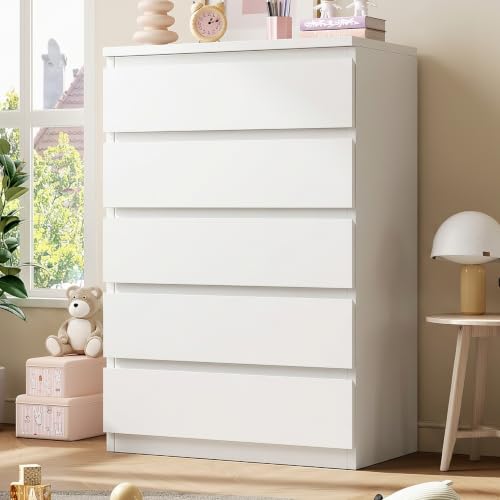
Assembled White Dresser: Skip the Toolbox, Keep the Style
Everything you need to know before buying a pre-assembled white dresser: construction quality, finish options, drawer configurations, delivery considerations, and how to choose the right one for your bedroom.
Explore Top PicksWhy an assembled white dresser? For anyone who has wrestled with cam locks and particle board on a Saturday afternoon, the appeal is obvious. A fully built white dresser arrives ready to use, with joints already tightened and drawers already gliding. This guide walks you through what to check, what to avoid, and which models stand out in each quality tier so you can make a confident purchase.
What "Assembled" Really Means
Product listings use several overlapping phrases, and they are not always interchangeable. Before you commit, it helps to know exactly what will show up at your door.
- Fully assembled: The dresser arrives with the frame, drawers, and hardware already installed. You may need to attach feet or knobs, and you will almost certainly need to fasten the anti-tip strap.
- Ready assembled / pre-assembled: Essentially the same as fully assembled. The unit is built at the factory or warehouse and ships as a single piece.
- Partially assembled: The main carcass is built, but drawers or legs ship separately. This is common with larger pieces that need to fit through doorways.
- No assembly required: A marketing phrase that usually means fully assembled, but always confirm by checking the shipping weight and box count.
If you are comparing options, our guide to assembled dressers for sale covers the broader category, including non-white finishes. For bedroom-specific options, bedroom dressers already assembled narrows the field further.
Benefits of a Pre-Assembled White Dresser
The advantages go beyond convenience. Factory assembly typically produces a more rigid piece of furniture than what most people achieve at home with basic tools.
- Stronger joints: Manufacturers use glue, dowels, and sometimes staples in addition to mechanical fasteners. This creates a stiffer carcass with less wobble over time.
- Aligned drawers: Drawer slides and runners are installed and tested before shipping, so you avoid the frustrating misalignment that plagues flat-pack builds.
- Time saved: A typical flat-pack dresser takes 45 to 90 minutes to build. An assembled one takes minutes to position and secure.
- Fewer missing parts: No loose bag of screws to lose, and no risk of discovering a missing cam bolt halfway through.
- Immediate use: Ideal for rentals, guest rooms, or situations where the dresser needs to be functional the same day.
Trade-Offs to Consider
Assembled furniture is not automatically the better choice for every home. Weigh these factors honestly before you buy.
- Shipping weight: A fully built dresser can weigh well over 100 pounds. Confirm the delivery method and whether the carrier will bring it inside.
- Stairwell clearance: A one-piece dresser cannot be disassembled to fit through a narrow hallway or around a tight corner. Measure your path before ordering.
- Moving day: If you relocate frequently, a flat-pack model is easier to break down. An assembled dresser stays assembled.
- Limited customization: You cannot swap drawer layouts or reverse door orientation the way you sometimes can with modular kits.
- Return logistics: Returning a fully built dresser is cumbersome. Read the return policy carefully before purchase.
Construction & Material Quality
White finishes hide grain, so the material underneath matters even more. Here is how the common construction types compare.
| Material | Durability | Best For | Tier |
|---|---|---|---|
| Solid wood (pine, oak, maple) | High; can be refinished | Long-term use, heirloom pieces | Premium to luxury |
| Plywood with wood veneer | Good; resists warping | Humid rooms, balanced construction | Mid-range |
| MDF with painted finish | Moderate; edges can chip | Smooth painted look, light use | Entry-level to mid-range |
| Particle board with laminate | Moderate; sensitive to moisture | Starter tier, guest rooms | Entry-level |
Look for dovetail or doweled drawer joints in mid-range and premium models. Stapled or nailed joints are a sign of entry-level construction. Drawer bottoms should be at least 3mm thick and set in a groove rather than stapled to the sides.
White Finish Types Compared
Not all whites are created equal, and the finish type determines how the dresser will look three years from now.
- Lacquer: Smooth, durable, and resistant to yellowing. Common in premium and luxury tiers. Can be repaired by a professional.
- Catalyzed conversion varnish: Very hard and scratch-resistant. Often found in commercial-grade furniture. Best for high-traffic rooms.
- Water-based paint: Low odor and safer for nurseries. Less durable than lacquer but easy to touch up.
- Laminate or melamine: Wipe-clean and moisture-resistant. Entry-level to mid-range, but edges can lift over time.
- Distressed or antiqued white: A styled finish that intentionally shows wear. Works well with farmhouse and shabby-chic decor.
If you prefer a softer, vintage look, an antique white dresser with mirror may suit your room better than a crisp modern white. For a coordinated bedroom setup, antique white dresser and nightstands pairs the finish with matching bedside storage.
Drawer Configuration Guide
Drawer count and size affect how usable the dresser is day to day. Match the layout to what you actually store.
| Configuration | Typical Dimensions | Best For |
|---|---|---|
| 3-drawer | 30–36" wide | Guest rooms, small bedrooms, kids' rooms |
| 4-drawer | 36–48" wide | Couples with moderate wardrobes |
| 5-drawer | 40–56" wide | Everyday clothing, mixed storage |
| 6-drawer | 48–60" wide | Families, shared bedrooms |
| Tall chest (5–6 drawers) | 30–40" wide, 48"+ tall | Small footprints, vertical storage |
Deep drawers are useful for bulky items like sweaters and linens, while shallow drawers work better for folded shirts and delicates. A mix of both in a single unit is often the most practical arrangement. For more on layout planning, see our bedroom dresser with deep drawers guide.
Sizing Your Space Correctly
Measure twice, order once, especially with a piece you cannot easily return or disassemble.
- Wall width: Leave at least 2–3 inches on each side for visual breathing room and drawer clearance.
- Drawer pull extension: Account for how far drawers extend when open. A 20-inch deep drawer needs 20 inches of clear floor space in front.
- Path of travel: Measure doorways, hallway turns, and stairwell width. A fully assembled dresser must fit through the narrowest point.
- Mirror clearance: If you plan to attach a mirror, confirm the dresser top depth and whether the back panel supports mounting hardware.
- Height relative to the bed: A dresser top roughly level with the mattress looks balanced in most bedrooms.
If space is tight, bedroom dressers no assembly required includes compact options that still arrive fully built.
Safety & Anti-Tip Essentials
Any dresser taller than about 30 inches should be anchored to the wall. This applies to assembled and flat-pack models equally.
- Use the included hardware: Most dressers ship with an anti-tip strap or bracket. Install it even if the dresser feels stable.
- Anchor into studs: Drywall anchors are a backup, not a substitute. Locate a wall stud whenever possible.
- Keep heavy items low: Load the bottom drawers with heavier clothing and reserve top drawers for lightweight items.
- Check drawer stops: Drawers should not pull out completely unless intended. A missing stop is a tip-over risk.
- Supervise children: Teach children not to climb on drawers, and consider drawer locks in nurseries.
Delivery & Moving Logistics
Delivery is where many assembled furniture purchases go sideways. Plan ahead.
- Curbside vs. inside delivery: Confirm whether the carrier will bring the dresser into your home or leave it at the curb.
- Appointment windows: Freight deliveries often require a scheduled window. Make sure someone is available.
- Inspect on arrival: Open the packaging and check for damage before signing. Note any issues on the delivery receipt.
- Moving it yourself: Use furniture sliders or a dolly. Never drag a dresser across hardwood floors.
- Two-person lift: Most assembled dressers are too heavy and awkward for one person to carry safely.
Pre-Purchase Checklist
Run through this list before you add an assembled white dresser to your cart.
- Confirm the listing says "fully assembled" or "no assembly required."
- Check the shipping weight and box count.
- Measure your room, wall space, and the path to the room.
- Verify the drawer count and layout match your storage needs.
- Review the material and finish type.
- Confirm anti-tip hardware is included.
- Read the return policy and delivery terms.
- Check customer reviews for stability and finish quality.
Recommended Picks
The models below are selected for their construction quality, finish durability, and suitability for a range of bedroom sizes. Use the tier labels to understand where each option sits in the market.